Archive for the ‘Faith’ Category

Lost and Found

May 15, 2013

Do you ever think deeply about “lost” people? The church of which I’m a member has as one mission to “find the lost”.

Jesus was at a dinner party one evening. He had just invited Levi (Matthew) to leave his job as a tax collector for the Roman government and join his group of disciples. In fact, Matthew went on to become one of the inner circle of 12 and then to write about his experiences.

At the party were a bunch of Pharisees. These were the people who thought they had already earned God’s grace through their good works (meaning obeying laws and rituals, not meaning helping people).

Also at the party were a number of “tax collectors and sinners.” Notice in the Gospels that these are always two groups. Matthew was not just a sinner, but a special kind of sinner–a tax collector.

Now these two groups of people did not like each other. In fact, they probably rarely ever socialized together. Read the Gospel of John and see how much John didn’t like the Pharisees! Anyway, imagine the grumbling of the “righteous” about Jesus’ associating with the not-so-righteous.

So Jesus, recognizing the tension, tells three stories. They are all about the celebration when something that is lost is found.

The third story is the story of the man and two sons. The man (God) loves his two sons. But they are very different. The elder son (Pharisees) always does the right thing. He’s always there. The younger son (Sinners and Tax Collectors–or, in reality, us) doesn’t do what’s right. In fact, he expresses the wish that his father were dead so that he could collect his inheritance and quit working.

You know the story. He gets his wish, goes away, spends everything, lives with the pigs (really revolting to a Jew), and finally comes home intending to just be a servant.

At this point, probably both groups at the dinner party were with Jesus. They recognized the elder/younger distinction. And that the elder inherits first. And that the younger son who was so offensive is going to get his just retribution (we’d say today thrown into Hell).

But…

The man throws a big party, restores the son to his place in the family and consoles the elder son who feels the lack of “justice.”

But the man said, your brother, who was lost, is now found.

Lost means not with the family. The kid wasn’t just wandering around in the wilderness with no sense of direction–physically. Only metaphorically. He was lost not being in the family. Found is returning to the family.

Just so with us and our fellow humans. God loves each and every one of us. He wants us to be in the family. He’ll celebrate every individual who returns to the family. So should we.

On of our tasks in life is to be, not like the elder brother pointing our finger in condemnation of others, but like a guide helping people return to the family.

Answering The Call

May 8, 2013

“Did you hear what I said?”

What mother hasn’t asked that question? Many times?

Or my wife when either I didn’t reply or replied too quietly for her to hear.

I was studying the story of Abraham and Isaac where Abraham was called by God to offer Isaac as a sacrifice to Him.

It’s a weird little story. Some drama. No emotion. Nothing like the dramatization of the TV show.

Notice Abraham’s lines in the story. “Here I am.” God calls to Abraham. Abraham answers, “Here I am.” Isaac calls to his father. He answers, “Here I am.”  God calls again to Abraham. Once again the answer, “Here I am.”

Are we present at the call? You know the joke, “The lights are on, but nobody is home.”

God doesn’t talk to us every minute of every day. It is our responsibility to notice when he calls and be present. “Here I am, God. What can I do for you?”

Sometimes, it’s not God directly who calls. Sometimes he uses other people to call you. Maybe a friend. A colleague. A pastor or teacher. It is up to us to recognize a call and then go and do it.

We don’t want to wind up like Jonah, I guess. Someone who heard the call and didn’t agree with it. God wouldn’t leave him alone. He tried to escape the call. God pursued. He did it, unwillingly, and grumbled to the end about the injustice of what God did (at least in his eyes).

Better that we just listen, acknowledge and act.

Energy As The Flow of Grace

April 26, 2013


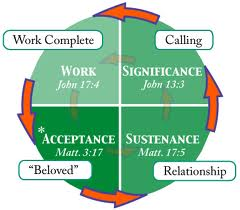
Cycle of Grace

Cycle of Grace from Acceptance to Work from Claypotchronicles

Of all the sciences I studied when I was young, I preferred physics. Thinking in the biological sciences has come a long way and I now appreciate the thinking of connectedness and networks biologists are studying. Chemistry? Well, I guess I’m glad they have it.

Physics is very much the empirical study of an ancient concept–energy. Ancient people contemplated the energy that flows throughout nature and from God to humans.

I think visually and associatively. So when I think of God’s Grace, I visualize it in terms of energy.

John Ortberg recently talked about a concept new to me called the Cycle of Grace. It comes from a book by Frank Lake (that I couldn’t find quickly). It dealt with burnout among pastors and missionaries. As a matter of fact, I lifted this image from claypotchronicles.com, where it seems that he starts with work. Ortberg started with acceptance.

You start the cycle knowing that you are loved and accepted by God. You didn’t earn that. God just says he loves you. Sustenance is what I often talk about here. It comprises the Spiritual Disciplines and practices that deepens and enriches your understanding and relationship. Next is significance, or why are you here? What is the work God called you to do? Finally is accomplishment (called work complete in the diagram).

If you start with work and try to gain acceptance, your efforts will be futile. That has often been the case with religious people. Check out Jesus’ debates with the Pharisees. But if you start with God’s Prevenient Grace, the fact that God loved you before you were you, then you have the foundation for great work.

Dallas Willard put it in terms that I can understand with my study of energy. He said that it now becomes God’s Grace flowing through you. I visualize that as a form of energy. We know people who give us energy when we meet them. Unfortunately we know those people who seem to drain the very energy right out of your soul when you meet them.

It is much better to be a channel of God’s Grace to others. A transfer of energy from God to another through you. That is the proper foundation for service.

Are You a Christian or a Disciple

April 9, 2013

I listened to one of my favorite teachers this morning on the subway (U-Bahn) ride from my hotel to the “fairgrounds” or Messe.

He is teaching for a few weeks on the topic of Christian or disciple.

This is worth pondering. The origin of the word “Christian” was from those outside the faith and used as a term of derision. If you were inside the faith, you were a disciple. Some today use the term “Christ-follower.”

One term is a description. The other term implies an action. Do I just identify with a group? Or, do I follow a teacher/mentor/leader? Do I ask of my mentor, when faced with a situation in my life, what would you do? Even before you ask the question, the answer is “yes.” That is, whatever my mentor would do, that I will do.

I have never been asked the question before last week, but someone asked, “Are you a born-again Christian?” To be honest, I am somewhat put off by the question. It is a description that could well be asked with political overtones.

But, I’m not really all that political any longer. I am trying to be a disciple–someone who follow Jesus.

I try to remember to ask in every situation (oh, I wish I were not sometimes forgetful), Jesus, what would you have me do? And then listen (an interesting concept to many–or even a foreign concept to some). And then do.

A disciple of Jesus:

  • Asks Jesus what to do
  • Listens for the answer
  • Does what Jesus says

Gosh, that sounds simple. I wish it were.

A Day of Heightened Tension

March 27, 2013

It’s Wednesday of Holy Week. I’m traveling this week first to Florida on business (rather successful, too) and then taking a couple of days off the grid in the hills of southern Ohio to refresh my thinking before Easter.

The year before this was Holy Week, Jesus continued to antagonize the religious leaders. He steered clear of Rome. Although his message was the direct opposite of Rome’s those he attacked were the leaders of his religion who had forsaken following God and replaced it with structured religion.

He had attacked the commercialism of the Temple–acting just like an Old Testament prophet. Symbolically attacking the seat of improper power. Events are rapidly heading toward conclusion.

But the conclusion is still a little over a day away. There is still uncertainty in the air. But things have started that cannot be reversed.

It’s the time between deciding and acting. That time of tension. Athletes feel it just before a game. You may feel it just before a big event.

Not like Jesus, though. It was life and death for him. And not a pretty death. But it was also anticipation of the resurrection. Really it was life and death…and life. But the waiting must have been tough. No wonder they recorded the scene in Gethsemane.

It is that still point of tension. Waiting for the inevitable.

Do We Stay True To Our Master

February 27, 2013

In American business conversation, we usually use phrases derived from sports. So we use a phrase from American football (which, of course is played very little with the foot) for at least the last 30 years, “Take the ball and run with it.”

Sometimes, I have seen people take the ball and run with it, but they don’t know when to stop. They go past the end zone, through the tunnel and “spike” the ball in the parking lot.

OK, it’s a tortured metaphor. I was thinking last night of the problem of disciples taking one phrase or attitude from their master, or teacher, and going too far.

A woman in our Yoga class last night said something that reminded me of a story about the great Russian writer, Leo Tolstoy. He was a well-known pacifist in almost all things. He attracted a flock of disciples who gathered at his estate, I suppose to live off the rich, old guy, or to learn from him.

It seems that one afternoon during a discussion, a mosquito landed on Tolstoy’s arm. He rather absent mindedly swatted it. His disciples were aghast! How could the great Tolstoy kill a living being!?

That’s going too far.

I’ve read many, if not most, of the world’s greatest spiritual seekers. Then I’ve read about what some of their followers have done with the teachings. Mostly the seekers wanted to breed other seekers. They wanted to point them in the right directions. Help them out.

But some of the followers just wanted a list of rules. Then they would take one of two of his teachings and emphasize them beyond the entire body of teaching–and against the attitude of spiritual seeking of the master. It’s more like, we don’t need to seek anymore. The master was the explorer. He found the gold mine. All we have to do is carry out the gold.

A friend of mine just discovered that in the history of Christianity, not all who professed to be Christian actually behaved in a Christ-like manner. In fact, the history of the Christian church is filled with violence, depravity, hate. That’s what happens when we cease being seekers and think we have found the gold.

Each person born into the world must seek for God himself. We cannot incorporate others’ learning by osmosis. We must learn for ourselves. There are no shortcuts in life.

A Time of Reflection

December 26, 2012

Christmas is over. Feeling a sense of loss? Or “is that all it is?” Nothing has changed–or has it?

I’m with Jon Swanson who pondered that Joseph had a lot to think over. Mostly for him, it meant that the baby was born. Mary was sore and grumpy, yet motherly with the new infant. He now had responsibilities to bring the boy up in the faith.

This time between Christmas and New Year’s Day has always been a time of reflection for me. Look back over the past year. What new things have I learned? What should I do better? What new things should I work on during the coming year? Am I doing the important things? Are there new people for me to meet this year? What new things should I learn this year?

I no longer set New Year’s resolutions or goals. But I look at directions. Where I’ve been. Where I’m going. What is God calling me to do and be this year?

Stop, pause, reflect, refresh. Establish some new habits this year. Maybe set a new pattern for your life. But most of all, enjoy.

Anticipation and Advent

December 24, 2012

Christmas Eve. Consumed by anticipation of what tomorrow will bring.

Remember when you were young? You were so focused on what presents you would get. It was all about you. It was hard to go to sleep.

The season is one of anticipation. By now you should notice the days getting slightly longer. This is the anticipation of spring and then summer–warmth and growth. And the food growing cycle. Some people don’t like celebrating Jesus’ birth on a day that pagan religions held holy. But just because other people like something, doesn’t me we can’t interpret it in the light of God’s working in history and celebrate it.

Even though some adults I know are still filled with that anticipation of a present under the tree, most of us are aware that we know what the present was. The “present” was a person. He showed the way to the Kingdom of God, and he was the Kingdom of God right there in the midst of the people of the time.

What is your anticipation for this new year? As the days grow longer and point toward a season of growth, what growth do you anticipate? Is it time for a new focus? A new mission? To reinvigorate your current mission? To meet new people? To renew old ties? To learn something new?

Advent is on our religious calendar to prod us to focus on the anticipation of Jesus entering into our lives fresh and new. We live in the anticipation that Jesus is not through working on us, yet. There is something new in store for us.

Today, we live in anticipation. Tomorrow, we celebrate.

Gratitude for the Season

December 21, 2012

I’m grateful that I’m up this morning, that the newspaper was at the door, that other people are around (yes, my wife even got up an hour early today)–wasn’t the world supposed to come to an end today? Or as one cartoon put it, maybe it’s just the Mayans who came to an end.

It is the winter solstice and it came in with the first day of winter weather. But I like snow. So I’m grateful for even that.

I was going through some recent notes and saw one I made a month or so ago–entitlement is the enemy of gratitude. As I was contemplating that and Matthew Chapter 2 this morning staring at our Christmas tree, I thought of all the people who believe they are entitled to receiving lots of presents in a few days. How many are grateful for friends and family who give those gifts? Or grateful to live in a rich and free society that can provide for them?

The magi, called wise men in English translations, were trained in seeing signs in astronomical events. They saw one such event and figured out the meaning. They traveled most likely from Persia (note that they were not Jewish) to find a baby who would be king. When they found him, they gave gifts.

Matthew says they had great joy. Joy is the flip side of gratitude this season. Giving a gift is done out of the pure joy of giving. If it’s an obligation or given to ungrateful people, it is just a chore. But given with just the pure joy of giving, now that’s a Spiritual practice.

And receiving? Just receive with gratitude that someone was thinking about you and cared enough to give.

Jesus was (and still is) a gift. To us. Just accept the gift with gratitude. Then share the gift. That’s legal–in fact, expected. With joy. That’s really all you need.

Signs of Spiritual Awakening

December 20, 2012

My good friend from Brazil linked me to this thought on her friend’s Facebook page. It was perfect to share here.

I’m not certain of the origin. The Facebook post refers to a book of the Grateful Dead–can’t believe it’s the rock group. Notice the wording. Nothing implies we are perfect in adopting these characteristics and some are more difficult to bring into your life than others. But it is true that ever since my first Spiritual awakening and more so with subsequent experiences, I notice these more and more often.

My Advent gift through my friend Teresinha:

12 Symptoms of Spiritual Awakening

  1. 1. An increased tendency to let things happen rather than make them happen.
  2. 2. Frequent attacks of smiling.
  3. Feelings of being connected with others and nature.
  4. Frequent overwhelming episodes of appreciation.
  5. A tendency to think and act spontaneously rather than from fears based on past experience.
  6. An unmistakable ability to enjoy each moment.
  7. A loss of ability to worry.
  8. A loss of interest in conflict.
  9. A loss of interest in interpreting the actions of others.
  10. A loss of interest in judging others.
  11. A loss of interest in judging self.
  12. Gaining the ability to love without expecting anything.