Archive for the ‘Disciplines’ Category

Helping Others By Getting Out of the Way

May 9, 2013

It seems to be a human fault. Telling others how to fix their problems.

I often have counseled husbands–just listen to your wife’s complaints. Don’t start offering suggestions about how to fix things. They just want someone to listen to them. As in really listen. If they want to fix the situation, they will try. Mostly, I think they don’t really want to fix it. Just talk about it.

Same way with when we try to help others through our missions. We try to tell people what to do to fix their problems as we have defined their problems.

Ernesto Sirolli discussed this situation in his TED Talk. When most well-intentioned aid workers hear of a problem they think they can fix, they go to work. This, Sirolli suggests, is naïve. In this funny and impassioned talk, he proposes that the first step is to listen to the people you’re trying to help, and tap into their own entrepreneurial spirit.

Bill Hybels, founder and senior pastor at Willow Creek Community Church, talked about his own epiphany–and that of his team–regarding this same issue. In his talk last week, he discussed how the church used to send checks to organizations. Then they started checking up on the organizations. Visiting locations.

Eventually they discovered that partnering with a local church, someone who knew the needs of the local people and could relate to the local people, was much more effective.

Once again, I think what works personally, works corporately. Listen first. Then act appropriately.

I have trouble sometimes with the listening part. How about you?

Are You Getting Better

May 7, 2013

There was a small group of men at one place I worked who considered themselves perfect. They couldn’t get any better because they had been “saved.”

Not sure where they got that idea. It doesn’t fit with 2,000 years of theology and practice. Oh, and none of the rest of us thought they were particularly perfect.

For the rest of us who don’t belong to small churches that take off and run with one idea, life is more of a practice of “sanctification.” That’s a big word that simply means becoming mature in faith.

We decide at some point in our lives that we are going to follow Jesus. As far as our daily lives go, that’s not the end. It’s the beginning. Spiritual life is a journey. Our goal is to live like our Teacher and become closer to perfect.

I recently heard Andy Stanley talking about getting better before getting bigger. He was talking about churches. In a sense it works corporately as well as personally.

Almost every pastor in the US wishes to build one of those mega-churches. Dreams of thousands coming every week to hear his messages. Reads the sociologists of church growth–build by an expressway, have a huge parking lot, don’t have any religious symbols, play loud music.

Business people have the same wish. They want their business to grow to huge proportions.

The strategy should be to get better first. As a person. As an organization.

Ask every day:

  • “Am I better today?”
  • “What am I (or are we) doing better today?”
  • “How can I (we) be better today?”

Sustain Your Gains

May 6, 2013

Some of the best ideas for both business and church come to you during a church service.

It is said that after the Procter & Gamble Co. accidentally invented a soap that floats, the marketing geniuses tried to find a name. I forget whether it was Procter or Gamble, but one of those men was in church when the pastor read something that had the word “ivory” in it. Supposedly, he got up, said, “that’s it” and left to go to the office.

I don’t know what the pastor said yesterday that triggered the idea, but there it was, fully formed.

“Why do we try these really cool things that get people all charged up–and then nothing happens to sustain it?”

Probably it was a reference to a big church-wide small group experience that will fizzle out unless there is sustaining drive. I’m afraid of wishful thinking on the part of leadership.

This same thing happens in our personal development. We call them “New Year’s Resolutions.”

It’s a great idea. But then we have trouble putting them into practice as a matter of daily routine.

It should be our leadership skill development (whether we’re leading a big organization or just ourselves) to plan for sustaining the idea or program.

  • What will the life of the organization or our own life look like when we adopt this new action?
  • How can we incorporate this new thing into our daily life?
  • Make a plan to complement the vision.
  • Communicate to ourselves and to the group daily about what this new life will look like.
  • Live into this new life.

Don’t let it drift away into the rubbish heap of forgotten dreams.

Energy As The Flow of Grace

April 26, 2013


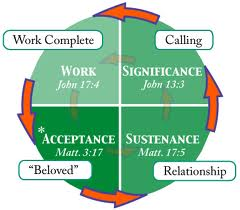
Cycle of Grace

Cycle of Grace from Acceptance to Work from Claypotchronicles

Of all the sciences I studied when I was young, I preferred physics. Thinking in the biological sciences has come a long way and I now appreciate the thinking of connectedness and networks biologists are studying. Chemistry? Well, I guess I’m glad they have it.

Physics is very much the empirical study of an ancient concept–energy. Ancient people contemplated the energy that flows throughout nature and from God to humans.

I think visually and associatively. So when I think of God’s Grace, I visualize it in terms of energy.

John Ortberg recently talked about a concept new to me called the Cycle of Grace. It comes from a book by Frank Lake (that I couldn’t find quickly). It dealt with burnout among pastors and missionaries. As a matter of fact, I lifted this image from claypotchronicles.com, where it seems that he starts with work. Ortberg started with acceptance.

You start the cycle knowing that you are loved and accepted by God. You didn’t earn that. God just says he loves you. Sustenance is what I often talk about here. It comprises the Spiritual Disciplines and practices that deepens and enriches your understanding and relationship. Next is significance, or why are you here? What is the work God called you to do? Finally is accomplishment (called work complete in the diagram).

If you start with work and try to gain acceptance, your efforts will be futile. That has often been the case with religious people. Check out Jesus’ debates with the Pharisees. But if you start with God’s Prevenient Grace, the fact that God loved you before you were you, then you have the foundation for great work.

Dallas Willard put it in terms that I can understand with my study of energy. He said that it now becomes God’s Grace flowing through you. I visualize that as a form of energy. We know people who give us energy when we meet them. Unfortunately we know those people who seem to drain the very energy right out of your soul when you meet them.

It is much better to be a channel of God’s Grace to others. A transfer of energy from God to another through you. That is the proper foundation for service.

Patience and Drive While Reaching Goals

April 22, 2013

I had a business meeting in the north suburbs of Chicago on Friday and am now in Kentucky where I overnighted on my way to meetings in Greenville, SC. In between, playing with the grandkids in the west suburbs of Chicago.

Do you ever travel long distances? Even if there are no kids, do you ever think “Are we there, yet?”

It started my thoughts on reaching goals. Even spiritual goals.

You begin. “I’ll read a chapter a day in the Bible.” Or some other goal. Even more ambitious–“I’ll treat everyone with just a little more kindness today.”

Then you go on with your life. And you don’t always do it. And you lose patience with yourself.

But you’re going to get there when you get there. Spiritual depth does not come overnight. Nor does treating everyone the way you should treat them.

A little at a time you find yourself growing toward your destination. It comes. Not on our time, but when the time is ripe.

In the meantime, you just have to remind yourself to be patient with the work in progress. It’ll come.

What is your excuse

April 10, 2013

I have much writing to finish reporting on my trip to Hannover so far. It is not getting done.

I am walking many miles per day (it is hard to describe how large the grounds are and the number of buildings to walk through at this trade fair). My legs are stiff. Especially in the morning.

Yesterday, I over slept (smarter today, I set an alarm). So I rushed through my morning to get to the train in time for my first appointment. No time for morning Yoga and meditation.

I was tired.

Tired is an excuse. Eating the wrong food so that my body sugar is not properly regulated is a reason. Deciding to talk with some people or stay for one more beer. These are reasons.

Reasons can be dealt with through proper decisions. It’s my responsibility to eat correctly to balance my weight and give me the proper energy. It’s my responsibility to decide when to return to my room. It’s my responsibility to decide to get up, stretch, study, meditate to begin the day. It is my responsibility to properly schedule my time in order to have time to write.

Are you not getting done what needs to be done in your life?

It’s your decision.

Excuses are tricks we use to deny our responsibility for our condition. We always have a choice about how to adapt to our situation.

Here is a little process:

  • What is the real cause for the way we feel or for the lack of  accomplishment?
  • What decision did I make or not make that put me in that situation?
  • What decision do I need to make right now that helps me toward my goal?
  • Make the decision and do it.

Help People, Make Friends, Have Fun

April 5, 2013

Jesus started a mission. Then he built a church.

For the past 1,800 years more or less, we have built churches. Sometimes we do mission. It is so rare to do mission that we hold up “missionaries” as heroes of the faith.

Jesus left us with two commandments. Boiled down to essentials, they were that we should love God and love other human beings.

Jesus mission was to equip us to love God and encourage us to use that equipment to love (serve) others. He showed us examples. He fed people who were hungry. Healed those who were hurt. Loved those who were emotionally hurting.

I’m thinking about all this because I just formally accepted a “position” within my church. Officially known as Missions Coordinator. Once we had a passion for mission. People went to Mexico to help orphans and work with women caught in sex trade. People went to China to help orphans. People went to Haiti to build schools and churches.

I made a mistake. I asked one of our pastors what happened that I don’t hear about that anymore. I made a second mistake. I let another church leader know that I study and write about leadership. So…they said, we haven’t had leadership in that area for some time. How about you actually doing what you write about. Ouch. Fair question. I’ve used that very tactic on others.

There was a guy who saw his mission in business as “Helping People, Making Friends, Having Fun.” I thought, what a great theme for missions work–which by the way is anything we do outside the four walls of the building to help those who are hungry and ill, listen with love to those who are emotionally hurting, let people know about how to live a life with-God following Jesus so that they, in turn, can help others. I’ve heard testimonies of people coming back from trips. They helped people, made friends–sometimes for life, and had a lot of fun.

There are many readers of this blog from around the world. How do you do missions? Any tips for bringing new life to our mission activities? Any places we should go to reach out to people?

Becoming Mature in Christ

March 21, 2013

I was thinking many things this morning–such as it’s the first full day of spring as I gazed out the window on the inch of “snow flurries” that visited during the night.

Then I picked up the daily newspaper–yes, “Mr. Online” reads the daily newspaper on paper–and saw the featured story was about many young teachers who have lost their career and even spent time in jail because of sexual misconduct with their students. It may range from inappropriate texting or Facebook posts all the way to intercourse.

I then recalled the many reports from research into poverty and lack of children’s achievement that directly correlates to single-parent homes usually headed by a woman. I don’t think any reports say it’s as much because the head of the household is female as much as it means that there is little or no male influence in the family and in the development of the young people.

Some people who were at university with me had the idea that they would never be a “role model” but just wanted to live the way they wanted. That evolved into Boomer parents who didn’t want to be parents but friends with their children. That has evolved into a “do your own thing” society where seemingly no one wants to grow up and accept responsibility. I see that in so many actions.

Fortunately, this is not descriptive of everyone. But it is descriptive of far too many.

Remember your adolescent years when you hated structure and rules? I do. I still don’t like to be told what to do. But I also had a goal of spiritual maturity. And because I believe (and I hope act) with responsibility people often mistake me for a conservative Republican.

I just think that we all have to grow up. And to those who are not, they are lost. Lost in the sense of no direction. Drifting through life.

Spiritual maturity comes through practicing the Spiritual Disciplines. Learning the goal. James says, “and let endurance have its full effect, so that you may be mature and complete, lacking in nothing.”

Paul writing about spiritual gifts in Ephesians says, “until all of us come to the unity of the faith and of the knowledge of the Son of God, to maturity, to the measure of the full stature of Christ.”

You don’t really “teach” Spiritual Discipline. You “guide” people into beginning and then deepening their practice. If there is one thing I wish I could do it would be to help many more people begin their journey to life with-God and help them break their cycle of wandering without purpose.

Forgive me for I have sinned

March 20, 2013
People in discussion.

People in discussion.

The ironic thing was that we were studying James.

What’s the singular teaching you should get from James? To hold your tongue. Silence is good. Don’t speak ill of others.

I know that my personality type includes the problem of being snippy when I’m overly stressed or agitated. Have you ever noticed that knowing and doing are different things?

So, I said something. Upset my karma for the rest of the day. That is, my balance and ability to focus on positive results rather than negative thoughts and emotions.

There is discussion and there is argument. I view discussion as two or more people who are open to each others’ points of view and try to reach an understanding–maybe not agreement, but understanding. I can live in a world where people don’t agree on everything. I view an argument as a thought process of putting forward reasons for your views. An argument is when two people are putting forward their reasons with no attempt to listen to the other.

To me, listening and silence are valuable spiritual disciplines. Violate them and your spiritual balance is out of whack.

Mostly, I hear arguments.

I got so interested in understanding how people can hold views about something that are in direct contradiction to facts that I embarked on a several-year study of the issue. I went through developmental psychology, cognitive psychology, brain science, physiology of feelings and thinking. I love this sort of study. I’m sure most of you reading this would be bored.

One interesting thing is that the brain will believe anything you tell it. Those motivational, self-help speakers use that fact to tell you to put positive thoughts in your brain. Repeat “I will be successful” a hundred times a day is their mantra.

Emotions (to put it entirely too simply) arise from the complex of chemicals originating in your gut.

If a thought in your brain becomes associated with a strong feeling from the chemicals in your gut, voila, an opinion is formed.

And that (once again, too simply stated, but if you want the gory details, I can refer you to a book list) is why arguing with people when they have strong opinions won’t get you anywhere. And that is why I usually know to “hold my tongue.”

By the way, whether they know it or not, preachers and politicians use emotional language to try to arouse your emotions in order to affect a change in your opinions. Watch that the next time you see a political ad.

But sometimes I slip. Hate it when that happens. Forgive me, I have sinned.

Achieving Balance in Spiritual Life

March 18, 2013
Balance requires focus and relaxation.

Balance, focus, awareness, relaxation

The idea of achieving balance in life came up several times the past few days. Our pastor spoke yesterday about how easy it is to equate busyness with doing something valuable. Someone told me that I was selected for a leadership position with our missions team. Others were talking about busy.

Balance requires focus. When I teach balance poses in Yoga (basically standing on one foot and doing something with the other one), I always begin by teaching focus. You must focus on one stable object.

The spiritual implications of this should be obvious. No matter what you are doing, you must remind yourself of your focus every day. First thing in the morning in your meditation and prayer time is best. Then organize your schedule (remember Hybels’ teaching?) to achieve the important things.

Balance requires emptying your mind. The second teaching point I give in Yoga is to empty your mind of all senseless chatter that goes on incessantly. I teach that after students try the first and discover that after a few seconds they begin to wobble and then have to drop the other foot. A quiet mind goes along with focus. Again this works for life, as well. And early morning quiet time–coupled with regular breaks for intentional breathing–help to quiet the mind.

[As an aside, “productivity gurus” advise working in 90 minute bursts followed by a break to refresh and renew. A few minutes of deep breathing, concentrating on your breath, letting the mind relax, all work toward spiritual and mental refreshment. You can do this sitting, walking, or laying down.]

Balance requires relaxation. This may seem paradoxical. But once you have achieved, say Tree Pose (pictured), you are focusing, clearing the mind, then relax your shoulders. Clear the tension. Settle in.

TS Eliot talked about the “still point” in his poem Burnt Norton. Follow these three steps to reach toward the still point where you find balance in your life.