Posts Tagged ‘growth’

Seven Principles Of Thinking Like Da Vinci

November 11, 2015

Michael J. Gelb’s book, How To Think Like Leonardo da Vinci, reminds us of how to elevate our consciousness, creativity, and contribution.

I talked about curiosity as the first principle Monday. Let me quickly summarize the entire seven. Then go pick up the book and dive into the details. The bonus last chapter teaches how to draw like da Vinci–maybe not as good, but builds on his ideas.

(Gelb uses the Italian. Go figure.)

  • Curiosita–Am I asking the right questions?
  • Dimostrazione–How can I improve my ability to learn from my mistakes and experiences? How can I develop my independence of thought?
  • Sensazione–What is my plan for sharpening my senses as I age?
  • Sfumato–How can I strengthen my ability to hold creative tension to embrace the major paradoxes of life?
  • Arte/Scienza–Am I balancing Arte and Scienza at home and at work?
  • Corporalita–How can I nurture the balance of body and mind?
  • Connessione–How do all the above elements fit together? How does everything connect to everything else?

It is about body, mind, and spirit. You can, and probably should, incorporate these into your spiritual practices. Something to think about.
Curiosity Is The Foundation of Learning

November 9, 2015

How could you draw that smile (on the Mona Lisa)? How do you draw? What do you know how to draw? How do they paint the Eiffel Tower? Do they tie ropes to the guys? Why can’t they make a light bulb that lasts longer? Why can’t they make a better battery? How did they know about waves in the air when they invented them to make a radio?

That wasn’t even the entire conversation with my 8-yr-old grandson. I just asked him about his trip to Paris.

I told him that the world is filled with problems to solve. That’s why we need engineers and scientists.

I’m worried that school will kill some of that curiosity, but that’s another story.

The thing is–he’s always been curious. At 18 months taking a walk down the street could take a long time as we stopped explore all manner of things.

The conference I attended a few weeks ago featured a keynote speaker called Michael Gelb. He wrote a book, “How to Think Like Leonardo Da Vinci.” It is a fascinating book about a fascinating guy.

The first of seven characteristics–Curiosity.

What is that doing in a spiritual discipline blog?

Think of all the curiosity in the New Testament.

All of the original 12 close disciples were curious about Jesus. Who is that guy? Paul at first was opposed, then he too wondered, “Who is that guy?”

Paul also had to answer the question, Now what do we do after we believe? (Hint: Love the Lord and love your neighbor.)

I’m incessantly curious–what is God trying to say to me? What does the Bible say? What should I be doing? Why do people act that way? How can I help? What can I do to serve?

Curiosity can be a powerful spiritual discipline. It keeps us from becoming complacent.

Mind Maps and Other Collaboration Tools

November 6, 2015

For the Friday Leadership post, I bring to you the idea of collaboration.

There are times when bringing people face-to-face is essential to accomplish something. Unfortunately most meetings are routine, pointless, serve only to bolster the leader’s ego, or serve as an excuse for coffee and doughnuts.

Many applications have appeared to help team members collaborate while being remote and also asynchronously. Consider Wikis, Slack, project management tools, Quip, Google Docs, (maybe) Microsoft Windows 365, Evernote, Nozbe, and many more.

I’ve been reading Think Like Leonardo Da Vinci lately. The author  spoke at the Emerson Exchange and whetted my curiosity (the first of seven traits).

Scholars have discovered some drawings akin to mind maps in Da Vinci’s journals. A mind map is a powerful tool. And, if you use a digital tool (I use Mindjet Manager), you can put it in the cloud and many can collaborate on ideas.

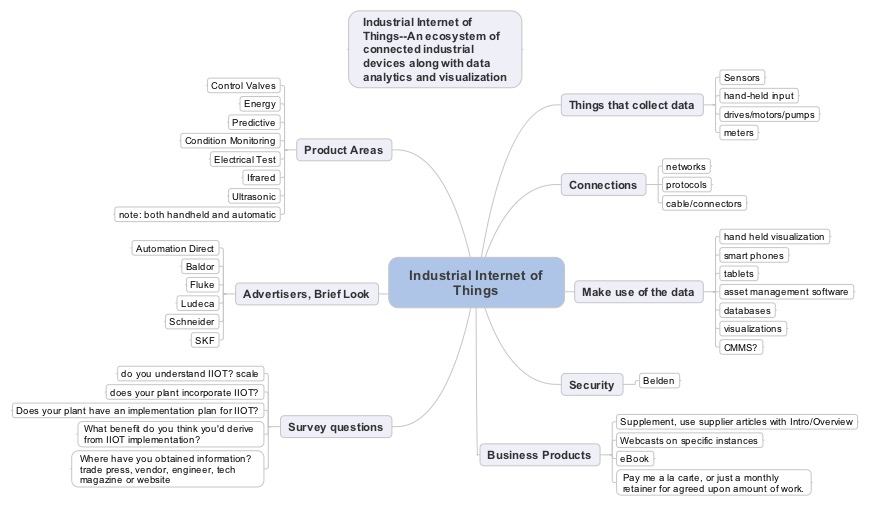
Don’t know what a mind map is? Here is one  I constructed using the computer app rather than just drawing (maybe the preferred way) for a project I’m working on.

IIoT Project

You can take notes on a mind map, doodle ideas, organize a project or a book, think creatively. It is a great tool. I’m about to work on two books while I’m between soccer seasons. I’ll mind map the outline and then just add text.

Mind maps are a tool. Thinking is the skill. Providing a safe environment for collaboration is leadership. Put it all together and accomplish something this year.


Sportsmanship

October 8, 2015

I woke up this morning and did a quick check of email. Since I quit working for organizations, I no longer dread checking emails and finding long chains of inane “conversations.”

But whatever I was going to write about vanished from my head after reading two reports from a soccer referee about examples of very poor sportsmanship in high school matches by a coach who is also a referee.

I’ve searched the Bible. There is very little about games and sports. Paul uses training for sports as a metaphor for trainig for the spiritual life. 

So, I’ll consider our actions in that light.

Whenever I read these reports or witness them in person as a referee, I have multiple flashbacks of utter chagrin about the many times I’ve acted about as childishly. My first two years as a soccer coach were highlighted (in my mind) by the times I yelled at the referees. Then I took a class and leaerned the Laws of the Game. Oops.

It may go with being introverted or touched by Aspergers or having a mom who had issues–but I tend to remember times when I acted poorly.

I wonder if others ever do that.

There was a report from a referee who was followed to his car in the parking lot by parents after a game last night passing along their judgement of his limited capabilities. There was a coach who yelled and screamed the entire game and then instructed his players to feign injury to try to delay the game (I suppose he must have been up a goal and wanted to find a way to not let the other team attack).

One of the pleasures I’ve had from my involvement with soccer for the past 30+ years is the development of young people. We’ll get kids at 13, 14 or 15. We teach them the Laws. We teach and assist them in learning how to apply them in a game. The kids must learn responsibility (boy if I’ve had one conversation I’ve had a hundred about showing up for your games and on time). They have to learn decision making. They develop confidence. 

I’ll teach an introductory course and then maybe not see the kid for 2-3 years. They grow up. Their confidence is obvious. We taught them life skills.

What are these parents and coaches teaching? How to blame others? How to cheat? How to take shortcuts? How to behave like children? I’ve seen 12-year-olds act more maturely than their coaches and parents at times. 

We forget. We’re each training for success in our spiritual lives. Sports is a metaphor. Some of us grow. Some of us don’t. Some of us look back at our lives and shudder–much like Augustine in his Confessions. But I would hope and pray that we all mature in faith and spiritual development.

Finding Our Way

September 30, 2015

Lake Tahoe

Last week on vacation in California we decided to drive up to Lake Tahoe from Folsom where my conference was held.

The tourist spot that overlooked Emerald Bay was packed. We kept driving. Found this nice rock outcropping.

We found  place to park and hiked around to a small, barely noticeable trail that led from the road to this small rock ledge.

The view was beautiful. I sat cross-legged on the rock and contemplated the view for a while.

Lake Tahoe 2

Then we turned to head back.

We had only traveled about 500 feet. There was no sign of the road. No sign of a path on the rock ledge. Looking up the terrain was just a pile of rocks.

For about five seconds I felt what people who have gotten lost in the wilderness must feel.

Or, people lost in life. There is nothing distinguishing with which to become oriented. If you go one way, it is sure death from a several hundred foot fall. The other way appears insurmountable.

What to do?

I took a deep breath. Quit looking far ahead. I knew the general direction from which we came.

So, it was one small trail. The noticing the small path that cut through some brush. Then the broken tree we had gone under. Then the tricky balancing act around some fallen rocks. Then the road was there above us. A short climb, and back to the road.

I thought–the spiritual life is like that. Sometimes we venture out to live life. We want the beautiful, the spectacular. We find ourselves in a spot where we’ve lost our bearings.

We only need to take that deep breath. Relax. Reorient.

In the spiritual life, the steps are opening the Bible again. Not to understand the whole thing. Reading Romans or James or Galatians. Simple paths.

Prayer, stopping to converse with God becomes another step.

Finding a spiritual mentor or guide or small group is another step.

Then we find our way through the rocks and brush. We’re on our way home.

Teach Your Children Well or Lose the Helicopter

September 1, 2015

Our pastoral staff just completed a summer series of teaching on parenting. I actually got out my acoustic guitar and sang Graham Nash’s song (Crosby, Stills, and Nash) “Teach Your Children” to help cap off the series.

I have always loved the parallelism of “teach your children” and “teach your parents”. We actually do learn from each other.

The next line is “feed them on your dreams.”

It doesn’t say live out your dreams through them.

Yesterday’s reading through my news feed contained a post on Big Think about Helicopter Parenting. Click the link and check out the infographic.

Helicopter parenting comes from the concept of one or both parents continually hovering over their kids. They just can’t turn them loose to learn to become independent, self-functioning adults.

It hurts the child. The infographic points out a number of dysfunctions among the children victims of these bad parenting practices.

I’ve had some involvement with athletics since I was quite small. Never even close to a star athlete, I could play tennis reasonably well and could run fast. But I started umpiring baseball at all levels at age 16. Even at that age i saw dads living out their dreams through their sons. It turned my stomach back then.

Then as I got deeper into soccer, I have seen countless parents, especially moms, who do everything for the kids except actually get out on the pitch and make the calls. I trust these kids to go out and be referees or assistant referees. Yet, they cannot call me for assignments. Mom must do the calling. Mom checks up. Mom calls to complain.

I’d tell them, if you’re old enough to referee, you’re old enough to contact me to either pick up a game or tell me why you have to drop a game.

The dad of a kid coming into the area to attend college actually called me several times to get him signed up and get “good” games. Guess what? The kid got a bad reputation among other referees before he crashed and burned and disappeared from the scene.

Let’s make it a spiritual discipline to try to parent in such a way as to let our kid (and grandkids) grow up strong and independently functioning adults. And help other kids, too, while we’re at it.

Being Humble Explained

June 24, 2015

When pride comes, then comes disgrace; but wisdom is with the humble. Proverbs 11:2

I have a friend who always brings up pride as the sin that lies at the foundation of most other sins. Perhaps he has become aware of himself and repented of past pride that almost proved his undoing.

Think about it a little. When are the times when pride has gotten between you and God? When pride has injured a friend or family member? When pride has stopped you from learning something new?

According to this proverb, humble is the trait juxtaposed to pride.

Humble is often misrepresented by those who think they do not want to lead a self-disciplined life. Or by those “social Darwinists” who believe in “survival of the fittest” and power is a virtue. They have led generations to believe that humble means weak.

But it is actually the opposite. Pride evolves from weakness. It is usually a compensation for the perceived lack of power or strength of the person. How many are they, who puff up with pride only to be deflated later. It’s only the true narcissists who continue in pride oblivious to the wreckage of the people around them.

It takes strength to be humble. One must be strong to put others ahead yet retain the strong spiritual core of a relationship with God. It takes someone strong in spiritual discipline who practices daily the spiritual disciplines of study, prayer, meditation, service, simplicity.

The other strength comes from putting aside the pride of believing that they know everything and acknowledge gaps in knowledge that can be filled through study or through the guidance of a mentor.

To be humble just means to put others ahead of yourself. It is a willingness to learn and grow every day.

I read this saying of a Desert Father that I wholly agree with, “I’d rather have a man who has sinned and repented than a man who has not sinned and thinks he is righteous.”

Self-Criticism or Self-Justification

June 23, 2015

From the sayings of the Desert Fathers: We have abandoned the light yoke of self-criticism and put on the heavy yoke of self-justification.

How often do we read a proverb or a parable of Jesus and think, “This does not apply to me. I am OK. Never do that.” 

Worse, we read something and think, “Yes, I’ve done that, but….”

Criticism does not necessarily mean negative. It does mean dispassionate evaluation. The ability to put our mind outside ourselves, so to speak, and look at ourselves.

There was a time in my life where I think I had anger issues. I’d don’t remember clearly except for one incident. Maybe I was 10 or 11. I was fighting another kid in the neighborhood. Suddenly I saw myself from outside. It was a moment of epiphany. “What the heck am I doing?” I thought. I got up, quit, and became a personal pacifist from that moment forward.

Although the temper bred from insecurity still showed up from time to time. I can still remember the last time. With great shame, by the way. It was maybe seven or eight years ago. Maybe more. There’s a guy who can get under my skin. He did. I exploded. 

When I should have showed some anger I chose to look at the big picture and let it pass. There was no win.

That thought process is self-criticism. I’m not justifying by saying that person was at fault. I was aware. I didn’t act appropriately. It’s all on me.

Do you know people who have no concept of self-criticism? Especially people with narcissistic tendencies have trouble looking at themselves.

Ask a narcissist, “Don’t you seem to think of yourself first?”, and they will reply, “Yes, of course” as if to say, “Duh.”

I have met these–and even asked the question. And received the answer.

According to a recent study, the best way to get beyond this attitude is to listen–really listen–to others. Hemmingway once said, “When you listen, listen completely. Most people don’t listen.”

As I teach Yoga, I remind the class to listen to their bodies and minds. I want them to become self-aware. That is the first step toward developing the ability to look at ourselves critcally and reward ourselves for steps in the right direction and pull ourselves back onto the right track.

Put on the light yoke of self-criticism. Check your mind and body frequently.

Reflection Empowers Your Day, Your Life

June 19, 2015

Life requires a rhythm. Almost all successful people rise early and get important thought work done. They are in bed by 10.

I usually am up by 5:30. Make coffee and a piece of toast. Read from various sources, meditate & pray, plan the day. Usually I write this blog. Then I am off for a workout–run in the park (or a treadmill), weights 3x per week, short Yoga series. Then off to the coffee shop to write.

There are three pauses that can make all the difference in your effectiveness, balance, and outlook. They are daily, weekly, monthly. I also set aside a couple of days between Christmas and New Years to think about the coming year.

The monthly pause comes easier for me. Take a Sunday evening at the end of a month. Gather you to do lists and notes. Review your lists and notes–checking what you’ve done, not done, and wish you had done. Take a longer view of what you wish to accomplish this year and where your focus should be for the month. Perhaps take a note card and write six things that you wish to devote energy toward in the coming month. Carry this card and refer to it daily. This period of reflection could last an hour or two. Probably no more.

The weekly pause comes less easy. Sometimes Sunday evening comes with a sigh of relief, and I unwind and go to bed. But even 15-30 minutes to review the coming week’s calendar and to do lists before you go to bed will feed information into your unconscious mind and help you start the week productively.

Benjamin Franklin kept a meticulous time planner. He asked himself daily two things. When he arose, he asked, “What good shall I do today?” At the end of the day he paused to reflect, “What good have I done today?”

Sometimes days and weeks get hectic. We fall into bed exhausted. We awake exhausted.

Sometimes we take that pause for reflection. It calms us and focuses us. And we are better prepared for the day.

Drawing From The Deep Source of Life

June 1, 2015

She was confronted by the owner of the company where she worked. His demeanor was angry as was his usual way of relating. Frustration boiled over him like an untended teapot on a hot stove. 

He was accusing her of many examples of wrongdoing. She was confused. The accusations were either greatly exaggerated or outright fabrications. She has told someone something. Huh? The accusation was vague. She had done something–it had never happened.

Then at a deep internal pause, the idea crept into her consciousness–she had been betrayed. Someone was out to get her, promoting themselves at her expense.

There are only a few choices at that point. She was on the defensive. The other person had the initiative. She could fight back, but the owner was famous for never backtracking. She could refuse to play the game and just continue doing the best work she could–oh, and also begin quietly probing contacts for job openings elsewhere.

I have just begun reading a book called Leadership Pain: The Classroom for Growth by Samuel Chand. He opens with a chapter on betrayal.

While I was contemplating my own experiences with betrayal, this verse from Jeremiah was part of a daily devotional:

Blessed are those who trust in the Lord, whose trust is the Lord. They shall be like a tree planted by water, sending out its roots by the stream. It shall not fear when heat comes, and its leaves shall stay green; in the year of the drought it is not anxious, and it does not cease to bear fruit. –Jeremiah 17:7-8

I love this metaphor. Jesus uses a similar one when he says, “I am the vine, and you are the branches.” Or also when he talkes about the Living Water.

When I’ve had some of these painful situations or when I’ve observed others going through the trials, I’ve seen where there is that life force that flows through life that provides strength and perspective.

Leaders who lack that life force drift into operating by pride, greed, narcissism. Parents not connected to the life force of God parent through intimidation (screaming) or by bribery. Others crumble into despair, depression, bitterness, anger, and hatred when going through trials.

I love to sit in contemplation of God’s Living Water flowing through my body and mind and soul. It’s the pause that refreshes. Then I can go and create.