Archive for the ‘Living’ Category

Your Body Is God’s Temple-Take Care of It

September 20, 2016

Do you not know that you are God’s temple and that God’s Spirit dwells in you?  1 Corinthians 16

Last night I still had some work to do. But I needed to eat. I had returned to the hotel from the conference and decided to just walk down the street for something rather than drive back for conference food.

There’s an Olive Garden about a half-mile away and I had not been to one in years. Although I know that diet is like religion–we get something we believe and cling to it against all evidence–I’m not opposed to carbs. Spaghetti can be OK, it’s a “slow” carb in that it digests slowly. Problem is quantity. I had salad and spaghetti with marinara. Ate almost half the bowl and two breadsticks (that is the bad stuff).

Walked back to the hotel and was in bed within a half hour. My energy was shot. Should have had no breadsticks and only a quarter of the bowl of pasta. My, don’t we make bad decisions?

Food–too much or wrong kind–has both an immediate and a long-term effect on the body. As Paul teaches, in this new religion of Christianity, God does not dwell in a temple that is a building as in all the other religions. God dwells within us. Therefore, we are a temple. Therefore, we should take care of it.

Kevin Meyer, formerly president of a company and a Lean consultant, writes about Lean and leadership. He also just published a book, Simple Leader.

He writes, “During that time, being overweight impacted my personal and professional leadership. It hurt my self-confidence, lowered my energy level, and complicated my life. Clothes didn’t fit right, so business travel and presentations took more planning.”

The basic pillars of Lean thinking are respect for people and elimination of waste. My food choice was full of waste. Loss of energy was the result. Meyer applied the Lean goal of eliminating waste to his diet. Stop eating wasteful things. Eat nourishing whole grains, vegetables, fruits. Portion sizes are wasteful. Take only a little.

Years ago there was a cartoon strip called Bloom County. Opus, the penguin, was always jumping on the latest fad. In one strip he was jumping from one fad diet to the next. Meanwhile, Milo, the voice of reason, says, “Eat less, exercise more.”

There are medical conditions that create weight gain, so don’t look at everyone and judge. But judge yourself. Am I eating less and only the right things while increasing my exercise? Am I making the decisions required about 50 times a day about the right foods?

How do I feel? That is good feedback about whether you’re on the right path or need an adjustment. As for me, today it’s off to better decisions. First, time for that run…
Painting a Picture of a Functional Family

August 25, 2016

How do you read (study?) the Bible? Or other more challenging books?

Some seem to read through looking for a verse they agree with. Or perhaps a controversial one where they can speculate all day about what-ifs and could-bes.

I know a guy who was leading a discussion in Ephesians. Remember how at the end of Chapter 3, Paul prays for his listeners (readers) by asking three times that they be filled with God?

He proceeds then to talk about how to live this new life filled with God–or as it is called the “With-God” life.

Rather than talk about this new with-God life, he picked up on the verse which is a parenthetical statement about if Jesus ascended to heaven where all things would be under his feet then he must have descended to earth. Well, there is a theology about Jesus actually descending into Hell. They speculated on that for a while and considered the study of Ephesians done.

That’s a shame. What if we read chapters 4-6 not as a list of instructions (let’s just pull out the “wives submit to your husbands” to stand alone and build a philosophy?) but as Paul painting a picture of a spirit-filled person, a spirit-filled family, and a spirit-filled organization?

Read this section as a description of how I would be as a person Paul describes. How I would live. How I would live in community.

Imagine a family where everyone is looking out for the other person. There is no putting myself ahead of the others. No trying to be the “boss”. Yes, there is leadership, but not tyranny. Wow, what a great family.

Let’s take it another step–because Paul does.

What if we were in an organization where people developed their gifts with the encouragement of everyone else in the organization. And people, instead of competing against their fellow workers, worked to build up other people. Equipping them for ministry, as Paul said.

If it is a business, equipping them for developing products and services that serve the customer. If a church, preparing people to go out and serve and witness. If a non-profit, equipped to serve fulfilling the mission of the organization.

How much time, emotional energy, grief would we avoid if when we lived together in family, church, and business we approached it as spirit-filled people?

You can pull out all your little philosophies you want by parsing Paul’s words to suit your purposes. But go back and read this as a picture–a vision of how to live.

So What’s Next?

August 4, 2016

So, Paul, you’ve told me about spiritual formation beginning with the death and resurrection of Jesus. Now what?

Spiritual formation only begins with belief in the resurrection. Jesus said that we would know his followers by their fruits. When the rich young man approached Jesus and asked how he could inherit the Kingdom of Heaven, Jesus sensed that he only followed the rules because of duty or maybe because of trying to prove he was better than others.

Jesus said, “Sell all you have and give to the poor.” The man went away sad. Now we know his heart.

Paul follows exactly in that tradition.

After his introduction in the letter to the Ephesians, he proceeds to talk about what’s next.

He tells us to live in love. To put behind us the lusts of our past lives. Thieves, he said, should stop stealing. He gives us lists of examples

The scary thing is that there exist people (actually in all cultures) who would like to take those lists, capture the government, have the government pass all these things and more as laws, then use the police and courts to force people to “behave like Christians (or Muslims, or Hindus, or whatever your culture is)”.

That worked so well for the Pharisees in the first Century, right?

Paul always placed this in the context of spiritual formation. Laws cannot force us into spiritual formation. They can attempt to force behaviour. But that does not work all that well.

So first we decide to walk with God with Jesus as our guide.

Then because our heart is right with God, then we start to re-orient how we live. Jesus and Paul seldom talk about life after death or after the arrival of the New Earth. But they talk extensively about how we live this life on this Earth with these people around us.

Back to Ephesians. Paul said that Jesus gave us gifts. Gifts of talents–maybe being apostles, prophets, evangelists, pastors, teachers. Why? To equip and build up people.  We are to speak the truth in love. Be angry but do not sin. Give up stealing. Do not speak evil, but grace. Be kind to one another, forgiving one another. Be imitators of God.

Take Care of Yourself

June 3, 2016

“I translate theology into English.”

Somewhere in a conversation, that thought occurred to me. I do that with technology, too.

Sometimes, though, we need to go beyond theology. We read about the great thinkers of the faith. Or the great leaders. We sometimes stop with what they wrote, or with saints, with the weird things they did.

I get annoyed. We don’t teach leaders how to take care of themselves. We don’t teach Jesus followers how to take care of themselves, either. Many of the leaders left traces of their lifestyles that would teach as much as their words.

Caregivers know, or soon learn, that they must take care of themselves and keep themselves healthy and balanced if they are going to be able to help others. “Put your oxygen mask on first before helping others,” the flight attendant intones at the beginning of every flight.

Part of the message of Keven L. Meyer’s book, The Simple Leader, advises us to use the principles of Lean and Zen to take care of ourselves, too.

  • Simplify our environment–get rid of clutter around us and organize what’s left
  • Simplify our minds–get rid of the clutter there, too; learn to be aware of the present–where we are, people and things around us, sights/sounds, conversations, focus on what you’re doing
  • Simplify our nutrition–use Lean principles of reducing waste by eating healthy foods, not preparing or trying to eat too much–that is waste and we remove waste
  • Focus–on where you are right this moment
  • Focus–on one task at a time
  • Focus–on the other person in a conversation
  • Awareness–of what we eat, eating slowly with awareness of flavor and texture, eating foods that are good to our bodies and minds
  • Awareness–of the other person, what are they thinking and feeling (not my response)
  • Awareness–of our purpose and the type of person we want to be, and where we are right now relative to those

All of these impact the type of leader we will be–and the type of person we’ll become. Go and take care of yourself, too.

The Body As The Temple of the Soul

March 18, 2016

The apostle Paul loved sports metaphors. He often discussed training using the example of athletes.

He also talked about the body as a temple.

We need to take care of our bodies. We need to maintain the best health we can and be in the best shape we can. We’re not all going to be body builders or anything, but we can be fit within our limits, healthy within our limits.

It is hard to concentrate on prayer or study or to be of service to others if we are always tired. If our concentration is lacking due to poor nutrition. If we can’t sit up straight due to weak abs.

Check out leaders. Often they have plenty of energy and fitness.

I’ve been reading a lot lately on nutrition. Just finished a book that began as a great report and survey of science regarding how bad simple carbohydrates are for our bodies. We consume way too much sugar. High fructose corn syrup, a sugar substitute in processed foods and drinks, goes straight to fat. White flour–not good.

The author of the book warned readers in the beginning that his conclusion would be controversial. I thought, with this great science, how could that be.

Well, he left science behind. His transition was a page or so discussing the glycemic index.

That’s a measure of how fast carbs are digested. The slower, the better. Whole grains are better than processed simple carbs. He mentioned the science of this briefly. Then jumped immediately into non-science.

He said someone asked a paleontologist what our first ancestors ate thousands of years ago. He said, meat. Lots of meat, and then maybe whatever plants they could pull off and eat.

Voila–the paleo diet. Supposedly this is what our genes are built to thrive on.

But, wait a minute. There’s no science in this. It ignores the science of glycemic index. It also ignores our ancestors who learned to cultivate grains, built civilizations and cities, practiced art and engineering, and lived longer and healthier lives.

Mostly in America we eat way too much. The dual problems are too much sugar (which is in everything) and too much food.

Train like an athlete. Eat lean protein, complex carbs, plenty of water (maybe some with coffee brewed in it ;-), lots of vegetables. Get plenty of appropriate exercise–walking, running, weight lifting, Yoga or Pilates, etc.

Your energy will go up. Miscellaneous health issues will disappear–although unfortunately maybe not the bigger ones. But you’ll still feel better.

Take care of the temple of the soul. It will help your spiritual discipline. It will help your leadership.

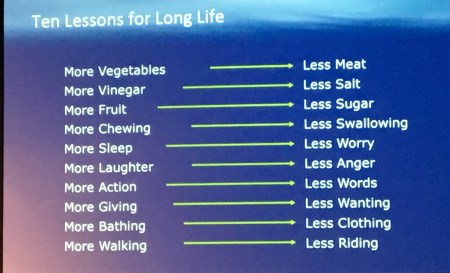
Ten Lessons for Long Life

March 4, 2016

I was at a conference last week, and one speaker led off with this slide. Well, actually, his first slide was in Chinese. This was the second slide 😉

10 Lessons For Long Life

These are excellent lessons for life and a healthy body. I’ve tried them all. They work. And when I’ve had health issues, it’s because of going the wrong way on a couple.

The result of having too much stress in our life has finally sunk in to me. I thought I handled stress well with meditation and Yoga. Not so much. You can do the practice, but if it is not deep and meaningful — and mindful — then it doesn’t alleviate all the stress.

Action rather than talking is good. Sometimes we’re good at talking about what we’d like to do–or what we’d like someone else to do–and never get around to doing.

Giving grows the soul. We all have too much stuff. I just threw out almost 1,000 lbs. of books from my library. That was about half. I still have four bookcases full. Some books I’d like to have for reference. Others, I’ll never read again. Like I told someone, I’ll most likely never program in C or C++ again, so why keep the books. Or the first version of Java. Programming and math books are the heaviest.

More chewing slows us down. I still have residual habits from working in manufacturing where we had 10 minute breaks and almost 30 minutes for lunch. You learned to eat quickly. Bad habit.

As for walking, never seek the parking spot closest to the door. Park at the end of the lot and walk.

I’ve been reading Dallas Willard’s “The Spirit of the Disciplines” again. He devotes much space to discussing Paul’s approach to the body–the body and its care is important to Paul, as it was for all the ancient peoples. We should learn from them.

Lost In The Futility Of Their Minds

January 7, 2016

Have you ever met someone who is so smart that they are actually ignorant? They have so many ideas rattling around inside their skull that often nonsense comes out of their mouth (or computer)?

These people are not only atheist philosophers. I have met people who call themselves Christians who live entirely in their heads. Religion is intellectual, ideas, agreements with propositions.

Sometimes people study things to overcome their own deficiencies. Perhaps I’m that way. For a couple of years at the university, especially the year I wasted in graduate school studying political philosophy, my goal was to be an intellectual. University was all about ideas. In fact, some philosophers who were really all about spirit were labelled “idealists” meaning they thought ideas were real.

Now, I often observe that people think too much. They read too much into other people’s writings.

Now this I affirm and insist on in the Lord: you must no longer live as the Gentiles live, in the futility of their minds. They are darkened in their understanding, alienated from the life of God. They have lost all sensitivity. (Ephesians 4:17-19 excerpted)

After the era of Freud, people seem to like to psychologically analyze other people. They think about others problems. Sometimes they explain away evil acts by saying it’s all their mother’s fault or some other such nonsense. (OK, I like Jung and James far more than Freud from that era, I’ll admit.)

We read the Bible and try to dissect every word as if we were scholars who had lived with the nuances of the language for a lifetime.

Jesus basically said it’s all about the status of our heart. It’s how we live out love. Paul emphasized grace. He also was concerned about how we live out love–but he was worried that people would return to being legalistic about it instead of living in the freedom of grace.

But freedom didn’t mean thinking about whatever you wanted to until you slowly went insane. Thinking that leads to understanding of God is good. Better is getting up every day and deciding to once again live out God’s grace by sharing it with others.

Stop sitting around thinking; start reaching out to others in love.

Learn Without Ceasing

October 21, 2015

Living is the constant adjustment of thought to life and life to thought in such a way that we are always growing, always experiencing new things in the old and old things in the new. Thus life is always new.― Thomas Merton, Thoughts in Solitude

I have had a core value ever since I was very little of constantly learning. I read everything I could get my hands on. Even in high school instead of studying the stuff we were supposed to be studying, I was off on arcane math, electronics, philosophy, psychology, theology.

I thought college was supposed to be a place of unending inquiry. Then I learned it was a place of unending memorization. So, I got my degree and went off to learn.

When I open the Bible, I am seeking to learn more about God, more about how I should behave (wish I could do it like the book says), more about life.

Seems like there are some people who open the Bible to pick up a cute phrase they can use on someone. Or just memorize some things so they can repeat them. Worse are those who open the Bible looking for words that justify their opinions and prejudices.

Thomas Merton is one of my intellectual/spiritual heroes. He has nailed it. We think, we live, we reflect on how the experience necessitates adjustment to thought. It is an ongoing process. It’s part of prayer.

God, teach me today so that I can grow and modify my thoughts and actions tomorrow to more closely follow you.

Teach About the Whole Body

October 15, 2015

The Christian church, especially the Protestant tradition that I’ve grown up in, focuses almost exclusively on the “soul”. Most Protestant denominations, at least in the US, focus on salvation messages.

Thanks perhaps to Dave Ramsey, more and more churches are beginning to discuss money not in terms of law–you should give more money to the church–but in terms spiritual development. How you manage your finances is an important part of your overall spiritual focus and development.

I hear almost nothing about taking care of your body. This “temple of the soul” as Paul says.

It’s not like the Bible is silent on the issue. Many of the Mosaic laws are in reality health laws. Of course, like all religious laws they quickly get taken to the extreme and the initial reason lost.

There is the “Daniel diet” that has gone around. You know, when the Babylonian king picked a group of Hebrew young men to join his leadership academy, they asked to stay on a healthy diet rather than the foods rich in fat and sweet and alcohol. After a trial run, they proved to be more healthy than the others, so they were allowed their own diet.

If you take care of your body, you are in better shape to pursue your spiritual development.

Taking care of your body does not mean that there is no illness or physical debilitation. Some of that is unavoidable genetics. Some accident. 

All of us can be like Daniel and watch what we eat. We could be vegetarian or allow ourselves some meat. Either works. But eating more of your diet from plant sources, eliminating excess fat and sugar, eliminating sodas, eating until 80% full, drinking more water, dining rather than gulping down your meals (like I did last night proofreading some PowerPoint slides while eating) all work for the betterment of our bodies. We can practice this no matter what we have.

Even those who have physical challenges can get some form of exercise. For those who can walk, few things are better than long walks in nature. For those who can run–run. Resistance exercises like some form of weight lifiting build muscles and bone. Mind/body fitness like Yoga, Tai Chi, or Pilates tone the whole body. Yoga is good for people with a number of chronic physical problems who can’t exercise any other way.

Lots of things contribute to our spiritual health. We need teach about mind, body, and soul so that we are fit for the race set before us.

Finding Our Way

September 30, 2015

Lake Tahoe

Last week on vacation in California we decided to drive up to Lake Tahoe from Folsom where my conference was held.

The tourist spot that overlooked Emerald Bay was packed. We kept driving. Found this nice rock outcropping.

We found  place to park and hiked around to a small, barely noticeable trail that led from the road to this small rock ledge.

The view was beautiful. I sat cross-legged on the rock and contemplated the view for a while.

Lake Tahoe 2

Then we turned to head back.

We had only traveled about 500 feet. There was no sign of the road. No sign of a path on the rock ledge. Looking up the terrain was just a pile of rocks.

For about five seconds I felt what people who have gotten lost in the wilderness must feel.

Or, people lost in life. There is nothing distinguishing with which to become oriented. If you go one way, it is sure death from a several hundred foot fall. The other way appears insurmountable.

What to do?

I took a deep breath. Quit looking far ahead. I knew the general direction from which we came.

So, it was one small trail. The noticing the small path that cut through some brush. Then the broken tree we had gone under. Then the tricky balancing act around some fallen rocks. Then the road was there above us. A short climb, and back to the road.

I thought–the spiritual life is like that. Sometimes we venture out to live life. We want the beautiful, the spectacular. We find ourselves in a spot where we’ve lost our bearings.

We only need to take that deep breath. Relax. Reorient.

In the spiritual life, the steps are opening the Bible again. Not to understand the whole thing. Reading Romans or James or Galatians. Simple paths.

Prayer, stopping to converse with God becomes another step.

Finding a spiritual mentor or guide or small group is another step.

Then we find our way through the rocks and brush. We’re on our way home.