Archive for the ‘Disciplines’ Category

Slow Is Fast

January 12, 2022

James Clear wrote Atomic Habits, a worthwhile companion to Charles Duhigg’s The Power of Habit. He wrote this in a recent newsletter, “Slowing down enables you to act in a high quality way. Kind rather than curt. Polished rather than sloppy. It’s hard to be thoughtful when you’re in a rush.”

These thoughts when incorporated into our daily life change our effectiveness and maybe even our health.

Imagine acting with quality in every interaction and everything we do. Our work improves. Our relationships improve. Slowing down while eating quality foods impacts our health.

When we slow down, we will notice other people. Not being in a rush, we can take time to be kind rather than curt or brusque.

Imagine yourself turning in polished work at your job or nonprofit organization or your church. See the impact quality work has on others and on your own self-esteem.

Some people set a goal and find a guide to reading the Bible in a year. You must go through many pages every day. What if you took one gospel, say Mark, or maybe part of a gospel, say the Sermon on the Mount, and read through it slowly and thoughtfully over the course of the year? Or maybe a deep spiritual teacher like one book of Thomas Merton or Henri Nouwen or even an ancient like Augustine of Hippo?

I think before I have quoted a former Navy SEAL, Jocko Willink, who advised, “Slow is smooth; smooth is fast.”

You could do worse for yourself in 2022 than bring this into your life. I know from experience.
Intellectual Discipline

January 11, 2022

The man sat next to me at lunch at the conference I attended last month in Florida. He is a reliability engineer. His professional life has a foundation built on numbers. He began talking about Covid and how he and his wife had both contracted a bad case of the virus. She took a medication recommended by few doctors. She did recover. I’m not talking about medicine here.

He quoted statistics from India to support their decision.

I was surprised. He has far more training in numbers than I, yet he quoted statistics that had a spurious rigor. If he used numbers like that in his plant, some very expensive equipment would be broken.

We all get suckered in by statistics that are incomplete or misleading. And we all can miss those numbers that tell us something important. Just like we should apply intellectual discipline when studying the Bible, we should also stop and consider when we see numbers thrown around in the news or even from the pulpit.

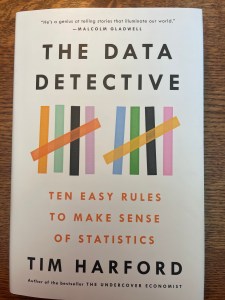
Soon after my conversation, I ran across The Data Detective: Ten Easy Rules to Make Sense of Statistics by Tim Harford. This book does not require a background in math. It is readable. Packed with stories about people who famously got the numbers wrong and those who got them right. This book will help you not be fooled by every number you see flashed at you.

I suppose I should hint at the ten rules (dare I say 10 Commandments in a spiritual disciplines blog?).

  • Stop and notice our emotional reactions
  • Combine the “bird’s eye” statistical perspective with the “worm’s-eye” view from personal experience
  • Look at labels on the data, do we understand what’s really described
  • Look for comparisons and context
  • Look behind the statistics at where they come from
  • Ask what is missing
  • Ask tough questions about algorithms and the big datasets
  • Pay more attention to the bedrock of official statistics
  • Look under the surface of any beautiful chart or graph
  • Keep an open mind

And finally, Harford’s “golden rule”—a good trait to develop for life in general—Be curious.

Further Questions of Ourselves For Guidance for the New Year

January 7, 2022

A couple of days ago, I asked a number of questions to guide us toward health for the new year. Let’s take it deeper with some questions from today’s reading in the Celtic Daily Prayer: Prayers and Readings from the Northumbria Community.

  • Why do we call impossible what God calls possible?
  • Why do we call unforgivable what God has forgiven?
  • Why do we compromise with what God calls sin?

How we need to know God’s heart, and reach out in His love and wisdom to others.

Maybe those are questions we can write on a note card to place on our desk to remind us daily. Especially when we are discouraged. Or when we are judging others harshly. Or when we are tempted.

How Can I Improve My Overall Health, Part 2?

January 6, 2022

I asked many questions yesterday for us to consider regularly to keep us on a healthy spiritual, intellectual, physical path. Today I’ve compiled a list of suggestions from a number of sources. They are all good, but way too many to implement all at once. Just consider them as suggestions. Pick one or two deficiencies and begin a habit to correct them.

Longevity and Mindset

  • Prioritize sleep
  • Build muscle mass, begin resistance weight training
  • Move (walk, run, bike, swim)
  • Minimize sugar intake
  • Socialize more
  • Adopt a diet more rich in plants (Eat food, not too much, mostly plants)
  • Practice gratitude daily
  • Find your passion and purpose
  • Consume optimistic and future optimistic content (turn off TV news and other negative sources)
  • Practice data-driven experimentalism
  • Take ownership of your health decisions
  • Practice simple habits
  • Practice change as lifestyle

Drink water

  • After waking up
  • After workout
  • Half-hour before a meal
  • Before going to bed (this has been a great change for me)
  • When you’re feeling sick or tired
  • When surrounded by sick people

Work smarter

  • Have a weekly plan
  • Focus on what you’re doing
  • Get organized
  • Have a routine (but be flexible)
  • Take breaks
  • Turn phone off
  • Prioritize

Hope you find some good ideas within.

How Can I Improve My Overall Health This Year?

January 5, 2022

Four questions for the year.

  • How can I improve my spiritual health this year?
  • How can I improve my physical health this year?
  • How can I improve my intellectual health this year?
  • How can I improve my emotion health this year?

Rather than goals or resolutions this year, how about beginning each week with a series of questions and answers?

Each week as part of our weekly review of projects and tasks, we can devote five minutes to answering each of these questions for the week:

  • What one thing will I do for my spiritual health?
  • What one thing will I do for my physical health?
  • What one thing will I do for my intellectual health?
  • What one thing will I do for my emotional health?

I hope you have completed an annual review of where you’ve been and where you’d like to go this year. Monthly reviews help you stay on track or make course corrections as necessary. Weekly reviews bring it home. You can look at the week and see the days you’ll exercise, the pattern of study and meditation, and so forth.

For me, I need to learn to ask better questions.

Wisdom, Or Be Careful What You Ask For

January 3, 2022

Solomon as an adolescent knew he would be king after his father, the famous King David. He talked with God, who told him he would grant a wish. Solomon asked for wisdom.

I often recommend reading the book of Proverbs in the Hebrew Scriptures (Christian Old Testament) during the month of January in order to set off the year with good momentum. It’s the writings of Solomon’s wisdom teaching. 31 chapters—31 days in January. Read a chapter a day.

But, the story of Solomon didn’t turn out well. He lived a dissolute life. Many of his wives brought pagan gods into Israel. His son was barely king when he caused a split in the kingdom due to his lack of wisdom. The huge kingdom was gone in an instant.

Think about this. What if…what if he had asked God to help him act wisely instead of just to have wisdom.

We can know a lot, but we can still act like a fool. We can be a couple of lengths short of a PhD, yet we can live wisely.

I don’t care how much of the book of Proverbs you have memorized. What matters is what you do after you rise from bed tomorrow morning. Ask God to help you live wisely and with kindness this year.

Happy New Year, We Hope

December 31, 2021

Welcome to the last day of 2021, or maybe the first day of 2022 depending upon when you get this. We hoped 2021 would be an improvement over 2020 when we had the shock of the first major pandemic perhaps since the Spanish Flu of 1918. It has caused immense changes in how we live and interact.

Still, a year end is an ideal time for reflection and gathering ideas for change in our lives–and maybe our thinking. We, the people, seem to be woefully short on reflection. Since most people have a few days left of holiday, use yours to set aside a few hours to just sit and think. That is called reflection.

What good did you do last year?

Where could you have done something and didn’t? No guilt. No excuses. Just a short list.

Who did you lose track of, perhaps due to Covid or not?

Where did you grow last year?

Then we can project into the new year.

What one thing can do in 2022 to grow intellectually, spiritually, or in relationship? What trigger can I set up to encourage it? For example, setting out workout clothes at night so that in the morning they are right there to be put on getting you in the mood of exercise.

What good can I do in 2022?

I stopped doing New Year’s Resolutions many years ago. I think of what kind of person I’d like to be and what changes I can make in my daily life to assimilate it.

I started this blog in 2008 as a service to my local church with another person. She left to go to seminary. The pastor was transferred to another place. I changed it in 2009 and then took it seriously a year later. Eleven years and 2,600+ posts later, it’s a part of my daily discipline. The blog never caught on to the tune of hundreds of thousands of readers. But I only promote it on Twitter. I seldom try to hit a “click bait” issue to trick people into clicking. And still there are a few thousand readers. If you care to pass it on, I’d appreciate it. I have no income from this. It’s as much for me to organize some thinking as anything.

I Choose Health, and Other Things

December 30, 2021

It happened many years ago. I remember lying on the bank of a creek in the warm spring sun watching otters play. I pulled out a cigarette. Back then I had taken up that disgusting habit for no apparent reason. The feeling of deep incongruity overcame me. How could I feel at one with nature and yet put such unhealthy stuff into my body? I stopped.

I learned to drink coffee with milk and sugar at university. And tea with sugar. One day grabbing a coffee in the break room at the manufacturing plant where I worked I became aware of the spoonfuls of stuff I was putting into my body (they used artificial creamer, of course). I stopped adding stuff to my coffee and tea–well, unless I have a cappuccino or, as I am now, having a chai tea.

I chose health.

Today, when faced with food or lifestyle choices, I have already chose. Or, if I choose to deviate, it is a conscious decision without guilt while knowing I will have to make up for it.

And I wear a mask and am vaccinated, because I’ve already made the choice for health. I understand those who fear needles or don’t want to “give in to authority”. I don’t agree, but I understand. I undertook a several year study into brain science and other physiology in order to understand. I won’t go into details, but suffice to say that the famous Descartes saying, “Cogito, ergo sum” was wrong. Reality is “Sum, ergo cogito.” For the Latin deprived, I am not a person because I think. Rather, I am, therefore I can think.

This is the week for New Year’s Resolutions. Or, does anyone make those anymore? Looking at the new year with a break in normal activities naturally leads to thinking of the future. I suggest choosing whom you will be. Not a resolution such as “I will lose 25 lbs.” which you will never do. Better are statements such as “I choose health” and “I choose to exercise every day.” Or, you can say, “I am the type of person who eats healthy and nutritious meals” or “I am the type of person who gets some exercise every day” or on another area “I am the type of person who gets up and writes three pages every day” or “I am the type of person who carries a sketch book and looks for interesting things to sketch every day.”

The Mind Needs Many Precepts To See

December 28, 2021

I sat here this morning to type a thought remembering something I read in number 94 (XCIV) On the Value of Advice from Seneca’s Letters from a Stoic. I prepared the quote and then noticed quotation marks. The quote I remembered was not from Seneca but from a rival called Aristo whom Seneca was refuting.

There was a writer popular in the early 70s. I read his brief, popular book. It was a good story, but it was also a little light on understanding some things that I had studied deeply. But enough was there to cause me to buy his next book. This was an explication of the Christian Bible book of Hebrews. I had gone maybe two of his chapters into his book when I had a feeling nagging at the back of my brain.

I pulled out a Bible (actually a couple) and read those translations along with the book. There was only a slight resemblance between two generally accepted translations of the book (actually it’s more like a sermon) and the author’s own translation.

I discarded that book and never read anything from that author or his colleagues.

I feel that that author made a translation to fit his theology. I felt a dishonesty at work. But, had I quoted and explained the thought as if it were Seneca rather than his rival Aristo, would I not also have been guilty of a dishonesty? Even if it were just sloppy research.

There is a lesson or more.

Read more carefully.

Check your memory.

If you have read incorrectly, be prepared to change your mind.

Prove Christmas In Your Own Life

December 27, 2021

“We are called to prove in our own lives that Christ is born.”

I came across that challenge in my reading during Advent. Some people think that all you have to do is say you believe aloud and that you will be saved and all is good. You would not find that in any definition of discipleship.

Jesus challenged us to live as if God were right there with us. Live in the kingdom of God, he called it.

There used to be a phrase making the rounds—if you were put on trial for being a Christian, would there be enough evidence to convict you?

That is looking at that thought from the outside in. If someone followed you around, like say in a spy novel, taking notes of what you did and how you acted, would they suspect that you were a follower of Jesus?

We have passed through Advent and are living the twelve days of Christmas. We celebrated in our own way the commemoration of his birth. Have we once again brought that into our lives from the inside out? Will people we meet and people observing us say, “That person proves there is a God in the way they acted”?

It’s not the megachurch pastor saying good words to thousands while masking a sordid life. It’s each and every one of us through our daily random acts of kindness that prove the birth of Jesus.