Author Archive

God’s Truth Is Not Theory, It’s a Life Force

February 24, 2021

Pope Benedict XVI presented a series of meditations on the early Church Fathers in 2007-2008. Discussing Clement of Alexandria’s thinking, he noted that Clement said Christians “must be guided by Christ and thus attain knowledge of the Truth…becomes a living reality in the soul: it is not only a theory; it is a life force.”

Discussing Irenaeus of Lyons, Benedict notes Irenaeus’ teaching that the Church should transmit the faith in such a way that it must be as it appears it is–public, one, spiritual.

Sometimes we humans become enraptured by a single word pulled from a context or by a theory proposed by another human. And we become fixated on just the words supposing that to be belief.

And we miss the spiritual, as Irenaeus would say, or we miss the life force described by Clement.

People who practice spiritual disciplines know that we must take those words and bring them to life within us. Not mere words, but descriptions of how we live. With the spirit, in the flow of the life force, described in the Christian Bible as living in the kingdom of God.

A Weakening of Charity

February 23, 2021

Those first century Corinthians must have been something else. Two letters that the Apostle Paul wrote to them are preserved in the Christian Bible. In one of the most famous passages in the entire Bible (chapter 13 of 1 Corinthians), Paul defines charity (love) for them. Evidently they didn’t have a clue.

Pope Benedict XVI in a series of talks on the Church Fathers talks of the third Bishop of Rome, Clement, writing to the Corinthians toward the end of the first century (maybe 30 years after Paul?), observes that if there were abuses in Corinth, the reason should be sought in the weakening of charity and other indispensible Christian virtues.

Someone must have thought, “Why did anyone ever stop in Corinth and start a church there? They’ve been nothing but trouble.”

If we look honestly at ourselves today, what would we observe?

Would the leaders who founded our congregation wonder why they bothered with such a divisive and stubborn people?

Would a church leader observe that problems within us are due to the weakening of charity?

Would we even consider that an indictment? I do know people whose attitude toward charity does not extend beyond themselves.

Many people observe Lent at this time of year by giving up something, making a sacrifice, turning their attitudes toward God and our need for grace. Maybe we could be in prayer and contemplation about whether we ourselves and our congregations are weakening in charity–and do something about it.

Seeking Unity Not Divisiveness

February 22, 2021

Alexis de Tocqueville travelled from France to the United States in the 1830s to find an answer to what to him and his European contemporaries was a perplexing question–How could the US operate with separation of church and state?

When I came to enquire into the prevailing spirit of the clergy, I found that most of its members seemed to retire of their own accord from the exercise of power and they made it the pride of their profession to abstain from politics. (When he asked them why, they answered) Because politics is intrinsically divisive. We want to be a unifying rather than a divisive force.

Alexis de Tocqueville, Democracy in America

Here were some key goals they held:

  • strengthen families
  • building communities
  • starting charities
  • inspiring people to a sense of common good
  • educating them in habits of the heart
  • bequeathing them the art of association

Concluding, de Tocqueville wrote, “Liberty cannot be established without morality, nor morality without faith.”

How do observers around the world describe American Christians in 2021, some 190 years later?

More to the point, looking into the metaphorical mirror, how would each of us describe ourselves? Are we building, strengthening, inspiring, educating? Or, are we promoting divisiveness?

A Race To Tame Testosterone

February 19, 2021

The philosopher Ken Wilber once wrote, “Civilization is a race to tame testosterone.”

Evidently the sex drive (metaphorically reduced to the hormone testosterone) of men in general knows few bounds. It exhibits itself in aggressiveness, abuse, and overly sexual behavior. I wrote yesterday about two TV series exploring the theme of men coming to an understanding of the changing role of women in the late 19th and early 20th centuries.

That struggle is not over. It’s even worse than the persistent belief among some that the woman’s place is in the kitchen and bedroom. Abuse is abundant in the USA, as well as throughout the world.

I knew about Bangkok, Thailand as a vacation destination for Japanese men seeking sexual pleasure many years ago. Probably men from many other countries, as well. It persists even today. Let me tell you the story of a coffee farmer in the highlands of Thailand named Abonzo. Like coffee farmers around the world, the family was unable to escape poverty and pay living wages to its employees given the economics of how coffee is purchased and distributed. The farm workers were so poor that many often sold daughters they could not afford to feed to brothels in Bangkok. Then a coffee roaster in Ohio learned about the family and purchased coffee from the Abonzo family farm directly paying a fair price. The last I had heard, they had brought 70 women back from Bangkok to work at the farm reunited with their families.

You can buy direct trade (direct from the farm) coffee from Hemisphere Coffee Roasters. I don’t see Thailand on the list right now. I buy Cafe Diego–I met Diego Chavarria from Nicaragua once and heard his story–plus we like the coffee. It is so much better than the usual stuff you get. And you support many people.

Another way you can help make a big difference in a person’s life is to support a women’s shelter. We send donations monthly to the Tijuana Christian Mission. The main mission supports two orphanages for children who often are the victims of neglect and abuse. There is also a shelter, Women With Purpose, you can reach out and donate at Women With Purpose, PO Box 85, National City, CA 91951. I’ve visited the shelter some years ago and done some painting to spruce it up. Tijuana is a sex destination for American men. I’ve also gone through that area of town. (Not as a “tourist”!) The shelter sometimes helps women who got out of that or most often are victims of abuse at home.

Only about 10 miles from where I lived in Ohio quietly existed a sex slave “business” serving long-haul truck drivers and others. You can support women in many ways. But we need to reach out to the men, too, and as Wilber put it–race to tame testosterone.

The Bible challenges us often in its pages to care for the widow and orphan. There are many ways to do it. You can help from wherever you are in the world.

Ever-Changing Roles

February 18, 2021

She was a freshman and I a sophomore at university. While we were chatting before an English class, she said, “I’m going to be a lawyer.” This would have probably been in 1967.

She noticed the involuntary look of (probably) disgust on my face and bristled, “You don’t think women should be lawyers?”

“It’s not that,” I replied. “I don’t think anyone should be a lawyer.” I had no problem with her being whatever she wanted to be, as long as it was legal and ethical (neither of which, oh well, you get the point).

Since we have settled into a routine with the pandemic-enforced not going to meetings or Yoga, my wife turns on the TV about 8 pm (as a retired elementary school teacher, her entire life revolved around schedules) every evening. Typically we pick an English murder mystery series and watch the entire series straight through at two hours per night. We currently juggle an older Australian murder mystery series, Miss Fisher, with the currently running on PBS Miss Scarlett plus a different kind of story All Creatures Great and Small.

Miss Scarlett works in Victorian 1880s London. Partly by circumstance, partly by disposition, she becomes a private detective. An old family friend is the local Detective Inspector, and she becomes his unwanted companion solving crimes. 40 years later in Melbourne, Australia, Miss Fisher, an adventurous and wealthy slightly older woman, becomes a private detective and unwanted companion also of the local Detective Chief Inspector. Miss Fisher brought a young woman, Dottie, into her household and into her business. Dottie becomes romantically entangled with Hugh, a police constable working for said DCI.

A significant subplot of both series tells the stories of the three men and how they struggle to accept the changing role of women.

100 years later, it’s today. and men in most of the world are continuing to struggle with the role of women. But it has gotten worse for these men (and many women, too) because the struggle has broadened to having to deal with the once-hidden reality of homosexuality. Lest you think that is an American problem, in the United Methodist Church (becoming dis-United thanks to this issue) the largest anti-homosexual voting bloc is from Africa. And not just sexuality, we are dealing more and more with the realities of acceptance of multiple ethnicities and races. Again, not only an American problem, it’s a human problem.

I was not brought up this way, but somewhere along the line of my maturing, I became pretty completely accepting of all this rich variety of humanity. I think it’s great, actually. One of my most moving meditation experiences was God showing me the family of the human race.

People have always tried to ascribe to the Apostle Paul 20th Century values to a guy brought up in the 1st Century. We miss the revolutionary parts of his remarks. Like the times he says there are no Jews or Greeks, male or female, slave or free, but we are all one in Christ.

Or the time he gave instructions about church services (totally misinterpreted by most) where he says men do not have to cover their heads while praying, but women should cover their heads when praying. What’s revolutionary? My wife still get upset thinking of this instruction. Why do men not have to cover their heads? That’s not the point.

In Jewish synagogue meetings, there were only men in the primary part of the building. They had “prayer shawls” and covered their heads when praying. If you have a mixed group of worshippers as in the early church, the “Greeks” would not have had those head coverings. Paul said, just do away with them so all are the same. And then, pause and let this digest, women were allowed to be in the main part of the worship with the men and they were allowed to pray in the group. Paul just asks for a a certain amount of modesty. I know that women today don’t make personal statements with their hair styling and coloring, but back then… I think Paul was being about as revolutionary as he thought he could get away with.

Recognizing our fear of change of these developing and empowering roles of gender, sexuality, race, ethnicity, is the first step to being able to deal with it. We can succumb to the fear by abuse and hatred and even killing others not like us. Or we can recognize and begin the hard work of dealing with it. That is something Christian churches were supposed to do–by accepting all these varieties of people into their worship with no second-class memberships.
It Has Been A Year

February 17, 2021

A year ago this past week I was in Hannover, Germany. The organizers of the annual huge trade fair known as Hannover Messe had assembled an international cohort of journalists, writers, and other media types to preview the trade show that none of us would return to visit. By April, we were all on some sort of lock down.

I returned home on Thursday evening. Friday morning I taught the regular Yoga class and went home to let the house inspector in. For we had accepted an offer (very nice one) to sell our house where we had lived for 35 years. Saturday, I taught a soccer referee class (most likely the last one I’ll do, even though I remain a ranking instructor), drove to the Chicago suburbs, looked at houses, and made an offer to buy.

While in Germany, we remarked that there were no Chinese journalists in attendance. We knew something was up. Little did we know how bad it would get.

The next four weeks were a blur of arranging financing, waiting for deals to complete, and packing. And packing. And selling excess stuff. And throwing away excess junk (I estimate 2,000 lbs.). Advice–don’t live in one place for so long–or leave it to the kids to clean up 😉

We moved March 23. We then found the reality of the Covid shut downs in the sudden reduction of activity. Yes, we had to unpack, hang pictures, and all that stuff. But we were in a new community where we knew no one, in a lock down, in a new state, with a new lifestyle (sort of).

The first thing I decided was to maintain my daily disciplines of study, meditation, writing. We made one trip back to Ohio to vacation in the back woods of the southern part of the state and to close out banking accounts. And then the virus took off again, and we were back to mostly staying inside.

I’m ready to travel, if I had somewhere to go. It’s been a year since the last time I set foot in an airport. Eleven months since I’ve taught Yoga; twelve since I’ve taught soccer.

But the daily disciplines carry on. Here I am with breakfast writing this essay just like the past six years or more. I hope you all remain safe and maintain your disciplines.

Do The Work

February 16, 2021

A brother came to one of the Desert Fathers, Abba Theodore, and began to converse about things he had not put into practice. Theodore responded, “You have not yet found a ship nor put your cargo aboard it and before you have sailed, you have already arrived at the city. Do your work first; then you will have the speed you are making now.”

How often we try to skip the work and arrive at the destination.

Once I worked for a man who was president of a small company as the marketing manager for a computer electronics product. We put together a marketing plan, packaging, started to find distribution. After six months, the president came to me, “I don’t understand. Steve Jobs and Steve Wozniak were millionaires overnight at Apple, yet we are not selling boards.”

I replied, “No, Joe, they were not millionaires overnight. It took them years and several iterations before they found success.”

Joe may have had a Ph.D., but he wasn’t smart in the ways of the market.

Similarly, we need to do the work for however long it takes before we reach the point of wisdom. You have to chop wood and carry water before you can fix your meal.

Specialization Is For Insects

February 15, 2021

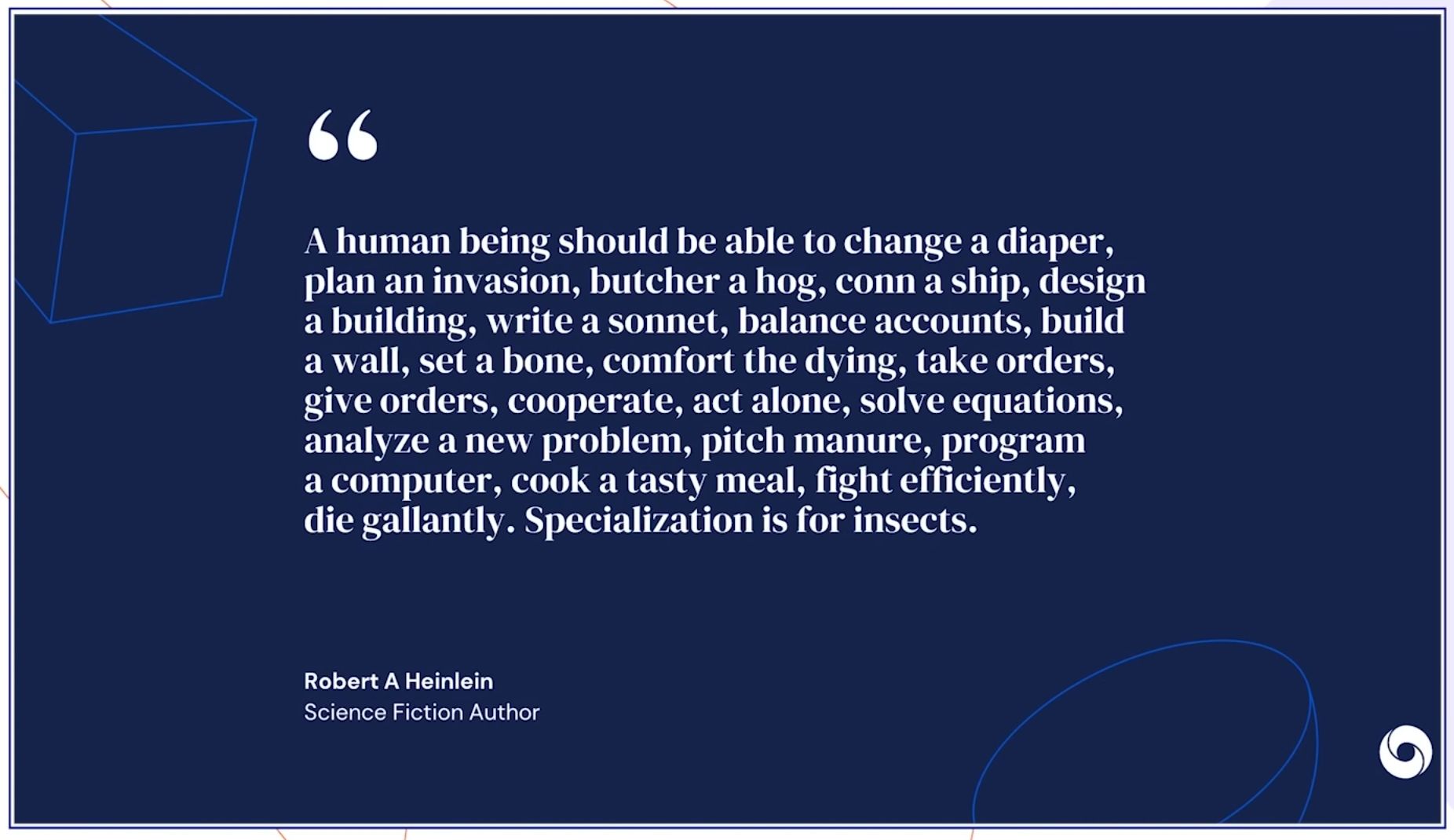
A human being should be able to change a diaper, plan an invasion, butcher a hog, conn a ship, design a building, write a sonnet, balance accounts, build a wall, set a bone, comfort the dying, take orders, give orders, cooperate, act alone, solve equations, analyze a new problem, pitch manure, program a computer, cook a tasty meal, fight efficiently, die gallantly. Specialization is for insects.

Robert A. Heinlein, science fiction author

Similarly in spiritual formation and practice, humans should be able to study, pray, lead a group, be led in a group, comfort others, be comforted, serve others, be served, lead worship, participate in worship, commune with God, honor those who are godly, be peacemakers, defend those weaker.

Dons’t leave it for the pastor. Don’t abdicate your power to others. Step up and take responsibility.

Don’t Just Study It, Practice It

February 12, 2021

I’m deep into another book. It’s a class on taking a spiritual journey from a different perspective. The Artist’s Way: A Spiritual Path to Higher Creativity by Julia Cameron.

Devoted as they are to the scholarly appreciation of art, most academics find the beast intimidating when viewed firsthand. Creative-writing programs tend to be regarded with justified suspicion: those people aren’t studying creativity, they’re actually practicing it! Who knows where this could lead?

Julia Cameron, The Artist’s Way

Once I had a bright idea. Going to the senior pastor of my church, I proposed teaching a class on prayer. Actually, the idea was not to teach about prayer; it was to teach and lead to practice the varieties of prayer. The students were not to view it as an intellectual enterprise where they would learn the types of prayer–intercessory, praise, complaint, or whatever–but they would become pray-ers.

The pastor was OK with it. Half-a-dozen people signed up. They all, each one, wanted to study about prayer.They did not wish to practice it. I never tried the idea on other people again.

I’m reminded of a scene in Zen and the Art of Motorcycle Maintenance where Robert Pirsig, the author, has been accepted into the Ph.D. program at The University of Chicago to study philosophy. He proposes to the department chair that he focus his studies on rhetoric. “That is not a substantive discipline,” the chairman replied. And thus ensued the beginning of a long-running battle between the two.

You see, you practice rhetoric. You don’t study it like, say, Aristotle–the chairman’s favorite.

The ancient philosophers? As much as anything, they taught how to live.

The Bible–both the Hebrew and the Christian? Oh, you can spend your life intellectually parsing through the thing getting hundreds of ideas. You can develop inane theologies, philosophies, cults.

Or you can follow what Jesus’ brother James said, “Be doers of the Word, not hearers only.” Or, Jesus as quoted by John, “Those who have my commandments and follow them are those who love me.”

I went to graduate school to study political philosophy (OK, that was a mistake, but well, I was young and stupid). We graduate assistants developed a phrase, “Operationalize your Eschaton!” In understandable terms, “Get off your metaphorical butt, go out, and do.”

Are You A Pilgrim or a Tourist?

February 11, 2021

This question appeared in my reading the other day. What a marvelous question to ask of ourselves if we look at our spiritual formation as a journey.

Do we travel around, visiting here and going there? Sample a little of the sights, perhaps in the comfort of a tour bus? Try the food–a little, perhaps with trepidation? We have no expectations of staying. Of meeting people and making friends. Of learning some of the language and customs. Adding to our personal cuisine.

Perhaps we have a destination. A journey to a sacred place. The journey has meaning. We pick up new habits along the way. We learn new things. Our minds expand from formerly provincial attitudes. We learn about new people. Perform large or small acts of kindness along the way–growing more frequent as we journey farther.

Perhaps we pick up our little notebook and a good pen and write some notes. Where are we now on the journey? How have we been a tourist? How have we been a pilgrim? What new attitudes can we work on to spend more time as a pilgrim, less as a tourist?

I love that question. It reframes the journey. I desire pilgrimage, not sight-seeing trip.