Archive for the ‘Service’ Category

Many Ways To Discipleship

July 1, 2013

Is there just one way to be a disciple? Are disciples like little toy Ninjas spit from an injection molding machine so that each is exactly like the one before and the one after?

The thing about becoming a disciple is that it is much harder than just saying you agree with some proposition. There are powerful and charismatic people who arise from time to time who have a vision of what a perfect person is like. He (almost always a “he” throughout history) then tries to develop a society of robots under his control.

Jesus was not like that. He had a core teaching. He expected his followers to abide in that core teaching. He also collected an amazingly diverse set of characters into his inner circle. Beyond the Twelve and into the next circle, there were religious leaders, wealthy people, recovered prostitutes.

I was thinking about this reflecting back on my life while I’m also reflecting forward into what I’m doing now. Have I always been a disciple? Have I always done what I should?

We can look to Paul for some advice. I, like many of my contemporaries, initially disliked Paul. In fact, I have a friend today who will tell people to get out the big, black magic marker when reading Paul’s letters to just blot out some of his words. People have been doing that for centuries.

That’s a mistake. It’s just that Paul tried so hard, sometimes he got a little confusing. And sometimes he was telling disciples in AD 60 how to organize without thinking about (it probably never occurred to him) organizing when Christ-followers (or Christians) became powerful and diverse.

But Paul addressed this discipleship thing a few times. What he said was that there exist a variety of people. These people in general possess a variety of talents. Each individual has at least one talent. These talents are what we devote to putting into practice Jesus’ commands–such as to go into the world and make disciples.

Early Christ-followers were remarkable in their service to fellow humans even from a political and social position of powerlessness.

I guess that in the end, am I using what talents I have to help people and further the Kingdom. Am I constantly developing those talents to help even more? That would be my task–and my test.

A Story of Courage and Determination

June 5, 2013

I bring to you today a story of courage and determination. It also shows how many people still need to be reached with the story of a new way to live taught to us by Jesus. This is a video of a TED Talk. I get a new one of these downloaded to iTunes every day. Most are either inspirational or educational–usually both.

This is the story of a girl who demanded school. Kakenya Ntaiya made a deal with her father: She would undergo the traditional Maasai rite of passage of female circumcision if he would let her go to high school. Ntaiya tells the fearless story of continuing on to college, and of working with her village elders to build a school for girls in her community. It’s the educational journey of one that altered the destiny of 125 young women.

It sort of makes me wonder what I’ve been doing with my life.

[Note: you’ll have to follow the link to the talk. I forgot to put on my to-do list to allow embedding video on this site. But it’s worth the watch. Enjoy.]

Helping Others By Getting Out of the Way

May 9, 2013

It seems to be a human fault. Telling others how to fix their problems.

I often have counseled husbands–just listen to your wife’s complaints. Don’t start offering suggestions about how to fix things. They just want someone to listen to them. As in really listen. If they want to fix the situation, they will try. Mostly, I think they don’t really want to fix it. Just talk about it.

Same way with when we try to help others through our missions. We try to tell people what to do to fix their problems as we have defined their problems.

Ernesto Sirolli discussed this situation in his TED Talk. When most well-intentioned aid workers hear of a problem they think they can fix, they go to work. This, Sirolli suggests, is naïve. In this funny and impassioned talk, he proposes that the first step is to listen to the people you’re trying to help, and tap into their own entrepreneurial spirit.

Bill Hybels, founder and senior pastor at Willow Creek Community Church, talked about his own epiphany–and that of his team–regarding this same issue. In his talk last week, he discussed how the church used to send checks to organizations. Then they started checking up on the organizations. Visiting locations.

Eventually they discovered that partnering with a local church, someone who knew the needs of the local people and could relate to the local people, was much more effective.

Once again, I think what works personally, works corporately. Listen first. Then act appropriately.

I have trouble sometimes with the listening part. How about you?

Energy As The Flow of Grace

April 26, 2013


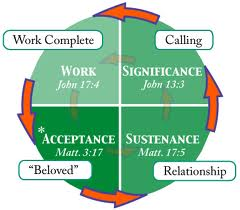
Cycle of Grace

Cycle of Grace from Acceptance to Work from Claypotchronicles

Of all the sciences I studied when I was young, I preferred physics. Thinking in the biological sciences has come a long way and I now appreciate the thinking of connectedness and networks biologists are studying. Chemistry? Well, I guess I’m glad they have it.

Physics is very much the empirical study of an ancient concept–energy. Ancient people contemplated the energy that flows throughout nature and from God to humans.

I think visually and associatively. So when I think of God’s Grace, I visualize it in terms of energy.

John Ortberg recently talked about a concept new to me called the Cycle of Grace. It comes from a book by Frank Lake (that I couldn’t find quickly). It dealt with burnout among pastors and missionaries. As a matter of fact, I lifted this image from claypotchronicles.com, where it seems that he starts with work. Ortberg started with acceptance.

You start the cycle knowing that you are loved and accepted by God. You didn’t earn that. God just says he loves you. Sustenance is what I often talk about here. It comprises the Spiritual Disciplines and practices that deepens and enriches your understanding and relationship. Next is significance, or why are you here? What is the work God called you to do? Finally is accomplishment (called work complete in the diagram).

If you start with work and try to gain acceptance, your efforts will be futile. That has often been the case with religious people. Check out Jesus’ debates with the Pharisees. But if you start with God’s Prevenient Grace, the fact that God loved you before you were you, then you have the foundation for great work.

Dallas Willard put it in terms that I can understand with my study of energy. He said that it now becomes God’s Grace flowing through you. I visualize that as a form of energy. We know people who give us energy when we meet them. Unfortunately we know those people who seem to drain the very energy right out of your soul when you meet them.

It is much better to be a channel of God’s Grace to others. A transfer of energy from God to another through you. That is the proper foundation for service.

We Need Disciples Like the First Century Ones

April 23, 2013

Jesus started a mission. He called disciples to do the work.

We have sort of screwed things up. We started calling ourselves Christians instead of Disciples. Then we sort of made it like a club.

But for three centuries, the Jesus movement grew because people saw how the disciples of Jesus lived and they wanted to be part of that.

Jesus said, you’ll know who my followers are by their love. Can we honestly say that about ourselves? About our churches? If yes, fantastic. If no, than as Desi used to say to Lucy, God will say to us, “You’ve got some ‘splainin’ to do.”

Willow Creek Community Church has begun its Celebration of Hope campaign featuring compassion and justice missions of the church. The first message was from Dr. Soong-Chan Rah. His description of how those early Christians lived is one of the best I’ve ever heard. You can click the link to listen for yourself.

In the 19th Century, Christians changed the world–women’s rights, ending child labor, ending slavery in many places, sending missionaries to carry Jesus’ story. By the middle of the 20th Century, Christians had changed and those of us who wanted to be both Christian and pursue justice were seen to be radical, or just weird.

Things are changing again. Disciples of Jesus are once again out in huge numbers carrying Jesus’ message along with our service and passion for justice. I wish this one sticks around for a longer time.

We Really Do Help

April 18, 2013

When you read about scary events, look for the helpers. There are always helpers.

Several people hare been writing about this quote from Mr. Rogers. He said his mother told him this when he was small.

It’s true. I bet everyone reading this has rushed to aid in a situation. I can recall some of mine–both when I helped and when I failed to act quickly enough because I failed to understand the situation.

There was an auto accident late at night. It was on the rural Interstate near home. I saw headlights going up and down weirdly. I stopped. As did the only other motorist that night. “Did you see what I did?” he asked.

I had no idea what I’d find as I ran across the median grass and across the other highway lanes. I had never witnessed a traffic accident. I had no training. A young woman had evidently lost control and the car flipped. Miraculously, she was completely uninjured. All she was focused on was finding her cat.

I stayed to calm her down while the other guy drove to a farmhouse we saw in the distance to call for help. I was no hero or anything else. It’s just the first impulse is to help.

Since I really don’t have time or interest to turn on CNN and watch endless repetition and mindless speculation, I miss some stories. In the Case of Boston, the stories of helpers and courage.

Humans do respond positively in a crisis.

But, as Teresinha pointed out about youth in Brazil, sometimes we don’t recognize the crisis. I’ve had training of various types since (sports first aid, first aid, CPR), but I’m no expert. I’ve since learned that first you need to recognize the situation or your training is worthless. There are a couple of times where I simply didn’t recognize the situation and failed to react. But I learn from that experience. Next time, I will know better.

We need to recognize the situations we have that maybe aren’t a single crisis, but rather a systemic crisis. Maybe more of us can point the helpers to situations before they get too destructive. Kind of like all the Christ-followers helping someone.

The Tragedy Visiting So Many Youth

April 17, 2013

My good friend from Brazil, Teresinha, wrote a comment on Facebook regarding one of my blog posts about the tragedy in Brazil of so many young men killing each other–she says like flies.

That same day, we have the bombings at the Boston marathon. What can a person be thinking as they assemble devices designed specifically to cause as much death and injury as possible?

Humans have asked why for a long, long time.

People come up with simplistic answers. “They just need Jesus.” Well, yes, that’s obvious. Except when you think of the thousands and thousands of people killed in the name of Jesus. Or, it’s because of single-parent families without a strong male influence. Well, yes. Except that there are many exceptions. Then there are the poor choices people make–like who their peer group will be. I just wrote about Lot, who made that poor choice.

It’s not easy. And it’s sad. It breaks my heart, too.

How do we reach these people early so that they can avoid the violent culture?

I am a member of a United Methodist congregation. The origins of that denomination are with the Anglicans, whose origins in turn are Roman Catholic. All of us practice infant baptism. This is not “believer’s baptism.” Different thing. We do that, too.

But infant baptism really is about the community. The parents and community of believers vow to raise that child to be a follower of Jesus.

Whatever happened to community? To be a safe place where people can come in their weakness and receive blessing and help? To a family with no male role model with the male role models within the believing community?

There will always be troubled and alienated people. But if we were more of a community, maybe we’d help more of them before they take that final, violent act.

I think about the mission work our congregation can do as I am preparing my mind and spirit to lead the effort. Is there just one thing we can do to help even just one young person caught in the dark side? There are millions of followers of Jesus in the world. If most of us reached out to just one or two (or more), think of the number of people we could reach.

But we have to do it in the spirit that Jesus taught. He said that people will know his followers because of their love. Not their judging attitude. Or their righteous attitude. But being the very personification of God’s love.

Meanwhile, the evil one is still at work in the world. We must be on guard.

Help People, Make Friends, Have Fun

April 5, 2013

Jesus started a mission. Then he built a church.

For the past 1,800 years more or less, we have built churches. Sometimes we do mission. It is so rare to do mission that we hold up “missionaries” as heroes of the faith.

Jesus left us with two commandments. Boiled down to essentials, they were that we should love God and love other human beings.

Jesus mission was to equip us to love God and encourage us to use that equipment to love (serve) others. He showed us examples. He fed people who were hungry. Healed those who were hurt. Loved those who were emotionally hurting.

I’m thinking about all this because I just formally accepted a “position” within my church. Officially known as Missions Coordinator. Once we had a passion for mission. People went to Mexico to help orphans and work with women caught in sex trade. People went to China to help orphans. People went to Haiti to build schools and churches.

I made a mistake. I asked one of our pastors what happened that I don’t hear about that anymore. I made a second mistake. I let another church leader know that I study and write about leadership. So…they said, we haven’t had leadership in that area for some time. How about you actually doing what you write about. Ouch. Fair question. I’ve used that very tactic on others.

There was a guy who saw his mission in business as “Helping People, Making Friends, Having Fun.” I thought, what a great theme for missions work–which by the way is anything we do outside the four walls of the building to help those who are hungry and ill, listen with love to those who are emotionally hurting, let people know about how to live a life with-God following Jesus so that they, in turn, can help others. I’ve heard testimonies of people coming back from trips. They helped people, made friends–sometimes for life, and had a lot of fun.

There are many readers of this blog from around the world. How do you do missions? Any tips for bringing new life to our mission activities? Any places we should go to reach out to people?

Humble Does Not Mean Weak

April 3, 2013

The other day I tweeted a link to a blog that discussed the merits of being nice. Someone responded that nice isn’t always good because people will misconstrue nice as being weak and will then try to take advantage of you.

Now, if you don’t know about “tweeting” (something you do when you send a message out to your followers on Twitter) or “links” (something you can click on to go to another page), don’t worry. I was just sharing something interesting with my 1,750 + followers on Twitter.

Can you be nice, humble even, and still be strong?

I answered back that you can be strong and be nice.

Jesus was not weak. Some 19th Century philosophers, notably Nietzsche, thought he was. They had that same notion as my questioner. If Jesus had been strong, he would have fought and conquered both the Romans and the Jewish leaders.

Actually, what Jesus did required strength. He had options. He chose the one that best served others. Starting a war would have been a disaster. Thousands would have died–as they did in the rebellion that occurred 30-some years later that resulted in the destruction of the Temple.

Jesus is always my guide in these matters. Think on his daily life. He might be tired and cranky, but if someone came to him with a problem, he set aside his own problems and dealt with the person.

Nietzsche had it wrong philosophically. He was a bit of a prophet, though, in that he foresaw the rise of people who thought of themselves as the Übermensch–sometimes translated as “Superman.” (yes, the beginning of the comic book hero) But he totally misunderstood the strength of Jesus.

Think about how you can maintain your core strength and beliefs and yet humble yourself. Being humble simply means to put God and others before yourself. The opposite of pride–or the prevalent disease of our day, narcissism. Because of my strength, I can serve. That might be a good mantra for meditation occasionally. Remind you of your focus and your strength.

Because of my strength, I can serve.

Becoming a Good Person

March 7, 2013

“She’s a good person.”

Have you ever said that about someone? What did you mean? What caused you to think of that person as good?

Someone recently mentioned the Pharisees in a conversation. That brought up a meditation on the group and Jesus. John, especially, draws very sharp lines between Jesus and the Pharisees. When I start to meditate, I usually wind up bringing several streams of thought into a river.

Dallas Willard said recently that the Pharisees tried to be good people by acting good. They had a list of rules and believed that if they followed the list completely, they would be good. Jesus said that you should become the kind of person who naturally does good.

Bill Hybels was talking about the power of a schedule (I wrote about that this week) and taught that you should look at your schedule as you make it out each week not as a list of things to do, but as a reflection of the type of person you wish to become.

I think I’m finally beginning to take a hint. OK, I’m a slow learner.

What do I want to be when I grow up?

I think someone whose heart is in the right place and that I naturally do good (not perfect, but good).

To answer my question posed at the beginning–I started thinking of a list of qualities (not a Pharisee list) of people we think of as being good:

  • Pleasant, always with a smile
  • Greets people when they see them
  • Helps out in constant, small ways
  • A comfort when you’re down
  • Rejoice when you rejoice
  • A guide when required, support when required
  • Never gossip or speak ill of others
  • Deflects praise to others

Can you think of others? God said that the Law would be written on our hearts. I think these actions reflect that sentiment. We’re living with-God when we naturally reflect God to others.