Posts Tagged ‘freedom’

We Are Spiritual Beings

July 1, 2015

We are not human beings having a spiritual experience; we are spiritual beings having a human experience. Pierre Teilhard de Chardin

Teilhard is one of my favorite philosophers/theologians. He was a Jesuit priest and scientist. He was often on the wrong side of Roman orthodoxy on certain matters. 

This quote just popped up in my reading. I started to contemplate on it. 

What if… What if we lived as if we were spiritual beings? What if we stepped outside our human wrapper and saw life from a spiritual perspective?

Would we get so wrapped up in worrying about what others are doing? Would we take a broader view of issues? Could we stop being as narrow minded as we often are and start seeing the world and its inhabitants more as God sees it (us)?

Would we be so insistent about formulating rules for others to follow in order for them to prove to us that they are “Christian” or “saved”?

Would we see the spiritual side of people? Discern the evil from the good and shun the evil?

We would live like Paul describes in Galatians. Or like Jesus described in the Sermon on the Mount. Or like Isaiah or Micah described.

Be free, Paul said in Galatians. Live in the spirit, receive God’s grace, and live a life of freedom.

And what is freedom? Living in the spirit and doing God’s will is freedom.
Be Calm To Reach Successful Life

April 14, 2015

The Yoga class is in the final 5-6 minutes in what we call “final relaxation.” There are people, usually called mothers of young children, who look forward to this twice-a-week ritual. Freedom from demands, noise, worries. This is the first stage of meditation. For many people, it’s all they need.

Over the years of teaching, I’ve noticed a few people who just cannot settle in for even 5 minutes. Usually they are about 18 years old and female. Lately I’ve noticed a woman probably right in the middle of middle age (she has a daughter in her mid-20s). She cannot lay quietly.

Last night she mentioned it. I gave her some tips on sounds or visualizations to help her focus and calm her breathing. I told her it could change her personality. Become less up-tight, calmer in situations, reduce worry, feel less stress. It’s all actually quite healthful. Her daughter was encouraging her to try it.

This calmness is essential for truly successful living. We actually achieve more by seeming to do less. Those who live in a flurry of activity are often not all that productive.

Great examples are quarterbacks in American football. Their position demands that they be the leader. The great winning quarterbacks achieve a calmness combined with intensity that inspires the team in the face of adversity. Watching Joe Montana in his prime or Tom Brady today, we can see that in action.

Just 5-10 minutes a day of quiet will eventually change your life. You will begin to achieve that calm focus–or return to it when circumstances pull you into frenetic worry or something.

Oh, and my tips:

  • Focus on breath, consciously begin to slow its pace
  • If you like sound, repeat a sound in your head–doesn’t matter too much what it is–ahh, om, god, love, whatever
  • If you have visual imagination, go off in your imagination to a beach and feel the sand and hear the surf, or lie in a meadow in the mountains in summer, or maybe walk down a country lane seeing a gate in a hedge fence opening and entering and finding an orchard with a bench sitting on the bench and resting. You get the idea.
  • Do not force random thoughts out. Just let them drift away as you return to your breath.

There is nothing particularly mystic about this, so far. You will start to slow down your processes and stop fidgeting. I know many people who would be well served (and their followers) to practice this. There are 535 who meet in a great domed building in Washington, D.C., for example. You probably know others. Perhaps yourself.

Calm yourself, focus, achieve.

Diversity Is Good Celebrate Difference

January 19, 2015

Have you noticed how often on Facebook that there are many people who talk about being individualist and celebrate political comments of individuality, yet they are all the same? They conform to common thoughts and opinions. Pretty much dress alike, too, depending a little upon age.

I heard Dr. King speak once. He was a classmate of our campus chaplain at Ohio Northern University. Dr. Udy invited him, and he came and spoke. We were almost all white. We were almost all Republican–in an era where that was becoming a code-word for being against civil rights. But he spoke well.

And, I, too, shared that dream that all people would be accepted for their character, not for their race, gender, religion. It has been a long process. It’s been 50 years. We’re closer, but, as you can see from Facebook postings where evidently people feel free to spout off about anything, we’re still far away.

Here is yet another study that shows why you should promote diversity and legitimate sharing on your teams–whether at work, church, civic organizations. The article discussing it is called, Sensitivity, Women, Sharing: What Makes Teams Smart, by Orion Jones. This one dealt more with women, but it shares results with other earlier studies that include race and ethnic diversity along with gender.

When teams of professionals are composed of more women, share ideas in equal part, and are emotionally perceptive, they make better decisions and find better solutions to problems.

As part of an emerging science of effective teamwork, researchers at MIT and Carnegie Mellon University have been asking why some teams, like some individuals, are measurably smarter than others.

The smartest teams were distinguished by members which contributed more equally to the discussion, were better at reading complex emotional states in lab settings, and were composed of more women (possibly because women are better at identifying emotion).

I try to the best of my ability to treat all people the same. I give them a chance to prove whether I should continue to associate with them, trust them, or do business with them all on an individual basis. Let’s celebrate the memory of Martin Luther King, Jr. by just quietly accepting others and quietly promoting diversity in our teams and groups.


Paul Wants Unity Among Christians First

October 20, 2014

“For you were called to freedom, brothers and sisters; only do not use your freedom as an opportunity for self-indulgence, but through love become slaves to one another. 14 For the whole law is summed up in a single commandment, “You shall love your neighbor as yourself.” 15 If, however, you bite and devour one another, take care that you are not consumed by one another.” Galatians 5

For some reason I’ll not understand, I woke up this morning thinking about this play on words–we Americans, we might live in the “United States”, but we’re not very united on much of anything.

In my study of Paul, I’ve been reading about how much Paul wanted his small groups he called ekklesia to be united in spirit. He wrote so much about that. About the hands and feet not battling each other, or the eyes and ears not trying to dominate each other in the body of Jesus.

Now he was writing to groups of maybe 10-15. They weren’t going to gather 500 in a house. Besides, if they did, the Romans would have pounced immediately.

But even these groups were in danger of splitting. A new person would come to town. Charismatic, with new ideas. Called Paul “out of it.”

People would gather for a holy meal in a somewhat small room (at least by contemporary American standards), yet would have all manner of problems–the wealthy wanting to go first, separating into smaller sub-groups according to wealth or status of one sort or another.

I remember talking with a woman about church many years ago. “Oh, I could never go to your church. The people are too wealth. They’d never accept me.”

But even more–instead of gathering to worship and praise God and care for one another, we criticize and gossip and break into groups. Leaders stop leading caring for other things. Or just their own status.

We think it’s freedom to go our own way. Do our own thing as we said in the late 60s never thinking about how that would go on to corrupt our society.

Freedom, Paul says, is the ability to serve others. Don’t use freedom for self-indulgence. Use it to bring others into the group. To care for those in the group. To worship God with prayer and song and teaching.

Set Free The Oppressed

September 2, 2013

We are  observing a holiday in the USA. Labor Day. It’s a day set aside to remember the contributions of laboring people.

The concept and definition of “labor” changed dramatically over the course of the 20th century. The labor movement actually began in the mid-19th century. Originally the term referred to workers in manufacturing. These people were often almost slave labor for the factory owners. Various labor movements sprung up to organize workers. Much of the language used by unions today is derived from the early struggles.

By the end of the 20th century, engineers and managers, sometimes at the prodding of government regulators, had removed most of the hazards of working in plants. By the mid-20th century, factory workers could earn a middle-class income–although that changed beginning in the 1980s as relative wages plummeted due to many factors. But it’s still possible to earn a middle class income as a skilled technician and operator in a plant or factory today.

Management trends, such as the adoption of Lean which puts focus on the value of the individual, have also helped improve the situation for labor.

Oppression

Very early in the growth of manufacturing developed a “white hat” versus “black hat” mentality by people involved. Of course, who wore the “white” had and who the “black” depended on your point of view.

All this is not new, of course. Check out Isaiah 58–my current text for study and meditation.

God tells the people through Isaiah to set the oppressed free.

Is this not the fast (Spiritual Discipline) that I choose:

to loose the bonds of injustice,

to undo the thongs of the yoke,

to let the oppressed to free,

and to break every yoke?

If you are a business owner or manager, you will find it morally, ethically and financially rewarding to treat all the people in the company fairly. Treat them as fellow human beings who are children of God.

Since I have worked both as labor and management, I have trouble with the “black hat” / “white hat” way of thinking. I most often think in shades of gray. Some people are more trustworthy than others; but all people are worthy of my respect to the degree that their character demands it. For me, it is not us versus them, but rather “we.”

True Worship

August 30, 2013

My wife and I were discussing church doctrines last night over dinner. Well, not in depth. But someone asked her about the doctrine of a certain denomination of Christian church. She was at a bit of a loss to explain it.

I thought a little, and the many variations of denominations flashed through my mind. Mention Baptist–but there are more than 57 varieties of Baptist. There are at least three variations of Lutheran of which I’m aware–and two Presbyterian. The Disciples of Christ broke away from the American Baptists a long time ago because someone thought the Bible taught to have communion every week.

It struck me how each of these took a bunch of verses from the Bible, seemingly at random, and strung them together into a doctrine. To me, many of those are misreadings often caused by lifting verses out of context or not understanding the reference.

Then I thought (sometimes maybe I do too much of that) about how these denominations and the people in them fight all the time. People get mad and leave, only to go to another denomination and begin the process again.

Then I returned to my study of Isaiah 58.

Look, you serve your own interest on your fast day,

and oppress all your workers.

Look, you fast only to quarrel and to fight

and to strike with a wicked fist.

How often that’s what we do today! And not just Christians. Check out the other two religions that grew from Abraham’s worship of the one true God–Judaism and Islam. We all gather to serve our own interests. We seem to gather to quarrel and fight.

That’s not what God said in the Old Testament 2,800 years ago. That’s not what Jesus taught 2,000 years  ago. Again from Isaiah 58,

Is such the fast I choose,

a day to humble oneself?

And,

Is not this the fast that I choose:

to loose the bonds of injustice,

to undo the thongs of the yoke,

to let the oppressed go free,

and to break every yoke?

Is it not to share your bread with the hungry,

and bring the homeless poor into your house;

Humble means to think of others before yourself. And think of God first. Leaders, take the lesson. All of us, let’s remember the source of life. “You shall love the Lord your God…, and your neighbor as yourself.”

To Let The Oppressed Go Free

August 26, 2013

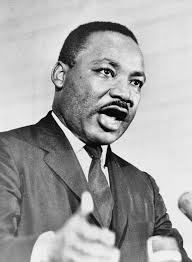
Martin Luther King, Jr. speaking out for freedom.“Is this not the fast I choose: to loose the bonds of injustice, to undo the thongs of the yoke, to let the oppressed go free, and to break every yoke?”

I’m studying Isaiah 58 right now. These are the words of the Lord spoken through his prophet. (That’s what prophets do, you know.)

This week is the 50th anniversary of the March on Washington where Martin Luther King, Jr., caught up in the Spirit, deviated somewhat from his prepared text and spoke about his dream. A dream where people were judged on character, not on skin color.

I was only a kid, living in a small village where everyone was either of German or Irish descent (read “white”)–well, except for one “hillbilly” family that moved in, and they were white. I never knew a black person until I was in college.

But for some reason, I was haunted by images of Ku Klux Klan cross burnings and murders. I can still remember nightmares that there was a local branch (don’t think there ever was–we didn’t have black people, but we did have a secret society of which my dad was a member called the Masons). I feared that they found out that I was pro civil rights and surrounded our house.

Later while I was in college, I endured much teasing about my civil rights stance (I still lived in town and drove 40 miles each way to college to save money since I was now mostly paying my own way). I remember driving through Mississippi to Louisiana in 1970 when I entered graduate school at LSU. Had an equal rights decal on my car. Arrived and then had the thought, what if my car had stopped in the piney woods? Still, I’m white. Not as bad as if I were not.

Progress toward freedom

There has been a lot of progress over the last 50 years. Like all human social change, there were cycles of success and cycles of regress. Many things are better for people of different colors, ethnicities, even gender. Many people have been set free. The leadership of Christians was an example to me that maybe the Christian church wasn’t all bad.

But we still have far to go.

Jesus understood. As have many spiritual people throughout human history. That passage from Isaiah is probably 2,800 years old. Yet, until we all change our hearts and begin to truly worship the one God, then we will not have the justice God demanded so long ago.

My Security Lies in Jesus

July 22, 2013

I’m still thinking about fears, worries. Although I try to capture a personal theme from the mascot of Mad magazine (I have not read it for years, but it was one of my favorites as an adolescent), Alfred E. Neuman, who said, “What!? Me worry?”

As an aside, we think American politics are bad now–good ol’ Alfred garnered several votes for President in 1968.

It is oh, so, predictable that race is part of the discussion of the whole Zimmerman affair. Conservatives seem to try to downplay race. Liberals seem to play it up. I keep returning to the words of Martin Luther King and wish we could move beyond race.

Unfortunately, we cannot. I think that this is not only an American problem.

Race remains an underlying tension. Many black men have told me about hearing car door locks being activated as they cross the street. I recently heard about a conversation at a gathering of “respectable, white, Christian” ladies where they quite frankly ascribed bad qualities to black people as an entity all the while disclaiming “I am not a racist.” Sorry, they are.

For black people, then, the issue becomes personal. Many have experienced the slights and innuendos. For most of us “white” people, the issue is theoretical. I wish it would go away, but it lingers.

Fear for your life had to be prevalent in Jesus’ time. He took as subjects for his stories things that people would readily understand. When he told the story of the Good Samaritan, there did not seem to be a reaction about the violence of the robbers. They all traveled from city to city in groups for protection. At the end of the Gospels, we learn that Peter carried a sword. Nothing is made of that simple fact–only in his use of it. I guess they needed some protection at times.

Jesus taught us that security really comes through Him and life in the Spirit.

For some reason in all our discussions in public life and private devotions, we keep losing our focus on the real source of life and security. Paul writing in Galatians further told us that if we are free in Jesus’ grace, why slip back into the old life of rules and worry.

Indeed.

No Freedom Without Constraints

November 13, 2010

I was listening to, of all things, a podcast of a speech on computer programming. The speaker brought in illustrations from literature, among other things. The basic point was that you have freedom to create only when you are focused by constraints. You have freedom to creatively express your thoughts once you choose a form–for example, writing in haiku or sonnet forms comprises a constraint, but it also frees your mind to express your thought.

Adolescents are fond of trying out the idea of freedom of action without constraints. When I observe people, I sometimes think that there are way too many adults who have not progressed beyond those adolescent urges. Too many choices leads to chaos, while narrowing your options leads to freedom.

God is wise in these matters. Once again, the adolescent mind says, “I should be free to do whatever I want. There should be no constraints on my thoughts and actions.” But God says, “If you live within the constraints that I have established for a good and fruitful life, then you will truly achieve freedom and life.” It’s a little like a paradox.

You have to experience it for yourself in order to understand the truth. But subduing your emotional reactions to events and your adolescent urges to satisfy every sensual desire, enables a life with God where you are free to change your life and the lives of those you meet.

If you live a life in nature, you will be tossed from emotion to emotion, desire to another unfulfilled desire. But if you live a life in the Spirit, then you bring focus and attention to your life and you are free to live a fulfilled life of peace, joy and service.