Archive for the ‘Disciplines’ Category

Beware the Yeast of the Pharisees

November 16, 2016

mind-map-mark-yeast

Still considering Jesus’ seemingly off-hand comment “Watch out–beware the yeast of the Pharisees and the yeast of the Herodians.”

Reporters didn’t follow Jesus around recording every word he said in hope of a “gotcha” moment where they could make him look bad. That type of “journalism” (and I use the word loosely) only happened recently in history.

No, the gospel writers took these little vignettes and recorded them because they moved their stories forward. So consider that whenever they record a comment, it is important.

So, we were looking at the spiritual meaning of the sentence, since Jesus obviously points us to the spiritual significance later.

Considering we–as in each one of us–are the “dough” in the story. And consider that yeast is a reactive agent that enters the dough, permeates throughout it, and then creates a chemical and physical change in the dough.

As we are the dough, and we are to beware letting the “yeast” of the Pharisees into us, then what does that mean?

Let’s look at how the Pharisees are represented in the gospels. They are rule followers. Empty on the inside. Remember the metaphor of the cup–clean on the outside and corroded on the inside?

Or seekers of loopholes–that is how all of us rule-followers are. How can we make the rules favor us rather than someone else?

Or lovers of comparison. “Lord, I thank you that I am not like that sinner over there.”

When we allow these thoughts and attitudes to permeate us, then our entire being is changed.

We are no longer kind, empathetic, loving, serving people of God–the sort of people who inherit the Kingdom. We become negative, cynical, separate, hard-hearted.

Perhaps we think back to Paul’s description of people of the flesh and people of the spirit in Galatians. Which do we want to be? Beware the yeast of the Pharisees lest it change your character!

Listening With Our Entire Mind As A Spiritual Discipline

November 15, 2016

Did you ever hear what someone said and not understand what was meant? Sometimes someone you know assumes a background and just makes a comment. You hear it and think it applies to something totally different.

What if you were a friend of Jesus back in the day? He was full of those comments. You knew that when he said something it had spiritual reference. But, still….

One day after coming up with a way to feed 4,000 people by miraculously coming up with truckloads of bread manufactured from only a few loaves as the “raw material,” Jesus was riding in the boat with his buddies.

He says, “Watch out–Beware the yeast of the Pharisees and the yeast of the Herodians.”

Do they let the spiritual significance of this comment sink in? Noooo. They are still thinking about all that bread they fed the crowd with and where in the heck it came from.

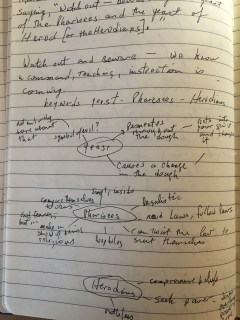
mind-map-mark-yeast

When I’m studying a section that obviously needs some thought, I like to make a mind map. This is a quick one I sketched out in my journal. There were three key words–yeast, Pharisees, Herodians. So, I mapped out a bunch of descriptions of the three and then tried piecing it together. [By the way, I have a prettier app for the Mac and iPad–MindJet Mind Manager. It’s a great way to outline thoughts and brainstorm.]

Of course, the disciples were caught by surprise. Then didn’t have it written. It was a quick comment.

Yeast can mean a number of things. I read once that it is a symbol of evil. But I thought it likely to look at two characteristics–it permeates through the dough and it causes change.

Pharisees? Well, they represented the religious elite who thought that behavior could be changed through laws and the legal system. And in this manner, they could prove they were better than “sinners” because they followed the law. Jesus usually poked at them.

Herodians? They were the political elite. Ruthless exercise of power was their characteristic.

If the dough is us, then think it through.

Augmented Reality or Distorted Reality

November 14, 2016

I put on the pair of magic glasses. Immediately I was transported to a magic land of another reality. I saw things floating in front of me. I could walk around objects and view them from every angle, but I couldn’t touch them.

There was a white dot. I focused on the dot and brought my hand up to eye level forming a fist with fingers on top. Then I opened my fist like a jasmine bud you drop into hot water to make fragrant tea. And a computer screen appeared before my eyes.  I raised a finger, pointed to a button, brought my finger down and then back up as if clicking. And a machine started.

No, I had neither smoked something or injected something. (Although people suspect that in my days at university… well that’s another topic for another day!)

Perhaps you’ve seen the TV ads for the Samsung phone with Virtual Reality (VR) goggles? I was wearing a real product–the Microsoft Hololense. This is Augmented Reality (AR). I could see people. I could see the actual machine in the second scenario. I controlled the fan speed of the real machine without touching anything. People watching would only see me waving my hand.

Last week I was in Atlanta at a trade fair sponsored by an industrial technology company–Rockwell Automation. At a stand called modestly enough The Future of the Connected Enterprise, they showed these working examples of AR in a manufacturing setting.

This being a spiritual discipline blog and not a technology blog (you can find mine here), I contemplated reality this morning. We often say that others live in a “distorted reality field,” that is, they couldn’t see reality if it raised up and kicked them. They think they are perfect, their kids are perfect, that nothing is going wrong. Or they live firmly in the belief that other people are going directly to hell (I guess that would make heaven a lonely place).

And I thought about how Jesus time and time again held a sort of mirror up to people–Pharisees, the rich young man, his disciples–and tried to get them to see beyond their VR or AR point of view to the reality behind.

Just now reading through Mark, I thought about this story where Jesus commented to his disciples to beware the yeast of the Pharisees and the yeast of the Herodians. They started to speculate that he said that because they had no bread to eat. Jesus said something to the effect of “put on your spiritual reality glasses and see the spiritual meaning of my comment.” He did that all the time, didn’t he?

What sort of glasses are we wearing today? VR, AR, or SR?

Productivity-First Admit Your Human Weaknesses

November 11, 2016

Pro-Tip: Productivity becomes much simpler once you accept your weaknesses as a human being.

I wish I were more productive. How about you?

The Podcast is a weekly conversation between Michael Sliwinski and Radek Pietruszewski about the things we’re interested in and passionate about. Michael developed a productivity app and a company called Nozbe. It is based on the ideas of David Allen expressed in Getting Things Done-The Art of Stress-Free Productivity.

“Continuing our discussion about morning routines, we talk about how we design our week to make productivity easy.” As they discussed the topic, they hit on a great sentence.

It sounds like the 12-Step program of Alcoholics Anonymous or the guide to spiritual formation found in the book of Romans in the New Testament. Well, those ideas have been tested for years and proven to work.

I guess that’s just what I need to boost my productivity just a little.

Where do I fall short? Do these things bring a pang of conscience to you?

  • Do not find my best working time of the day
  • Do not get up in the morning at a regular time (early enough to get started)
  • Do not have a morning routine that gets me into the groove (see the link above)
  • Do not focus on getting one task done at a time
  • Waste time by immediately checking email, Twitter, Facebook, Instagram
  • Am not sure what to work on next
  • Have not assembled the best tools for the job at hand

Peter Drucker once said something to the effect that management is getting things done and leadership is doing the right things.

Therefore, as we look at where we fall short on a daily basis, there is a longer term view. We also fall short in deciding (for me the week between Christmas and New Years is the time dedicated to this process) what we want to be in the near future and longer term future.

Then we fail to set aside time every month to track progress. Are we becoming the person we want to be? What do I need to do this month?

Then there is the most important part. The weekly review. What have I done this week that furthered my goals? What opportunities have I missed or neglected? What are the three most important tasks for me to work on this week?

All the tips are great. However, every day I meet someone who thinks they are productive–and they are in reality far from it.

We all live in the land of self-delusion. Sometimes (at least once per day) we need to pause and consider where we fall short. Then we can wake up and get to work.


Those Who Do Such Things Will Not Inherit

November 10, 2016

Now the works of the flesh are obvious: fornication, impurity, licentiousness, idolatry, sorcery, enmities, strife, jealousy, anger, quarrels, dissensions, factions, envy, drunkenness, carousing, and things like these. I am warning you, as I warned you before: those who do such things will not inherit the kingdom of God. — Paul writing to the followers in Galatia

Let’s be honest with ourselves. Did we read through that list of works and think about each word? Or did we just glance through thinking, “Oh, joy, another one of Paul’s lists. I don’t do any of those, so I can skip this part.”

I haven’t slept with women outside of marriage. (What was it that Jesus said about looking at another woman with lust in the heart? Oh, never mind.) I haven’t tried to predict the future (sorcery) through some magic (statistics?). Hmmm. Did I get angry? Well, it was justified. He was an idiot. Did I create dissension in the community? I’m certainly not jealous of anyone–except I do look at the catalogs and dream of being like the models pictured there.

Paul was discussing freedom. How do we handle freedom? Are we mature and responsible? Or, are we adolescent, rebellious, do-whatever-we-want types of people?

Honest now. What have you posted on Facebook or Instagram or whatever this week? Did you try to be funny or cute? Was it really funny? Or did it degrade another human being loved by God from an attitude of moral superiority?

It is so easy to look at this list and think it’s about other people. It’s not about other people. It’s about all people–including me, including you.

I don’t think we understand Paul’s answer in the next paragraph about the fruit of the Spirit until we digest and take responsibility for our own participation in the works of the flesh.

We can listen to John Adams’ admonition about the American experiment with democracy that it only works with a moral society and think it only applies to other people.

When we understand our participation in the works of the flesh, then and only then can we really start to live into the fruit of the spirit.

Love, joy, peace, patience, kindness, generosity, faithfulness, gentleness, and self-control. To paraphrase a famous movie line, “I want what she’s having.” I’m wondering if this isn’t one of those things we should read early each morning to get our mind focused correctly for the day.

The Only Thing That Counts

November 9, 2016

You know the type. We all know the type. Unless you are that type, then maybe you don’t recognize it at least in yourself.

One kid like this exists in every classroom. At least one kid. And in church… sometimes an entire church is filled with them. And in other organizations, as well. And in families.

That is the person who knows all the rules. And follows them. To the letter. Other kids in school hate that kid. Or, at least they don’t like them too much. These people love to point out to everyone else what the rules are. “You’re not supposed to do that.” Or “I’ll tell the teacher.” Or “You’ll roast in hell for doing that.”

The Apostle Paul started some fellowships of Jesus-followers in what today we call central Turkey. These were loving, joyous, giving  communities.

Then some strangers rode into town. They taught that these people needed to follow the law before they could be so joyous and loving. In fact, maybe it breaks the laws to actually be joyous and loving.

The particular law that those ancient teachers brought to the people in Galatia was the law of circumcision. They taught that first you had to earn the right to know God, and only then could they call themselves followers.

Paul told his friends that listening to that teaching would end their freedom in Jesus. He said that as soon as you follow one law, then you have to follow all the laws. Except he had already taught them that following all the laws in order to earn God’s favor was impossible. That’s why Jesus came–lived, died, and then lived again.

Paul said, “For in Christ Jesus neither circumcision nor uncircumcision counts for anything; the only thing that counts is faith made effective through love.”

Paul just taught what Jesus taught, “You’ll know my followers by their love.”

We need fewer “Church Ladies” and more followers. Can we ditch the rule following bias we have and just open ourselves up to finding the freedom to act in love? “Against such there is no law.”


Freedom Must Be Lived In Terms of Responsibleness

November 8, 2016

Freedom is not the last word. Freedom is only part of the story and half of the truth. Freedom is but the negative aspect of the whole phenomenon whose positive aspect is responsibleness. In fact, freedom is in danger of degenerating into mere arbitrariness unless it is lived in terms of responsibleness.
Viktor E. Frankl, Man’s Search for Meaning

Viktor Frankl knew something about freedom–and being deprived of it. He was incarcerated in a Nazi concentration camp in World War II.

He watched people react in the face of great deprivation and facing death. He discovered that the key to survival from a mental health perspective was having meaning in life.

He also saw the reaction to freedom.

I’d have to imagine he’d be cringing at the attitudes of people over the past few years who keep screaming for freedom–as in leave me alone so I can do what I want to do–with no companion thought of responsibility. Or to paraphrase an old movie, “Responsibility? I don’t need no stinkin’ responsibility.”

Jesus often set people free. And usually he gave them something to do, some responsibility.

He was walking one day and ten guys with very serious and debilitating skin diseases approached him. Jesus had sympathy. He said, “Go and show yourself to the priests and you will be made clean.” (You had to have a priest certify your ritual cleanliness so that you could be admitted back to the community.)

They did this with great joy and were healed. Healing… responsibility.

That story has a peculiar ending for us to ponder in this racially charged era we find ourselves in.

One of the ten came back to thank and praise Jesus. One! And that one–he was a Samaritan, a person of a different “race.” That story was designed to rock the world of the Jewish listeners. What!? The good guy is not one of us?

Unless we become responsible people, our freedom degenerates into self-absorption.


Evaluating Leadership By The Wake It Leaves

November 4, 2016

Dr. Henry Cloud was recently asked about success and how to achieve it.

Although there is much room for definition of the word, Cloud noted that you need to be competent at something. Go out and learn a skill at something. Then there is the ability for forge and maintain relationships. Building a network of people you can call on.

And he talked about character. He mentioned the Hebrew word translated as virtue in the Bible has the connotations of force. It is as if a leader is a force in the organization.

boat-wake

It’s like a boat going through a lake. It leaves a wake. There are two sides to the wake as it fans out if the boat is moving correctly.

Just so, a successful person is a force leaving behind results and relationships in its wake.

Think of leaders you’ve known who perhaps show results but leave behind a trail of broken relationships. It is symptomatic of a boat going around in circles. Where lies success?

Sometimes we work on building relationships but have no results. Once again this is an unbalanced situation. The organization will fail. The business will close.  But you’ll all be happy–for a while.

Worse is the situation where results are poor and relationships broken. It’s like a boat “dead in the water.” Success is but a dream.

Show me a person of strong moral character who leaves good results and firm relationships in the wake, and I’ll show you success.

It’s Not Freedom From, But Rather Freedom For

November 3, 2016

Freedom’s just another word for nothing left to lose.  Kris Kristofferson, Me and Bobby McGee

Kristofferson had just lost his girlfriend as Bobby McGee disappeared one night growing tired of their nomadic life. Now he was free. But for what?

As we were checking out what Paul was saying to the disciples in the Galatian provinces yesterday, we found that Paul said we were free. Free from the burden of following the law. But we were also warned about what not to do and to do. Don’t engage in self-indulgence, but rather love your neighbor.

I researched for a book on freedom when I was in grad school. Built a Website called Spirit and Freedom. Never finished either one.

But I was fascinated by the differing ideas on freedom. Some say, “I’m free from the law, now I can do anything I want.” Others say, “I’m free from the law, now I can live a fulfilled life in service to others.”

Freedom from….Freedom for.

Which have you chosen?

Paul describes the two paths.

On the one hand, the self-indulgence one, one finds

  • fornication
  • impurity
  • licentiousness
  • idolatry
  • sorcery
  • enmities
  • strife
  • jealousy
  • anger
  • quarrels
  • dissensions
  • factions
  • envy
  • drunkenness
  • carousing

On the other hand, we find

  • love
  • joy
  • peace
  • patience
  • kindness
  • generosity
  • faithfulness
  • gentleness
  • self-control

Then he concludes this last list–“There is no law against such things.”

What!? If we live like that last list, we don’t have to worry about being arrested?

Kristofferson doesn’t really say what happens with the new-found freedom. Mostly wishes for the good old days, I guess.

We can look at these two lists, though, and decide daily–which will be the way we use our freedom?

Freedom But Not Opportunity For Self-Indulgence

November 2, 2016

For you were called to freedom, brothers and sisters, only do not use your freedom as an opportunity for self-indulgence, but through love become slaves to one another. For the whole law is summed up in a single commandment, “You shall love your neighbor as yourself.” If, however, you bite and devour one another, take care that you are not consumed by one another. –Paul (Letter to the Galatians)

Three sentences. So much wisdom packed into them.

For those who wished to get right with God or the gods at the time of Paul, the work was all on you. You had to do things to make the gods happy with you. If you were Jewish, that meant following each one of the 600+ laws. Every minute of every day. You had to be worried about breaking a law. Other gods had their requirements.

Then Jesus came and set us free from worrying about following laws and doing things to earn God’s favor. In fact,  we can’t earn it, he said. But, God will grant us his grace if we but believe.

So, we have gained freedom. To this day, people everywhere are hoping to gain their freedom however it is defined in their culture.

But Paul knew. Like little children who first taste freedom, we take that freedom as permission to do whatever will satisfy our desires. That is why Paul teaches not to use freedom as an opportunity for self-indulgence.

We see results around us. Jails and prisons are full of people who went too far and then lost their physical freedom. Therapists and counselors are kept busy with the emotional/psychological results of too much freedom spent too freely.

People throughout the centuries have hated that word “slave.” They thought it taught weakness. Loss of freedom. They are wrong.

Paul shows us the alternative. To be successful at life, we use our freedom to help others. It is the spiritual lifestyle.

It is also practical. We know–and teach–in business and marketing to focus on solving a problem for our customers. Make the customer’s problem our problem. In that sense, we are becoming a “slave” to our customer.

If we are in a family, group, organization where everyone is a servant, then we have a successful experience. Life in the Spirit trumps living in self-indulgence.