Posts Tagged ‘Faith’

Spirit and Action, Can’t Have One Without the Other

September 6, 2013

I’ve been reading and contemplating Isaiah 58. Past posts have quoted extensively. One concept has been made clear with this reading–God directly links the spiritual pursuit of Him with ethical actions toward others.

If we think clearly, we remember that Jesus did the same thing. Almost all the time he linked spirit and action.

I devoted years to spiritual pursuit through meditation and contemplation. The goal was to find God. Experience God. And I did. And the experience is fantastic. But all the while I remembered two of my spiritual heroes–St. John of the Cross and St. Teresa of Avila. They left us with some supreme spiritual writing and advice. They also worked hard at reforming their religious orders at a time when people began to notice the corruption within the organization of the Catholic Church.

Spirit plus Action.

Last night I was catching up on my podcast queue while driving home from the Chicago area. Caught this TED Talk by Kelly McGonigal. She is a psychologist who studied stress. Once she believed that all stress was bad for you. Then she discovered some research that suggests that stress may only be bad for you if you believe that to be the case. She urges us to see stress as a positive, and introduces us to an unsung mechanism for stress reduction: reaching out to others.

Turns out that by helping others a hormone is released that not only affects the brain to increase your awareness, but also there are receptors in the heart for this hormone (oxytocin) where the hormone actually helps rebuild the heart.

And you can use the two meanings of heart in English–the actual organ and compassion. The effect of oxytocin in the brain is to cause you to want to reach out to others in times of stress–either yours or theirs. When you do that it impacts your own heart positively.

I know that there are many Christians (and people from other religious traditions) who are skeptical of science. But the more I study science and the intricacies of the relationships of all the components of life, the more I am in awe of the God who created everything.

Use your heart to help your heart.
God’s Logic

September 4, 2013

When we program computers or other digital devices, an essential logical statement is “if…then” or sometimes “if…then…else”. If the user taps the app icon, then open the app (else return to home screen).

This is akin to cause and effect. If you do something, then something will happen to (or for) you.

This logic is not new. 2,800 years ago Isaiah said these words to the people of his nation:

Is not this the fast that I choose:

to loose the bonds of injustice…

Is it not to share your bread with the hungry,

and bring the homeless poor into your house…

Then your light shall break forth like the dawn,

and your healing shall spring up quickly.

Isaiah 58 is written as poetry. One technique poets use is repetition of an idea using different images or words.

If you remove the yoke from among you,

the pointing of the finger, the speaking of evil,

if you offer your food to the hungry

and satisfy the needs of the afflicted,

then your light shall rise in the darkness

and your gloom be like the noon-day.

Didn’t get the idea? Then try a third time:

If you refrain from trampling the sabbath,

from pursuing your own interests on my holy day; …

then you shall take delight in the Lord,

and I will make you ride upon the heights of the earth…

Our actions have effects. They affect us. They affect others. Either for good or for bad.

Be careful what you do and say. Everyone is watching. Especially God.

True Worship

August 30, 2013

My wife and I were discussing church doctrines last night over dinner. Well, not in depth. But someone asked her about the doctrine of a certain denomination of Christian church. She was at a bit of a loss to explain it.

I thought a little, and the many variations of denominations flashed through my mind. Mention Baptist–but there are more than 57 varieties of Baptist. There are at least three variations of Lutheran of which I’m aware–and two Presbyterian. The Disciples of Christ broke away from the American Baptists a long time ago because someone thought the Bible taught to have communion every week.

It struck me how each of these took a bunch of verses from the Bible, seemingly at random, and strung them together into a doctrine. To me, many of those are misreadings often caused by lifting verses out of context or not understanding the reference.

Then I thought (sometimes maybe I do too much of that) about how these denominations and the people in them fight all the time. People get mad and leave, only to go to another denomination and begin the process again.

Then I returned to my study of Isaiah 58.

Look, you serve your own interest on your fast day,

and oppress all your workers.

Look, you fast only to quarrel and to fight

and to strike with a wicked fist.

How often that’s what we do today! And not just Christians. Check out the other two religions that grew from Abraham’s worship of the one true God–Judaism and Islam. We all gather to serve our own interests. We seem to gather to quarrel and fight.

That’s not what God said in the Old Testament 2,800 years ago. That’s not what Jesus taught 2,000 years  ago. Again from Isaiah 58,

Is such the fast I choose,

a day to humble oneself?

And,

Is not this the fast that I choose:

to loose the bonds of injustice,

to undo the thongs of the yoke,

to let the oppressed go free,

and to break every yoke?

Is it not to share your bread with the hungry,

and bring the homeless poor into your house;

Humble means to think of others before yourself. And think of God first. Leaders, take the lesson. All of us, let’s remember the source of life. “You shall love the Lord your God…, and your neighbor as yourself.”

Why don’t you hear us, O God?

August 28, 2013

Why don’t you hear us, O God?

A teacher was speaking. I made a hurried note, because I was driving across rural northern Indiana at the time. “Read Isaiah 58” was all I noted.

So I returned home late last week, opened to Isaiah 58 in the Kindle app on my iPad and began reading. What a great passage. A preacher could easily develop a sermon series from this passage.

I’m going to contemplate this for a while. So, pull out that old Bible and read it to prepare for a few meditations.

Isaiah, speaking God’s words to his people, answers the question I began with. But, to start at the beginning…

“Shout out, do not hold back!

Lift up your voice like a trumpet!

Announce to my people their rebellion,

to the house of Jacob their sins.”

This is God talking to Isaiah. He’s encouraging his prophet to speak. In fact, not just to speak, but to do so dramatically. What is it he is to speak? It’s about how the people have stopped doing the Lord’s will–what the Lord wants.

Before we condemn those people of 2,800 years ago when Isaiah preached, we can think of ourselves.

“Click and Clack, the Tappet Brothers” (if you followed “Car Talk” on National Public Radio) talk of the famous “dope slap.” That’s when you’re acting like a dope or said something stupid and somebody (maybe even yourself) slaps you on the side of the face. You dope.

That’s a little crude, but it’s what Isaiah is doing to the people of his nation. He’s saying something like, “Wake up people. You think you are so good, but you’re not. Oh, and here’s why.”

Probably all of us need one of those “dope slaps” every once in a while. Usually just when we think we’re so smart, or so good, or so wise, or so beautiful.

Has someone tried to give you a verbal dope slap recently? Did it wake you up? Or did it miss the mark?

To Let The Oppressed Go Free

August 26, 2013

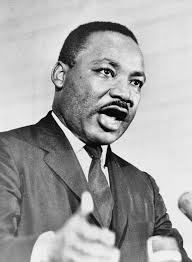
Martin Luther King, Jr. speaking out for freedom.“Is this not the fast I choose: to loose the bonds of injustice, to undo the thongs of the yoke, to let the oppressed go free, and to break every yoke?”

I’m studying Isaiah 58 right now. These are the words of the Lord spoken through his prophet. (That’s what prophets do, you know.)

This week is the 50th anniversary of the March on Washington where Martin Luther King, Jr., caught up in the Spirit, deviated somewhat from his prepared text and spoke about his dream. A dream where people were judged on character, not on skin color.

I was only a kid, living in a small village where everyone was either of German or Irish descent (read “white”)–well, except for one “hillbilly” family that moved in, and they were white. I never knew a black person until I was in college.

But for some reason, I was haunted by images of Ku Klux Klan cross burnings and murders. I can still remember nightmares that there was a local branch (don’t think there ever was–we didn’t have black people, but we did have a secret society of which my dad was a member called the Masons). I feared that they found out that I was pro civil rights and surrounded our house.

Later while I was in college, I endured much teasing about my civil rights stance (I still lived in town and drove 40 miles each way to college to save money since I was now mostly paying my own way). I remember driving through Mississippi to Louisiana in 1970 when I entered graduate school at LSU. Had an equal rights decal on my car. Arrived and then had the thought, what if my car had stopped in the piney woods? Still, I’m white. Not as bad as if I were not.

Progress toward freedom

There has been a lot of progress over the last 50 years. Like all human social change, there were cycles of success and cycles of regress. Many things are better for people of different colors, ethnicities, even gender. Many people have been set free. The leadership of Christians was an example to me that maybe the Christian church wasn’t all bad.

But we still have far to go.

Jesus understood. As have many spiritual people throughout human history. That passage from Isaiah is probably 2,800 years old. Yet, until we all change our hearts and begin to truly worship the one God, then we will not have the justice God demanded so long ago.

My Security Lies in Jesus

July 22, 2013

I’m still thinking about fears, worries. Although I try to capture a personal theme from the mascot of Mad magazine (I have not read it for years, but it was one of my favorites as an adolescent), Alfred E. Neuman, who said, “What!? Me worry?”

As an aside, we think American politics are bad now–good ol’ Alfred garnered several votes for President in 1968.

It is oh, so, predictable that race is part of the discussion of the whole Zimmerman affair. Conservatives seem to try to downplay race. Liberals seem to play it up. I keep returning to the words of Martin Luther King and wish we could move beyond race.

Unfortunately, we cannot. I think that this is not only an American problem.

Race remains an underlying tension. Many black men have told me about hearing car door locks being activated as they cross the street. I recently heard about a conversation at a gathering of “respectable, white, Christian” ladies where they quite frankly ascribed bad qualities to black people as an entity all the while disclaiming “I am not a racist.” Sorry, they are.

For black people, then, the issue becomes personal. Many have experienced the slights and innuendos. For most of us “white” people, the issue is theoretical. I wish it would go away, but it lingers.

Fear for your life had to be prevalent in Jesus’ time. He took as subjects for his stories things that people would readily understand. When he told the story of the Good Samaritan, there did not seem to be a reaction about the violence of the robbers. They all traveled from city to city in groups for protection. At the end of the Gospels, we learn that Peter carried a sword. Nothing is made of that simple fact–only in his use of it. I guess they needed some protection at times.

Jesus taught us that security really comes through Him and life in the Spirit.

For some reason in all our discussions in public life and private devotions, we keep losing our focus on the real source of life and security. Paul writing in Galatians further told us that if we are free in Jesus’ grace, why slip back into the old life of rules and worry.

Indeed.

Worry is a form of useless fear

July 19, 2013

Had a conversation yesterday that send my mind on a time trip remembering my mother. She was a worrier. I think she worried herself to death.

The guy who “styled” my hair back in the 70s told me, “I’m a worrier. All of us German immigrants are. It’s part of the genes.”

Worry is the fear of what might happen.

Most things that might happen, never do. Some things that happen, you have no control over. Rationally, there is little reason for worry.

But most of us do.

This goes along with yesterday’s meditation on fear.

We fear so many things. We worry about much.

Jesus said, why worry?

I was a child of my mother. But I changed. I seldom worry now. Just like I’ve conquered about 98% of my fearfulness.

How?

  • Deliberately choose something else to think about
  • Start to work on a project
  • If in the middle of the night, either set imagination on another topic–or–get up and read the Bible, a good novel, your Mandarin Chinese lesson
  • Work though the one think among your worries that you can control and develop a project list of tasks to cover it.

Viktor Frankl, psychologist, developer of Logotherapy, survivor of a Nazi concentration camp, discovered it for himself, “The ultimate freedom is the freedom to choose my attitude in the face of uncertain circumstances.”

How Shall You Live, In Fear or In Peace

July 18, 2013

I’ve been a little under the weather this week, with the net result a night in the hospital for some observations. Going well, but this all gave me some time to ponder some current events in the US.

A man in our small group Tuesday responded to a question about how shall we live with, “In peace.”

That comment was a perfect complement to my thinking about the Zimmerman case specifically and a more general problem in this country. For my many international readers (you may know this better than I, in fact) the Zimmerman case which was just concluded involved a private citizen on a neighborhood watch patrol who brought a weapon along for company. He saw a hooded figure and shot said hooded figure, who later died. I think those are the basic facts.

I cannot comment on motives, whether race was a factor, what the confrontation really was, who started it, and all the rest. I don’t read those news stories–which are pretty much all speculative anyway.

I can imagine fear playing the main supporting role in the drama, though. I have talked to many people (and seen the Facebook posts, among other things) who have weapons for “protection.” And I talk with and observe many more.

The common theme is fear. There are varying degrees, but that is the core.

I understand fear–at least on some levels. Have you ever felt as if you are being attacked or threatened? Not only physically, but maybe your job or your position or something? It has been years for me, but I remember. And I remember that I responded with anger. And the anger escalated.  I’ve observed it on the soccer pitch, as well.

We can Jesus is the antidote. But that is too easy. What is it about Jesus that brings the antidote. It is “the peace that passeth all understanding.” You can live with-God daily in peace–or you can live a shriveled life in fear. What’s your choice?

Sickness of the soul

February 24, 2011

Do we talk much about the soul anymore? After 90 years of “scientific psychology” (psychology was once called the “science of the soul”), have we tried to limit our discussions to physically observable phenomena?

The soul — if I may attempt a very brief description — is that part of a person that lives within our physical being, drives our personality, unites with or rebels from God, and lives forever. The care and feeding of the soul is probably our single most important task in life.

As I continue to read through Julian of Norwich, this passage jumped out at me this morning

God showed two kinds of sickness of the soul that we have:

-the one is impatience or sloth

-the other is despair or doubtful fear

I’m not sure which would be more prevalent for us today. We certainly want instantaneous results. Evidently people 600 years ago did, too. But I have to believe in this electronic age that we are even more impatient. And if we can’t get results right away (without working for them I might add), then we don’t want to bother working for them.

A woman I knew once was hiring young people for entry-level marketing positions. She was amazed. These young people would say “OK, I’ll do this for a year or so, but I expect to become CEO of this large company after a couple of years.” They didn’t understand the work and sacrifice it takes to be CEO–or to just improve as human beings.

Then there is the sickness of whining. “I can’t do it. Mom liked you better. I was never good enough.” These people are diverted from seeking God (remember her “seek, wait, trust”?).

She said later that it was easier to know God than to know ourselves. Unfortunately, the first step to healing these sicknesses, if you have one, is to be able to look at yourself, recognize the sickness and then work to heal it. Here’s a tip. If something is getting in the way of your prayer, study or fellowship life, then it is time to find that obstacle and work on it.

Will Divisive Arguing Kill the Church

February 23, 2011

When I wrote the post yesterday about making statements that kill a conversation, I didn’t realize I’d contemplate this thought from the author Donald Miller (Blue Like Jazz, Searching for God Knows What):

And on a side note, I am wondering whether the church in Europe decreased in size and impact because of loose, liberal theology, or because the church got divided and people got tired of the fighting. You never hear about that loose European theology, but you do hear a lot about bitter fights (historically, to the death) over theological squabbles. I think people just left the dinner party saying to themselves that they’d just rather find community at the pub. If the church dies in America, it wont be because of liberal theology, it will be because people don’t sense Christians actually understand or respect Jesus’ prayer in John 17. It goes without saying, then, that if they will know us by our love, they will also know we are not of God by our inability to acknowledge an individuals sovereignty.

He was talking about how so many of his friends do not attend church because they get tired of theological jabbing. The “if you don’t believe just as I believe you’re going to Hell” attitude. The people that speak up and then wonder why the energy just gets sucked out of a room.

You can’t base sociology on just a few people, but combining my study of history with comments European friends of mine have made over the years, I’ve got to agree with his comment. I know that I’ve grown tired of theological debate. It’s not about theology–it’s all about Jesus.

Oh, his prayer in John 17? He is praying for his followers as he is preparing to leave Earth. Part of the prayer goes, “And now I am no longer in the world, but they are in the world, and I am coming to you. Holy Father, protect them in your name that you have given me, so that they may be one, as we are one.”