Posts Tagged ‘Ethics’

Treat Everyone Equally

January 13, 2014

When most of you read this post, I will be in the air on my way to Mexico to visit the Tijuana Christian Mission. I’m going with three members of our church’s pastoral staff partly so that I can rejuvenate our mission ministry.

One of my small groups is studying James right now. As always, what we study seems to have immediate application. Twice early in his letter, James teaches on respecting everyone. Everyone in the community is equal before God. We should not feel either inferior or superior. We should not treat others as superior or inferior.

That’s one of the things I admire about Pope Francis, by the way. In an organization that retains most of the medieval trappings of power and authority, he is trying to bring some other traditional Christian teachings into the church.

I have traveled internationally enough to intentionally try not to be the “typical American.” But often I’m at engineering conferences. This is a different trip. I’ll be the only engineer. James’ teachings will be at the front of my mind. Although (probably as an American) I seldom recognize personally superiority or inferiority, going on a mission trip with the poor and dispossessed will be different, for sure.

James teaches two things early in his letter–respect for others and awareness of our own motivations. Nowhere does this come out as much as during travel into other cultures. Should be an interesting time.
So That You May Bear Fruit

November 1, 2013

“You may be filled with the knowledge of God’s will in all spiritual wisdom and understanding…”

Paul wrote to the Christ followers in Colossae that he prayed for this for the people. I know of people who think that this is the end of the sentence. The purpose of life is to be filled with spiritual wisdom and understanding.

Some of these people live as though they have achieved this state and this gives them permission to tell others about how they have not achieved such a state. They either implied or stated boldly that this made them better people.

Do you know people like that? I certainly do. And Jesus met them every day. Back then, they were called Pharisees. And he told many stories about how they were wrong.

How wrong? Well, Paul finishes his sentence, “so that you may lead lives worthy of the Lord, fully pleasing to him, as you bear fruit in every good work and as you grow in knowledge of God.”

So that! The end is not wisdom and understanding. These are only the foundation, the means, the tools, for living a life pleasing to God.

And what is a life pleasing to God? Paul tells us. “Bear fruit in every good work” and “grow in knowledge of God.”

What are good works? One story Jesus told was of a man beaten by robbers. Three men passed by him as he lay bleeding. Two were from the higher ranks of Jewish society–they did nothing (and they were listening as Jesus told the story). One was an outcast in the eyes of Jewish society–a Samaritan. The Samaritan took care of the man. That was a good work–as well as a teaching that our neighbor to be helped is whomever we find along the road of life.

Another good work comes from Jesus’ words at the end of the Gospel of Matthew where he tells us to make disciples. Preaching at people does little to no good. Helping them through example, teaching, love, mentoring to be like Jesus is what our work in life is.

What will be your so that today? Will you recognize it?

Spirit and Action, Can’t Have One Without the Other

September 6, 2013

I’ve been reading and contemplating Isaiah 58. Past posts have quoted extensively. One concept has been made clear with this reading–God directly links the spiritual pursuit of Him with ethical actions toward others.

If we think clearly, we remember that Jesus did the same thing. Almost all the time he linked spirit and action.

I devoted years to spiritual pursuit through meditation and contemplation. The goal was to find God. Experience God. And I did. And the experience is fantastic. But all the while I remembered two of my spiritual heroes–St. John of the Cross and St. Teresa of Avila. They left us with some supreme spiritual writing and advice. They also worked hard at reforming their religious orders at a time when people began to notice the corruption within the organization of the Catholic Church.

Spirit plus Action.

Last night I was catching up on my podcast queue while driving home from the Chicago area. Caught this TED Talk by Kelly McGonigal. She is a psychologist who studied stress. Once she believed that all stress was bad for you. Then she discovered some research that suggests that stress may only be bad for you if you believe that to be the case. She urges us to see stress as a positive, and introduces us to an unsung mechanism for stress reduction: reaching out to others.

Turns out that by helping others a hormone is released that not only affects the brain to increase your awareness, but also there are receptors in the heart for this hormone (oxytocin) where the hormone actually helps rebuild the heart.

And you can use the two meanings of heart in English–the actual organ and compassion. The effect of oxytocin in the brain is to cause you to want to reach out to others in times of stress–either yours or theirs. When you do that it impacts your own heart positively.

I know that there are many Christians (and people from other religious traditions) who are skeptical of science. But the more I study science and the intricacies of the relationships of all the components of life, the more I am in awe of the God who created everything.

Use your heart to help your heart.

Set Free The Oppressed

September 2, 2013

We are  observing a holiday in the USA. Labor Day. It’s a day set aside to remember the contributions of laboring people.

The concept and definition of “labor” changed dramatically over the course of the 20th century. The labor movement actually began in the mid-19th century. Originally the term referred to workers in manufacturing. These people were often almost slave labor for the factory owners. Various labor movements sprung up to organize workers. Much of the language used by unions today is derived from the early struggles.

By the end of the 20th century, engineers and managers, sometimes at the prodding of government regulators, had removed most of the hazards of working in plants. By the mid-20th century, factory workers could earn a middle-class income–although that changed beginning in the 1980s as relative wages plummeted due to many factors. But it’s still possible to earn a middle class income as a skilled technician and operator in a plant or factory today.

Management trends, such as the adoption of Lean which puts focus on the value of the individual, have also helped improve the situation for labor.

Oppression

Very early in the growth of manufacturing developed a “white hat” versus “black hat” mentality by people involved. Of course, who wore the “white” had and who the “black” depended on your point of view.

All this is not new, of course. Check out Isaiah 58–my current text for study and meditation.

God tells the people through Isaiah to set the oppressed free.

Is this not the fast (Spiritual Discipline) that I choose:

to loose the bonds of injustice,

to undo the thongs of the yoke,

to let the oppressed to free,

and to break every yoke?

If you are a business owner or manager, you will find it morally, ethically and financially rewarding to treat all the people in the company fairly. Treat them as fellow human beings who are children of God.

Since I have worked both as labor and management, I have trouble with the “black hat” / “white hat” way of thinking. I most often think in shades of gray. Some people are more trustworthy than others; but all people are worthy of my respect to the degree that their character demands it. For me, it is not us versus them, but rather “we.”

True Worship

August 30, 2013

My wife and I were discussing church doctrines last night over dinner. Well, not in depth. But someone asked her about the doctrine of a certain denomination of Christian church. She was at a bit of a loss to explain it.

I thought a little, and the many variations of denominations flashed through my mind. Mention Baptist–but there are more than 57 varieties of Baptist. There are at least three variations of Lutheran of which I’m aware–and two Presbyterian. The Disciples of Christ broke away from the American Baptists a long time ago because someone thought the Bible taught to have communion every week.

It struck me how each of these took a bunch of verses from the Bible, seemingly at random, and strung them together into a doctrine. To me, many of those are misreadings often caused by lifting verses out of context or not understanding the reference.

Then I thought (sometimes maybe I do too much of that) about how these denominations and the people in them fight all the time. People get mad and leave, only to go to another denomination and begin the process again.

Then I returned to my study of Isaiah 58.

Look, you serve your own interest on your fast day,

and oppress all your workers.

Look, you fast only to quarrel and to fight

and to strike with a wicked fist.

How often that’s what we do today! And not just Christians. Check out the other two religions that grew from Abraham’s worship of the one true God–Judaism and Islam. We all gather to serve our own interests. We seem to gather to quarrel and fight.

That’s not what God said in the Old Testament 2,800 years ago. That’s not what Jesus taught 2,000 years  ago. Again from Isaiah 58,

Is such the fast I choose,

a day to humble oneself?

And,

Is not this the fast that I choose:

to loose the bonds of injustice,

to undo the thongs of the yoke,

to let the oppressed go free,

and to break every yoke?

Is it not to share your bread with the hungry,

and bring the homeless poor into your house;

Humble means to think of others before yourself. And think of God first. Leaders, take the lesson. All of us, let’s remember the source of life. “You shall love the Lord your God…, and your neighbor as yourself.”

Having the Right Heart and Attitude

August 29, 2013

Isaiah is almost sarcastic at the beginning of Chapter 58:

Yet day after day they seek me

and delight to know my ways,

as if they were a nation that practiced righteousness

and did not forsake the ordinance of their God;

they ask of me righteous judgments,

they delight to draw near to God.”

I added the italics on “as if.” That phrase reveals the points to come. The people say they seek God, but there is something wrong. Wonder what it is?

“Why do we fast, but you do not see?

Why humble ourselves, but you do not notice?”

So the people are also asking of God what’s wrong. In our terms they are saying, “We go to church. We donated to the church. Why does it seem that you are against us?”

Look, you serve your own interest on your fast day,

and oppress all your workers.

Ah, now we have reached the point that God charges against them. Two points really. First, when they “fast” or worship, their attention is not on God. It is on themselves. They fast only to serve their own interests. Then look at the last phrase. We’ll study more on that later. I don’t think I’ve ever seen a spiritual teaching that does not also include a moral teaching–a teaching on the way we treat other people. Those seem to go hand-in-hand.

“What is the greatest commandment?” asked the teacher to the Teacher. Jesus replied with the Shema about worshiping the Lord. Then he said that the second commandment was as important as the first–to love your neighbor as yourself.

These people were thinking of ways to take advantage of people in their community even while worshiping God. This is abhorrent to God, the God who wanted to build a community focused on Him.

When I teach the Spiritual Disciplines, I always begin with the proper attitude. Simply practicing the Disciplines will do you little good. It begins with the right attitude.

Same with leadership. Beware this judgement of Isaiah in your practice of leadership. Take care of your attitude.

To Let The Oppressed Go Free

August 26, 2013

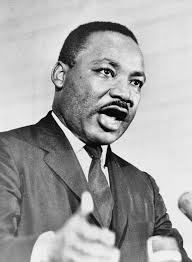
Martin Luther King, Jr. speaking out for freedom.“Is this not the fast I choose: to loose the bonds of injustice, to undo the thongs of the yoke, to let the oppressed go free, and to break every yoke?”

I’m studying Isaiah 58 right now. These are the words of the Lord spoken through his prophet. (That’s what prophets do, you know.)

This week is the 50th anniversary of the March on Washington where Martin Luther King, Jr., caught up in the Spirit, deviated somewhat from his prepared text and spoke about his dream. A dream where people were judged on character, not on skin color.

I was only a kid, living in a small village where everyone was either of German or Irish descent (read “white”)–well, except for one “hillbilly” family that moved in, and they were white. I never knew a black person until I was in college.

But for some reason, I was haunted by images of Ku Klux Klan cross burnings and murders. I can still remember nightmares that there was a local branch (don’t think there ever was–we didn’t have black people, but we did have a secret society of which my dad was a member called the Masons). I feared that they found out that I was pro civil rights and surrounded our house.

Later while I was in college, I endured much teasing about my civil rights stance (I still lived in town and drove 40 miles each way to college to save money since I was now mostly paying my own way). I remember driving through Mississippi to Louisiana in 1970 when I entered graduate school at LSU. Had an equal rights decal on my car. Arrived and then had the thought, what if my car had stopped in the piney woods? Still, I’m white. Not as bad as if I were not.

Progress toward freedom

There has been a lot of progress over the last 50 years. Like all human social change, there were cycles of success and cycles of regress. Many things are better for people of different colors, ethnicities, even gender. Many people have been set free. The leadership of Christians was an example to me that maybe the Christian church wasn’t all bad.

But we still have far to go.

Jesus understood. As have many spiritual people throughout human history. That passage from Isaiah is probably 2,800 years old. Yet, until we all change our hearts and begin to truly worship the one God, then we will not have the justice God demanded so long ago.

Can we accept redemption?

January 10, 2011

Paul writes to the Ephesians, “In him we have redemption through his blood, the forgiveness of our trespasses, according to the riches of his grace that he lavished on us.”

I am curious about this action of God. Actually, I’m more curious about how we, as humans, accept the redemption of others. Most of us probably live day-by-day not even aware that we ourselves are redeemed or forgiven by God. How many times have you sinned already today? Probably not really big ones, though. Right?

But how about the times you done some bigger bad things? Could you accept God’s forgiveness? Or, can you accept that God forgives others? I know that for some people healing from the sin of someone else takes forgiveness of the other to begin to heal.

I thought about this during the weekend when Michael Vick was about to play in an NFL football game in the playoffs. He participated in some barbarian activities using animals–he supported dog fighting. I know that this is a male diversion in many parts of the world. But we try to be more civilized here. We count that as a sin and have made it illegal.

However, Vick acknowledged his sin and spent time in jail–perhaps having to forgo a career worth perhaps hundreds of millions of dollars. But he served his time and emerged promising to turn his life around. And, so far, so good.
Many people hold Vick’s past activities against him and evidently believe that one should never be forgiven for past sins. God doesn’t feel that way–and we should all be eternally grateful for that. We are still accountable for our actions. If we but acknowledge our short comings, God is steadfast in his support of us. The least we can do is to act the same way to a fellow member of the human family.

Then we have the tragedy in Arizona. We know little about the young man who went “crazy” and started firing his automatic pistol at a crowd. But what a shame that someone, sometime ago, perhaps an older man in his life, couldn’t have provided some support. According to stories, many people were afraid of him. But, so far as we know, no one stepped in.

Maybe we should be even more watching for troubled souls who need a human to intervene and show God’s redemption so that they don’t have to take terrible action.

But this I know–I am grateful for God’s redemption, and I’m grateful when people turn their lives around for the better. Wish I could share that better.

Ethics Matter In Business and in Life

January 6, 2011

Does ethics matter? If you are a leader, do you realize the impact of your ethical decisions and lifestyle on your team and on your career?

Try the situation of US Navy Captain Owen Honors (see The New York Times article).

I bet there were sighs of relief in Oxford, Ohio, home of Miami University and the “cradle of coaches” in football, when the football coach they lost to Pittsburg University had a lapse of ethics and judgement and was arrested for allegedly physically attacking his ex-girlfriend and mother of his child. He was just over two weeks on the job at Pitt when he was summarily fired.

It really pays to think. We used to live in a world where ethical lapses of our leaders were quietly hidden by press relations and media. We live in a more transparent world now where instead of whispered rumors we have public information.
And it’s not just sexual ethics or restraining our violent side. There are tons of ethical decisions facing you every day. In my business, a big one is to not be bought off by advertisers, but to retain my independence and integrity. Not that we can’t be friendly, but I have to be watchful. What are the biggest temptations you face for taking the easy route? How do you handle them?

Free or Responsible Speech

October 23, 2010

In the U.S., there is a legal case pending before the U.S. Supreme Court on the First Amendment right of free speech. I don’t know many details–but it has something to do with a group of people who say they are Christians who are upset with something, so they chose to generate publicity for their cause by protesting outside funerals of  U.S. soldiers who had been killed in Iraq or Afganistan. The legal case involves the group’s first amendment right of speech versus the families’ fourth amendment right to privacy.

I’m not commenting on that–exactly. But I’d like to take a teaching from my new best friend, James. I think he would agree with me (although they didn’t have many of these legal “rights” in his day) that just because you have the right to do something doesn’t mean you should do it. The word “responsibility” creeps in here. You need to combine doing things with responsibility. I guess when we protested for civil rights and against the war in VietNam in the 60s, we didn’t dream to what extent that idea would spread. Now we have protests arranged mostly to generate publicity all over the place. (Another good reason to turn off TV news.)

James told us to watch our tongues, because that is one organ that can surely send us to hell. He also said just after his teaching on the tongue that wisdom from above is pure, peaceable, gentle, willing to yield, full of mercy and good fruits, without a trace of partiality or hypocrisy.

I think that list is one we should compare ourselves to. When is our speech not up to God’s standards of wisdom? How can we bring ourselves back to these attributes? Remember this list. Watch for when you stray. Then revisit the list and bring yourself back into God’s way.