Archive for the ‘productivity’ Category

Slow Productivity

March 14, 2024

Are you the type of person who is known for getting things done? Is yours the first name that comes to mind when someone in the organization needs a report written or a light bulb replaced? Is “no” a seldom used part of your vocabulary?

In other words, do you always feel busy yet not accomplishing the work that would most boost your career or inner peace?

These thoughts are not specifically about spiritual practice as much as just practice practice.

When you feel the need to focus on the things that really matter needing a way to say “no” more—or better stop being the name everyone thinks of first—then you need to dive into Slow Productivity: The Lost Art of Accomplishment Without Burnout by Cal Newport (author of Deep Work, A World Without Email, Digital Minimalism, So Good They Can’t Ignore You, and more).

Influenced through reading about the Slow Food movement in Italy, Newport thought about how our decades long obsession with productivity has led to what he calls pseudo-productivity—busy-ness just for the sake of appearing to be, well, busy.

He will show you a few calendar tricks to help you say “no” or at least something like “I’d be glad to help if you see where on my calendar I could get to it.” 

How do I get to Slow Productivity?

  • Do Fewer Things. 
  • Work at a Natural Pace. 
  • Obsess over Quality.

If you do what you’re supposed to do and do it well, how can anyone complain?
Get Out of Your Own Way

October 26, 2023

“Getting Things Done,” by David Allen swept through the ranks of knowledge workers twenty-some years ago. I actually have four of his books staring at me from my bookshelf. GTD, practitioners were called “GTD-ers”. 

People thought they would increase productivity exponentially (for the math challenged, that means by a lot).

They missed some of the points. The most important perhaps was clearing your mind. You need to cultivate a “mind like water,” that is, a mind that restores itself to tranquility soon after a random agitation. It’s what happens when you throw a pebble into a still pond.

You clear your mind by capturing your thoughts in a trusted place. This habit clears your mind—it no longer needs to keep it in random access memory.

Similarly, I just listened to executive coach and author Jerry Colonna talk about writing on his latest book during his annual two-month sabbatical (yes, he has taken a sabbatical that long for 20 years). He talked about productivity influencers instructing us to write 1,000 words/day. He was frustrated. Stressed. Then thought—I’m putting this stress on myself. Why don’t I get out of the way? Don’t stress. Get up. Write some. Go out and hike in the wilderness.

Maybe we have committee work. Or deadlines. Or wallboard repairs in the garage (oops, that’s mine).

Maybe we quit stressing about it. Write what needs to be done. Tackle these items serially. Don’t stress. When there’s an opportune time, work on it.

Cal Newport, author and computer science professor who wrote Deep Work, calls this slow productivity. I say develop workflows and just plug away at things without stressing over them.

Get out of your own way. Do what’s important. Rinse and repeat.

How Do You Get Things Done?

September 6, 2023

I try to stay on the positive side of looking for ways to live a meaningful life. Sometimes I let my observations of human behavior lead in a more cynical direction, but that’s just me.

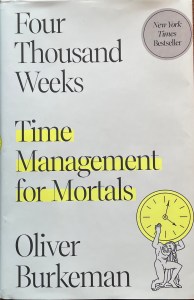
Rather than an illustration from the Bible I picked up an idea from an interesting English writer—Oliver Burkeman who writes The Imperfectionist blog and wrote the influential book Four Thousand Weeks: Time Management for Mortals.

Let’s say you go to a nice restaurant. They show you to a table. You and your guest are seated. They hand you an elegantly printed menu. You look over all the options presented and choose. Perhaps you choose an appetizer to start dinner. Then you choose a salad, an entre, and a dessert. Perhaps a bottle of wine to complement the meal.

Now, let’s change the venue. You are at your desk. You need to decide what to do next. You look at your to do list. You know, that list that never stops growing thanks to email and Slack and other computerized incoming enemies.

Do you just take the top item? Do it? Check it off? Then look at the next thing?

Do you look at the list and panic at its size?

How about your email? You read about “inbox zero” but know that it is an unachievable vision of heaven.

Burkeman suggests looking at these things like a menu. Ah, I’m presented with a fine list of options. Which shall I work on now? I will select this one first as an appetizer. Later I’ll select the entre.

Thank you, Oliver. Somehow I feel a little better about the whole productivity thing.

Productive or Effective?

July 27, 2023

Some economists and journalists looking for a passing story bemoaned statistics revealing a lack of productivity increase over a stated period of time.

Is this really a problem?

Whatever your job, whether in a business or church or other organization, do you feel that you have productivity metrics?

  • Number of meetings attended
  • Number of memos sent
  • Number of articles written

Maybe what is more important is fewer meetings that actually accomplish an objective. Maybe it is effective communication that clearly explains or motivates change. Maybe something written with more depth and less gloss.

Are you working on a really big and juicy problem? Those take time to solve. That may not look good on your productivity chart. It may be really important work.

Do The Next Right Thing

October 7, 2022

Sometimes we sit at our desk or stand in the middle of the room having just completed a task. We feel lost. What should we do? Where is our task list?

There is a phrase I’ve heard many times. It helps me focus when I’m either at a loss of what’s next or when there are so many pressures that I’m overwhelmed.

Do the next right thing.

This combines the command to do something with the moral imperative to do the right thing.

Now, our mind can operate to focus our attention.

Productivity Misconceptions

July 15, 2022

I still remember the theme of the first personal development speaker at the first management conference I attended–TRY…EASY.

Try to do a good job. Try to get it done. But don’t kill yourself doing it.

This was probably 10 years before Yoda told Luke Skywalker, “Do or do not. There is no try.” But that’s a different story.

That speaker gave all the attendees a DayTimer planner. I’ve been through so many different systems over the following 40 years, I should have saved them and started a productivity museum. The last thing I used was computer-based called Nozbe, loosely based on David Allen’s Getting Things Done methodology. I even have a category on this web site for productivity.

Some people, perhaps many people especially in Silicon Valley of the 90s and aughts, following productivity guru Frederick Taylor thought of productivity as “how much more can I get done in my 70-hour work week”.

Tim Ferriss published The 4-Hour Work Week in 2007. It was sort of an anti-productivity book in the sense above. Cal Newport somewhat later published Deep Work. Both of these talked about getting the important things done while leaving time for hobbies, family, leisure, and the like. That is, until they were co-opted by the “how much more can I get done in my 70-hour work week” crowd.

These days I have a list of things I need to accomplish. I work on these for a set number of hours a day, then set aside other time for other things–reading, guitar, whatever.

We don’t need more. We need enough. Or, as a retired US Navy SEAL taught me, “Slow is easy; easy is fast.”

TRY…EASY

Next Best Thing

April 28, 2022

Jon asks, “What do we have time for? For what do we have time?”

Oliver Burkeman leads us through time and the use of time in his latest book, Four Thousand Weeks: Time Management for Mortals.

Perhaps you went into the rabbit warren of time management and productivity gains like I did. Some ideas were admirable. Choose your goals, and that sort of thing.

Burkeman warns “productivity is a trap.”

David Allen of Getting Things Done fame has us make a list and do the next task.

As Burkeman summarizes his research, he lifts a thought from psychologist Carl Jung, “Do the next best thing.”

What is the best thing you could be doing in the next half-hour?

Smooth is Fast

October 7, 2021

Slow is smooth; smooth is fast.

Navy SEAL Saying

I heard a story of a guy who got into fitness, bought a bicycle, and began riding a route as fast as he could. One day he was somewhat more tired and rode at a little slower, yet more comfortable pace. His time for that route went from 43 minutes to 45 minutes.

I’ve noticed over the time of my life that I’ve stopped trying to do everything in a great rush. When driving I consciously stop and pause at stop signs (unlike the guy I saw this morning who blew through a stop sign making a right turn in front of oncoming traffic not far away–guess he trusted the other guy to slow down). Yes, I still commonly drive at speed limit + 5, but I no longer tempt more speeding tickets like 30 years ago.

Take a moment several times a day to pause, breathe, relax, refocus, then return to work. And accomplish more.

This season of the year finds me with the pressure of finding referees for soccer matches. This year has been especially hard. Before the season even began, I lost 20% of the officials on my list due to health, retirement, jobs, or moving away. I gained one person. Not a good long-term trend.

I could sit there and stare at my screen that said 90+ games lacking a referee and panic. Or, I could just breathe and tackle them one at a time. Solve this one and move to the next.

Slow is smooth; smooth is fast.

More gets accomplished; my attitude remains calm.

Try it, you’ll like it.

Slow Down, Accomplish More

May 10, 2021

Slow down 

You move too fast 

You gotta make 

The morning last, just 

Kickin’ down 

The cobble stones 

Looking for fun 

And feeling groovy.

Paul Simon, 59th Street Bridge Song

Henry Ford imagined a new way to build cars. Productivity per person in manufacturing increased tremendously in the 20th Century and prosperity followed.

By the 1980s continuing until today, much work is done by “knowledge workers” sitting in front of computer screens. No one (or very few) are imagining new ways to do this work. Productivity lags, people are frustrated, work never ends thanks to the always-on mobile phone.

Well, one person is thinking about it. Cal Newport. I am in the midst of his latest book, A World Without Email: Reimagining Work in an Age of Communication Overload. His previous best seller changed the way many of us thought about work–Deep Work: Rules for Focused Success in a Distracted World.

You can sort of summarize the latest book with a quote from a 50s-60s comic strip by Walt Kelly, Pogo. One time, Pogo, the title character–an opossum in the Okefenokee Swamp, said, “The hurrieder I go, the behinder I get.”

In this latest book, I’ve gotten to a section where, after discussing Henry Ford and increasing productivity making Model Ts, brought up the story of a German entrepreneur Lasse Rheingans. He looked at the way people worked in his small company. He then told the employees–you will work 5-hour days. Come in about 8 and leave about 1. When you leave, you’re done. No more work. No more checking emails. No more on-call. You should be able to get all the important work for the company done with 5 5-hour days per week.

How?

No social media during those five hours. Severely restricted meetings. Severely restricted email checking. Two years down the pike, the concept is still working.

He did hire some outside coaches to help the employees through withdrawal. They showed that it was in their best interest to not check all those distracting apps. They also encouraged stress reduction through mindfulness and meditation. And physical health through exercise such as Yoga.

Rheingans’s goal was for everyone to slow down; to approach their work more deliberately and with less frantic action; to realize that they were’ running all the time without getting anywhere.’

Cal Newport

I bet that no matter what we’re up to, this is sound advice.

Pause. Breathe. Ahhhhhh.

Unhurried

March 24, 2021

Jim was my boss for perhaps almost two years. He was the engineer’s engineer. Pleasant, but dull; methodical; never rushed, but accomplished more than any two people I’ve known; could think more about work that other people should be doing than anyone I’ve met.

Made me think about this thought from Dallas Willard, who once said one of the defining characteristics of Jesus’ life was that he was unhurried.

Similarly, John Wesley said, “Though I am always in haste, I am never in a hurry; because I never undertake any more work than I can go through with perfect calmness of spirit.”

I have tried to inculcate that lack of hurry into my life. When much younger even as a child, I rushed through everything. Things would not get done to completion. Accidents would happen. I’d wind up spending more time because I’d skipped a crucial step and had to go back.

These days, it’s more like “don’t rush me, I’ll get to it when I get to it, but I will have thought it through before I start and (often) do it correctly.”

You can’t rush wisdom. You have to live through experiences and then learn to slow down in order to accomplish more.