Archive for the ‘Ethics’ Category

Where Your Heart Is

February 28, 2014

Did you see the pictures coming from the Ukraine this week about the way the ruling elite lived? The personal palace of the guy who was President for really only a short period of time? Some members of Parliament?

Maybe because I wrote some thoughts about materialism on Monday I’m more sensitive to more news about it. The Ukraine is not a poor country in the ways of some really impoverished countries are, but even in those the leaders seem to be able to amass fortunes and live in luxury.

And it’s not just there. Especially since World War II, think of how many people go off to Washington, D.C. to “serve the people” as middle class citizens and leave as wealthy, entitled people.

And it doesn’t stop there. Have you ever worked in corporations where not just the top guy or top level are enriching themselves but also managers all the way down are figuring out ways to beat the system and grab some perks or additional money.

Preachers are not immune. Even volunteers serving local organizations succumb to the temptation to use their positions to enrich themselves.

How can these people spend so much time cultivating friends and figuring out ways to enrich themselves while supposedly working for the betterment of the people who entrust them?

Well, it must be in the heart. Jesus warned us–we cannot serve two masters. And if we choose the wrong master, we will not live in eternal life. Justice is usually served to the greedy ones. But even if not in a civil sense, it is in a spiritual sense. And it is life in the Spirit that matters.

None of us are immune to the temptation. The scale may be different, but the heart is the same. We cannot serve both God and money. What do our lives say about our choice?

The Conscience of a Society

January 28, 2014

Pete Seeger has passed away at age 94. That’s what an alert from the Wall Street Journal on my iPhone told me this morning. He was the conscience of the nation at a time of great changes in our society. I was greatly influenced by him. I can see many of the things he saw about society, but in the end I lack his courage to live an entire life as a conscience.

In that fear part of the 50s and the rise of Joseph McCarthy, he was branded a communist and lost the ability to earn a living for many years. Still, he persisted. He followed the footsteps of another folk-singing legend–Woody Gutherie. And some who followed him, such as Paul Stookey and Peter Yarrow of the group Peter, Paul & Mary, did not have the same stamina.

I wonder who is today’s conscience. In America, is it John Stewart? Not the same. Most likely Bono of U2 fame.

Seeger probably looked like our mental image of some of the Old Testament prophets. He was like some of them. He saw injustice in society and pointed it out. Much as those old prophets, he was not often revered. Instead often ridiculed, despised.

Still, the last time I heard him, he was firm to his convictions and ever watchful of the movements in society. Still seeking a society that has justice for all. Still pointing out shortcomings.

As the prophet Amos said (5:24), “But let justice roll down like waters, and righteousness like an ever-flowing stream.”

Seeger lived that. Why do I fall short?

According To Their Character

January 21, 2014

I got a little swamped Sunday evening and yesterday recovering from my trip to Mexico. This is really yesterday’s post.

There are so many wonderful people in the world. Notwithstanding the depravity I saw in the “red light” district of Tijuana (in all my travels, I’ve never seen so many prostitutes per square yard), I met many truly wonderful people. In our political debates, often Mexicans are pictured in negative ways. People think negative things about Mexicans personally. I’ve seen the prejudice, and dealt with it, on the soccer pitch.

But I was in Mexico, so I was surrounded by Mexicans. What wonderful people.

Thinking of the holiday the US sets aside to honor the legacy of Martin Luther King, Jr., I recall his words that all people should be judged by the strength of their character not the color of their skin. Those are words that I have always tried to live by.

That can become a spiritual discipline. Recognizing that every individual is created in God’s image by God can change the way you look at other people. “She’s made in God’s image.” “He’s made in God’s image.” “Did I just diss that person who is made in God’s image?”

Let’s work on that discipline this year.

So That You May Bear Fruit

November 1, 2013

“You may be filled with the knowledge of God’s will in all spiritual wisdom and understanding…”

Paul wrote to the Christ followers in Colossae that he prayed for this for the people. I know of people who think that this is the end of the sentence. The purpose of life is to be filled with spiritual wisdom and understanding.

Some of these people live as though they have achieved this state and this gives them permission to tell others about how they have not achieved such a state. They either implied or stated boldly that this made them better people.

Do you know people like that? I certainly do. And Jesus met them every day. Back then, they were called Pharisees. And he told many stories about how they were wrong.

How wrong? Well, Paul finishes his sentence, “so that you may lead lives worthy of the Lord, fully pleasing to him, as you bear fruit in every good work and as you grow in knowledge of God.”

So that! The end is not wisdom and understanding. These are only the foundation, the means, the tools, for living a life pleasing to God.

And what is a life pleasing to God? Paul tells us. “Bear fruit in every good work” and “grow in knowledge of God.”

What are good works? One story Jesus told was of a man beaten by robbers. Three men passed by him as he lay bleeding. Two were from the higher ranks of Jewish society–they did nothing (and they were listening as Jesus told the story). One was an outcast in the eyes of Jewish society–a Samaritan. The Samaritan took care of the man. That was a good work–as well as a teaching that our neighbor to be helped is whomever we find along the road of life.

Another good work comes from Jesus’ words at the end of the Gospel of Matthew where he tells us to make disciples. Preaching at people does little to no good. Helping them through example, teaching, love, mentoring to be like Jesus is what our work in life is.

What will be your so that today? Will you recognize it?

Spirit and Action, Can’t Have One Without the Other

September 6, 2013

I’ve been reading and contemplating Isaiah 58. Past posts have quoted extensively. One concept has been made clear with this reading–God directly links the spiritual pursuit of Him with ethical actions toward others.

If we think clearly, we remember that Jesus did the same thing. Almost all the time he linked spirit and action.

I devoted years to spiritual pursuit through meditation and contemplation. The goal was to find God. Experience God. And I did. And the experience is fantastic. But all the while I remembered two of my spiritual heroes–St. John of the Cross and St. Teresa of Avila. They left us with some supreme spiritual writing and advice. They also worked hard at reforming their religious orders at a time when people began to notice the corruption within the organization of the Catholic Church.

Spirit plus Action.

Last night I was catching up on my podcast queue while driving home from the Chicago area. Caught this TED Talk by Kelly McGonigal. She is a psychologist who studied stress. Once she believed that all stress was bad for you. Then she discovered some research that suggests that stress may only be bad for you if you believe that to be the case. She urges us to see stress as a positive, and introduces us to an unsung mechanism for stress reduction: reaching out to others.

Turns out that by helping others a hormone is released that not only affects the brain to increase your awareness, but also there are receptors in the heart for this hormone (oxytocin) where the hormone actually helps rebuild the heart.

And you can use the two meanings of heart in English–the actual organ and compassion. The effect of oxytocin in the brain is to cause you to want to reach out to others in times of stress–either yours or theirs. When you do that it impacts your own heart positively.

I know that there are many Christians (and people from other religious traditions) who are skeptical of science. But the more I study science and the intricacies of the relationships of all the components of life, the more I am in awe of the God who created everything.

Use your heart to help your heart.

Set Free The Oppressed

September 2, 2013

We are  observing a holiday in the USA. Labor Day. It’s a day set aside to remember the contributions of laboring people.

The concept and definition of “labor” changed dramatically over the course of the 20th century. The labor movement actually began in the mid-19th century. Originally the term referred to workers in manufacturing. These people were often almost slave labor for the factory owners. Various labor movements sprung up to organize workers. Much of the language used by unions today is derived from the early struggles.

By the end of the 20th century, engineers and managers, sometimes at the prodding of government regulators, had removed most of the hazards of working in plants. By the mid-20th century, factory workers could earn a middle-class income–although that changed beginning in the 1980s as relative wages plummeted due to many factors. But it’s still possible to earn a middle class income as a skilled technician and operator in a plant or factory today.

Management trends, such as the adoption of Lean which puts focus on the value of the individual, have also helped improve the situation for labor.

Oppression

Very early in the growth of manufacturing developed a “white hat” versus “black hat” mentality by people involved. Of course, who wore the “white” had and who the “black” depended on your point of view.

All this is not new, of course. Check out Isaiah 58–my current text for study and meditation.

God tells the people through Isaiah to set the oppressed free.

Is this not the fast (Spiritual Discipline) that I choose:

to loose the bonds of injustice,

to undo the thongs of the yoke,

to let the oppressed to free,

and to break every yoke?

If you are a business owner or manager, you will find it morally, ethically and financially rewarding to treat all the people in the company fairly. Treat them as fellow human beings who are children of God.

Since I have worked both as labor and management, I have trouble with the “black hat” / “white hat” way of thinking. I most often think in shades of gray. Some people are more trustworthy than others; but all people are worthy of my respect to the degree that their character demands it. For me, it is not us versus them, but rather “we.”

Having the Right Heart and Attitude

August 29, 2013

Isaiah is almost sarcastic at the beginning of Chapter 58:

Yet day after day they seek me

and delight to know my ways,

as if they were a nation that practiced righteousness

and did not forsake the ordinance of their God;

they ask of me righteous judgments,

they delight to draw near to God.”

I added the italics on “as if.” That phrase reveals the points to come. The people say they seek God, but there is something wrong. Wonder what it is?

“Why do we fast, but you do not see?

Why humble ourselves, but you do not notice?”

So the people are also asking of God what’s wrong. In our terms they are saying, “We go to church. We donated to the church. Why does it seem that you are against us?”

Look, you serve your own interest on your fast day,

and oppress all your workers.

Ah, now we have reached the point that God charges against them. Two points really. First, when they “fast” or worship, their attention is not on God. It is on themselves. They fast only to serve their own interests. Then look at the last phrase. We’ll study more on that later. I don’t think I’ve ever seen a spiritual teaching that does not also include a moral teaching–a teaching on the way we treat other people. Those seem to go hand-in-hand.

“What is the greatest commandment?” asked the teacher to the Teacher. Jesus replied with the Shema about worshiping the Lord. Then he said that the second commandment was as important as the first–to love your neighbor as yourself.

These people were thinking of ways to take advantage of people in their community even while worshiping God. This is abhorrent to God, the God who wanted to build a community focused on Him.

When I teach the Spiritual Disciplines, I always begin with the proper attitude. Simply practicing the Disciplines will do you little good. It begins with the right attitude.

Same with leadership. Beware this judgement of Isaiah in your practice of leadership. Take care of your attitude.

To Let The Oppressed Go Free

August 26, 2013

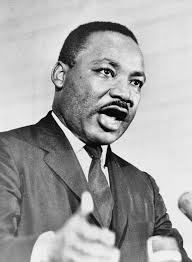
Martin Luther King, Jr. speaking out for freedom.“Is this not the fast I choose: to loose the bonds of injustice, to undo the thongs of the yoke, to let the oppressed go free, and to break every yoke?”

I’m studying Isaiah 58 right now. These are the words of the Lord spoken through his prophet. (That’s what prophets do, you know.)

This week is the 50th anniversary of the March on Washington where Martin Luther King, Jr., caught up in the Spirit, deviated somewhat from his prepared text and spoke about his dream. A dream where people were judged on character, not on skin color.

I was only a kid, living in a small village where everyone was either of German or Irish descent (read “white”)–well, except for one “hillbilly” family that moved in, and they were white. I never knew a black person until I was in college.

But for some reason, I was haunted by images of Ku Klux Klan cross burnings and murders. I can still remember nightmares that there was a local branch (don’t think there ever was–we didn’t have black people, but we did have a secret society of which my dad was a member called the Masons). I feared that they found out that I was pro civil rights and surrounded our house.

Later while I was in college, I endured much teasing about my civil rights stance (I still lived in town and drove 40 miles each way to college to save money since I was now mostly paying my own way). I remember driving through Mississippi to Louisiana in 1970 when I entered graduate school at LSU. Had an equal rights decal on my car. Arrived and then had the thought, what if my car had stopped in the piney woods? Still, I’m white. Not as bad as if I were not.

Progress toward freedom

There has been a lot of progress over the last 50 years. Like all human social change, there were cycles of success and cycles of regress. Many things are better for people of different colors, ethnicities, even gender. Many people have been set free. The leadership of Christians was an example to me that maybe the Christian church wasn’t all bad.

But we still have far to go.

Jesus understood. As have many spiritual people throughout human history. That passage from Isaiah is probably 2,800 years old. Yet, until we all change our hearts and begin to truly worship the one God, then we will not have the justice God demanded so long ago.

Are Perfectionists Always Right

July 25, 2013

Some people seem to exist only in order to point out what is wrong about what everyone else does. You know these people. I hope one of them isn’t you! These are people whom you avoid at receptions. You hate to get stuck in the same room alone with them.

I was around one of those critical people the other day, and I started to think. (That’s one of my vices; I’m always thinking.) What is it that makes these people think that they are always right? Or, even, are they always right?

Even worse–am I one of those people sometimes?

I’ve listened to many during my long life. Seems to me most, if not all, fit into the category Jesus described when he said that you’re more worried about the speck of dust in your neighbor’s eye than in the plank in your own eye.

Jesus challenged people. He could see through people into what their real motivations were. He’d say things like, “Sell all your possessions and follow me.” He could see what was holding that person back from truly following him.

Where Jesus did  get critical was toward his archenemies–the Pharisees. These guys lived that life of pointing out what was wrong about everyone else. But they really tried to be perfect in their lives just as they were telling other people to be perfect.

Except–

You can’t live a perfect life. And to tell others to do that is to pile up burdens on them. And that is not the way to salvation.

Jesus was critical towards the Pharisees. He’d point out all their inconsistencies. How they were more worried about the outside of the cup than the inside. Symbolic of how they were more concerned with their outward appearance than with inner holiness.

My guess is that those critical people could use a dose of love. Leading to understanding and empathy. And worry about their own inner life. Not so much worrying about other people.

Loving Does Not Equal Condoning

May 16, 2013

If you reach out to help someone, you’re condoning their actions. They must first show true sorrow about their actions (implied, come begging to me for mercy) and only then can we love them.

I have heard that from my more righteous friends and relatives.

Jesus heard that, too.

In fact, the dinner party I talked about yesterday had attendance divided amongst the righteous and the not-righteous. And Jesus seemed to be having more fun with the not-righteous. Made the righteous indignant–and left out. When they thought they should have been the rock stars.

Jesus told the parable of the two sons about God’s love and acceptance of both the sons–that is, both of the groups at the party.

Jesus didn’t condone sinful actions. He knew that those actions led to death. But he loved the people. The woman at the well. The woman about to be stoned. He loved them, but he told them to go and sin no more.

Matthew, the “not-righteous” host of the dinner party, went on to a great career as a disciple of Jesus. Seems the love part worked out pretty well in his case. As in Mary Magdalene’s. As in many others–even today.

Only when you show love to someone can you earn enough respect to be able to show them the way to a life with-God.

Jesus knew and showed example after example. Reach out in love, but ask for total commitment in return.

As Andy Stanley is saying in his current series of messages. Jesus didn’t create “Christians.” He created something far more difficult. He created disciples. And he did it often from the ranks of the “not-righteous.”

Tell someone today that God loves them. And mean it. That will help both of you.