Archive for the ‘Disciplines’ Category

Take It to the Limit—And Beyond

June 26, 2020

So put me on a highway
And show me a sign
And take it to the limit one more time
—The Eagles

There is a phrase from American football used in business many years ago, “Take the ball and run with it.”

A colleague and I at a company long ago used to talk about the people who “took the ball and ran with it—and ran through the tunnel and spiked it on the highway on the way home.”

Humans seem to have a problem with limits and balance. Adolescence is a time of testing limits. But there must be limits, or maturity and freedom are lost. When my daughter was that age, I would tell her, “Your job is to push the limits; my job is to rein you in.” It seemed to work.

Some people are all about themselves. Freedom is what I want to do, when I want to do it, with whom I want to do it with, and so forth. No thought about others.

There exist other people who lose their core in serving someone or some idea or some thing. They fail to think of their own well being while serving the other.

Wise people have know for millennia that balance is the key. I am a disciple of Jesus (but you could be following some other ancient tradition with similar advice on this point). Reading Jesus’s teaching carefully, we find that he often was concerned with the state of the individual person’s heart. Are you strong and focused?

But he also was concerned that you care for (love) your neighbor. And who is your neighbor? Once he gave an example. His example of the good neighbor was the most despised ethnic group his listeners could imagine.

There must be balance. You must look after yourself (eat and train like I said yesterday). But you must also think of those around you in an ever widening circle.

Don’t take it to the limit…and beyond.
Think Verbs not Nouns

June 25, 2020

Think Eat and Train, not Diet and Exercise.

I was listening to an audio excerpt from Tim Ferriss’s book of tips from successful people Tools of Titans. That phrase grabbed me.

Change your focus.

Any diet will guide you to weight loss. In the longer term though, they will not be healthy and you will regain the weight.

Eat food. Not too much. Mostly plants. (Michael Pollan, Food Rules)

Simple.

Instead of some vague—get some exercise—intentionally train.

Move. Lift. Stretch. (Gary)

Train—your mind.

Read. Think.

Train your spirit.

Pray. Meditate.

Exercising Spiritual Discipline with Technology

June 24, 2020

Technology is supposed to make our lives better.

This has been true for thousands of years. A better plow. Figuring out how to use oxen to pull the plow. A simple pull cart leading thousands of years later to autonomous vehicles. Medicines.

Technology in just the last decade figured out better ways to blow people up, yet on the other hand better devices to replace those missing hands, arms, and legs. Better mobility for invalid people.

And yet—there is social media.

With all the problems in the world to solve, today’s prevalent technology mostly serves to spread hate, fear, anger, lies, division.

The latest issue of MIT Technology Review proclaims technology has let us down.

The thesis contains much truth. But it doesn’t have to.

Technologists could remember that they have a moral responsibility to make the world a better place. And, so could users of technology.

After all, the inscription on Pete Seeger’s banjo read, “This machine surrounds hate and forces it to surrender.”

We could, if we wish, develop and exercise our spiritual muscles and go on a “social media diet” and be mindful of our use.

Technology, and we ourselves, do not have to let society down. We can be the solution, not the problem.

Often Our Fears and Worries Are About Nothing

June 23, 2020

Yesterday, upon the stair,

I met a man who wasn’t there!

He wasn’t there again today,

Oh how I wish he’d go away!

William Hughes Mearns

That little poem comes to me at odd times. I don’t know what Mearns meant by it, but I know the ancient psychology behind the thought.

Now, if you are walking through a meadow in Yellowstone National Park and disturb a couple of Grizzly Bear cubs, and mama comes running—well, that’s fear.

More often the fear is of people who aren’t like us who might be taking our jobs, or getting something we want, or that nameless fear that leaves us awake and worrying in the middle of the night.

But in reality, it’s like the man who wasn’t there. We keep meeting him. He won’t go away. But, he’s not there.

Most likely 99% of the things you fear and are worried about can’t happen and won’t happen. A few things you can do something about.

Do those things you can control. Put the other things out of your mind by focusing on other things. Perhaps focus on how you can be of service to others. Or how you can learn a new skill or technology. Or meet new people who live in the world of possibility, not the world of scarcity.

And you will cease to notice the man who isn’t there.

After The Holiday

June 22, 2020

I have to admit that I’m not much of a holiday person. Oh, I’ve got the “big three” in America—Christmas, Easter, Fourth of July. I try to remember birthdays. For 30 years, Memorial Day meant a soccer tournament. But I think soccer is over for me, now.

But even those, what about the day over. I remember even as a child the day after Christmas. We’d opened the presents. Had the usual disappointments. And it was over.

I grew disillusioned about the power of protests to change anything. There were some very good changes resulting from the civil rights and anti-war protests of the 60s, but not enough. And much was soon forgotten.

Then we had these protests erupt. And globally. Societies worldwide began to face their racist pasts. Suddenly the holiday Juneteenth was highlighted and explained in most media. People and companies made pious statements and promises.

But that was so last week. What about this week? Have we forgotten already? What will we do this week to keep the spirit of Jesus’ command to love one another alive?

Today, I point you to a podcast that I wish you’d take time to listen to. Seth Godin is worth listening to every week. But last week he linked to a reading of Dr. Martin Luther King’s Letter from Birmingham Jail. It is thoughtful, yet passionate. Logical, yet emotional. And persuasive.

Please listen to this episode of Akimbo. Thank you.

It’s Not Over Until It’s Over

June 19, 2020

With a somewhat crude reference to opera, there was a saying in sports that even though you might be ahead in the score, “It’s not over until the fat lady sings.”

I’m told that back in Ohio, many people have stopped wearing face masks. I guess it is some weird interpretation of freedom. Or perhaps a sense that it’s over and we can return to normal life.

I haven’t heard the soprano sing the final aria, yet.

A sheriff somewhere in the US known for downplaying the threat of SARS-CoV-2 now has the disease. He’ll discover that even if he is lucky with a “mild” case that he’ll be quite sick for a couple of weeks. I’m told by those who have had it, “You don’t want to get it. It’s bad.”

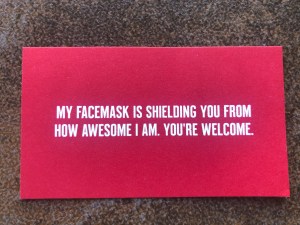
I ordered a couple of new masks with the emblem of one of my new favorite news feeds, NextDraft, from Emblem Athletics. But the card that came with it has just that bit of truth mixed with humor that appeals to me. [Note: If you are a Trump supporter or lack a sense of humor, don’t click the link to NextDraft. If you have thrown away your masks or want to be awesome, click the other link.]

There are many spiritual disciplines. One is service to others. Wearing a mask in public places protects others from you and shows that you care.

Facts or Story

June 18, 2020

I had been taking classes at the university filled with facts. Calculus, engineering mechanics, chemistry—memorize facts and learn to work the formulas you were given.

Then I took my first Liberal Arts class—American History. At the first mid-term I wrote all the facts. Was graded a D. The graduate assistant told me that I didn’t show that I understood what really happened during the time covered by the test. For the next test, I wrote, and wrote, and wrote. All the facts were in there, but I retold the story of the time covered by that test. Received an A.

I learned a lesson. Facts are nice, but understanding how they fit is better. I built a career on that.

Guy Kawasaki is a legend in Silicon Valley. He has a new podcast where he interviews Remarkable People. Recently Stanford history professor Sam Wineburg told of his son studying for an important test at school. “Did the Korean War occur before World War II or after?” he asked. Wineburg said, “I realized that he didn’t understand the sweep of American history. Without understanding the sweep of history from World War I to World War II to the Korean War, he would not have a context for understanding the Cold War.” He said that you can’t just try to remember a bunch of disjointed facts.

And I thought, “Many of us as Christians or seekers treat the Bible much like my engineering classes or the way Wineburg’s son had been taught history—a bunch of disjointed facts thrown at us to memorize.”

We read the writings of the Apostle Paul as if they were recipes or lists of commandments. We don’t understand the story. Where he came from, what he was trying to do, what the culture and understanding of his audience were, where it fits in the story of our life.

This leads to the type of Christian who gathers with like-minded people and point to the failures and shortcomings of others.

What we should be doing is understanding the story, then living the story, then helping others to join the story.

Giving Thanks

June 17, 2020

The Covid crisis has me down.

I know I’ll never get sick, so why should I social distance?

I’ve been locked up with family for months.

The economy is bad, politicians are worse.

I have no reason for giving thanks.

The American native tribe called Minquass had a proverb, “If you see no reason for giving thanks, the fault lies in yourself.”

The Apostle Paul told us to give thanks in every circumstance.

Even modern psychologists (who often echo ancient wisdom even when they don’t know it) explain the health benefits of an attitude of giving thanks.

If you don’t see a reason to give thanks, you have not looked for it.

Attentive and Respectful of Other’s Needs

June 16, 2020

Toru Sato leads us through dynamics of human interactions as we develop in his little book, The Ever-Transcending Spirit: The Psychology of Human Relationships, Consciousness, and Development.

He looks at this over a time period and concludes, “As evolution progresses, we have become more and more attentive and respectful of each other’s needs and desires.”

Ancient religious leaders saw this as a goal, even a command, about how to live.

Jesus left two commands that were bound intimately together:

The most important one is this: ‘Hear, O Israel: The Lord our God, the Lord is one. Love the Lord your God with all your heart and with all your soul and with all your mind and with all your strength.’ The second is this: ‘Love your neighbor as yourself.’

Later Jesus explained about loving your neighbor by expanding the definition beyond that expected by his listeners. He implied that our neighbor is whomever is in need and we can help.

Sometimes these days we can scan social media and look only for the opposite of attentiveness and respect—of which there is way too much.

On the other hand, there was a large mix of white faces amongst the Black Lives Matter protests. And the protests went global. Maybe, little by little, we are living out maturity through our being attentive and respectful to others.

[Note: I’ve changed my book links to bookshop.org in rebellion against Amazon. Twenty years ago, Amazon was cool and convenient. But it grew in size and power. This is a way to help out the local independent bookshop who will help you out and not be obnoxious with your data. Yet another way to be attentive and respectful.]

Awareness Leads To Freedom Leads to Responsibility

June 15, 2020

I have finished Toru Sato’s small, but potent, The Ever-Transcending Spirit: The Psychology of Human Relationships, Consciousness, and Development. I have read several writers who took 700-800 pages to explain the research that Sato condensed into 100 readable and logical pages. [Note: I used to give book links to Amazon, but I discovered bookshop.org where you can buy books and donate to independent booksellers or find a local independent bookseller from whom to purchase. I’m changing my ways.]

While discussing the findings of a number of researchers, he summarizes:

The more we mature, the more we develop the ability to step out of ourselves and see ourselves more and more from an objective standpoint.

I remember clearly the incident, however I’m not sure if I was 11 or 12 at the time. I was fighting with another boy. The reason doesn’t matter. But I had a moment when I clearly saw us and the guys standing around watching us. And I thought, how stupid to be fighting. And while subjecting my temper is a lifelong project, I never had a fight again.

Therefore, more maturity means more awareness.

Then he shows that awareness leads to freedom.

If we have awareness and freedom, we realize the more freedom we have, the more we feel responsible for what we do.

But, researchers also show that we don’t like that responsibility, so we blame others for many things in our lives.

We can refuse to develop our awareness in order to escape from responsibility.

And thus describes much of the country, and indeed the world, today.

That is why practicing awareness is so important to begin with. Then accepting that maturity is good and freedom carries with it responsibility.

Stop, pause, breathe, exhale slowly. Become aware of ourselves, see ourself in action, see how we need to change.

(From an English translation of Burns’ To a Louse:

Oh, would some Power give us the gift
To see ourselves as others see us!
It would from many a blunder free us,
And foolish notion:
What airs in dress and gait would leave us,
And even devotion!