Posts Tagged ‘Leadership’

Is It Better To Be A Hands-On or Hands-Off Manager

November 20, 2015

A great example of this is the section on task-relevant maturity. This part of the book became very personal for me as it taught me how to formulate the most useful management question that I use in interviews: “Is it better to be a hands-on or hands-off manager?”

Venture Capitalist and author Ben Horowitz wrote the introduction to the latest edition of Andy Grove’s classic book, “High Output Management.” He published it also on Medium. He included this classic question.

What was your initial reaction when you first read that quote? I bet that answer is an indicator to how you manage.

My first reaction with very little thought was, “Yes.”

Grove said, “It depends.”

As a leader, you must observe your co-workers. You must  provide the focus of the organization and an understanding of each person’s role. Then you observe how they are doing.

Some people just take off and start doing. They don’t need someone to tell them what to do next. Or how to do it. They are creative and motivated. Just pull gently on the reins to keep them on the path and get out of the way.

Some people, often new one to the organization or inexperienced ones, need more guidance. Perhaps a few more 1-on-1 meetings to ask questions and provide some guidance.

Knowing your people, their strengths, their motivations, their weaknesses, and then acting appropriately will reward you with a high output team that enjoys the journey.
Leaders Working With A Board

November 13, 2015

He had started a ministry to addicted people. It was a vision. He could help people in dire straights turn their lives around and become clean and productive.

The ministry grew and became an organization. He found it necessary to develop new skills. Some influential people in the community had become members of the advisory board. He needed to learn how to manage them for continued effectiveness of the organization.

I worked with him for a while. Here are some ideas I passed along:

  • You have the vision, never stop passing it along
  • Invite individual board members for breakfast and lunch to share the vision and solicit ideas
  • Help the board find new members with specific expertise–fund raising, marketing, finance, contacts
  • Work especially with the board chairman to encourage team work and collaboration

There was a board I was on once where the administrator was a tyrant. It was “agree with me or leave” except that I was elected to the post and he couldn’t remove me. So, he resorted to intimidation. Didn’t work and he eventually lost the confidence of the entire board and was gone.

His replacement was collaborative both with the board and with the staff. Things worked much better.

Recently the local newspaper reported on a board meeting of a local public school. The superintendent pitched a personnel change. Several board members asked questions about the reason and the necessity. “I’ve done this a long time and I know what I’m doing,” came the retort.

Oops, not a collaborative move. The narcissistic ploy just doesn’t make it as a leader. There should have been an open, collaborative discussion before the meeting ever happened. The leader needs to solicit input receiving (and listening to) a variety of views.

When a leader is dysfunctional or when a board is dysfunctional, then the mission and well being of the entire organization suffers.

Mind Maps and Other Collaboration Tools

November 6, 2015

For the Friday Leadership post, I bring to you the idea of collaboration.

There are times when bringing people face-to-face is essential to accomplish something. Unfortunately most meetings are routine, pointless, serve only to bolster the leader’s ego, or serve as an excuse for coffee and doughnuts.

Many applications have appeared to help team members collaborate while being remote and also asynchronously. Consider Wikis, Slack, project management tools, Quip, Google Docs, (maybe) Microsoft Windows 365, Evernote, Nozbe, and many more.

I’ve been reading Think Like Leonardo Da Vinci lately. The author  spoke at the Emerson Exchange and whetted my curiosity (the first of seven traits).

Scholars have discovered some drawings akin to mind maps in Da Vinci’s journals. A mind map is a powerful tool. And, if you use a digital tool (I use Mindjet Manager), you can put it in the cloud and many can collaborate on ideas.

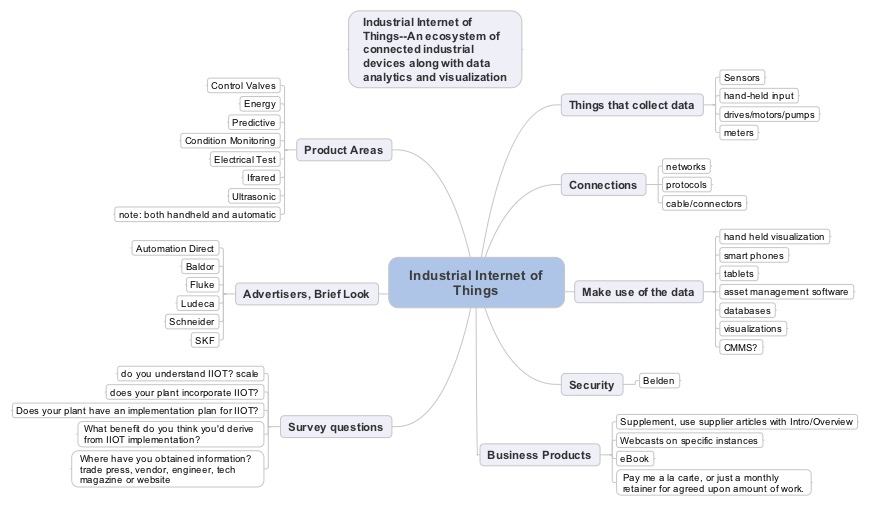
Don’t know what a mind map is? Here is one  I constructed using the computer app rather than just drawing (maybe the preferred way) for a project I’m working on.

IIoT Project

You can take notes on a mind map, doodle ideas, organize a project or a book, think creatively. It is a great tool. I’m about to work on two books while I’m between soccer seasons. I’ll mind map the outline and then just add text.

Mind maps are a tool. Thinking is the skill. Providing a safe environment for collaboration is leadership. Put it all together and accomplish something this year.


Friday Leadership Post On Creating a Culture

October 30, 2015

“We need to have a program that we import from a consultant in order to change the organization’s culture,” said a staff member of an organization to me when questioned about why do a program.

This week at the Safety Leadership Conference in Greenville, SC, the subject of a company’s culture for safety came up far more often than any technology discussion.

Culture is important.

Uh, what is it?

Well, it’s the way people in the organization do things. It’s how they act and interact. It’s the questions they ask. The things they focus upon. It’s what they discuss in the coffee room. Or–lack of all that.

Programs almost never work. I think that they never work.

Change begins depending upon what questions the leader asks. When the leader begins asking about safety at every chance (as in the case of the conference this week), then people are naturally going to begin thinking about safety. Not with the first question. But over time, everyone begins to realize what’s important.

In a non-profit (but also often in a business), one of the questions asked is “Can you help with this?” The leader defines a need, finds a person who appears to have the qualities needed to fill that need, and asks.

Organizations ponder how to get more volunteers. Well, have you defined the need such that people would know what they’re in for? Maybe you have to advertise for candidates, but often the best candidates will be referred through networking. You ask, who do you know, then ask the candidate can you help.

I remember at my first job in manufacturing, the president called at 3:35 pm every working day and asked the production manager, “How many did you get out?” So, sometimes the products went “out of the door” not completed so that the manager could report a better number. Even though the company prided itself on building a quality product, the question was never about quality. Always about numbers. Guess what was important.

As a leader, what questions do you ask?

Achieving Balance As Primary Leadership Trait

October 23, 2015

I write most Fridays on leadership. And I can’t believe it’s Friday already. This was a hectic week at a high technology conference in Austin for Dell Computers.

This article on leadership from the New York Times popped into my reader this week. It puts forth an interesting concept. Balance.

Are you decisive? Good, right? But what if you are too decisive without the balance of an open mind. I remember taking my first marketing job back in the 80s. I had a fixed model in my head about how to go to market with a computer add-on product. 

The model wasn’t good. But then, neither was the product. Oh, well.

Today we talk much about collaboration. Millennials wish to collaborate, we’re told. That’s all good. But what if we collaborate so much that no decisions are made. Not so good, right?

Ancient wisdom from Greece, the Middle East and the Far East all extol the beauty, grace, and necessity of balance.

We would rather work for a balanced leader than an unbalanced one. We ourselves probably feel better at night when we have been more balanced during the day.

Let’s take the idea a little further. Jon Swanson on his 300 Words a Day blog wrote about writing and telling stories aloud. Good point. My daily studies include both reading from the Bible and listening to teachers on podcasts. A balance of written and oral. I mostly write, but on my business side I used to have a fairly popular podcast (search Gary Mintchell on iTunes). I’ve let it go on vacation. Recently I’ve decided to put the effort into resuscitating it. Maybe I should do one for this blog. 

The point being–can I achieve a balance of written and oral communication?

I’d rather find more balance in my life, though. Breathing mindfully is a start. Bringing myself back to center when I feel out of balance. Or changing what I eat to balance my body. Or doing better at Eagle Pose in Yoga.

Balance is a good thing for the leader in us.

There Is Wisdom and then There Is Being Wise

October 19, 2015

Read the Proverbs every year. This spiritual  discipline keeps the wisdom of how to live well deep in your mind.

The book was written and compiled by Salomon, the most successful Israeli king.

The story goes that he became king due to his mother succeeding in palace intrigue in the court of King David. He moved quickly to consolidate power and kill off his adversaries. Sometime later, he had a vision of a conversation with God in a dream and asked for wisdom as his gift.

God was happy with that request and granted it. And King Solomon’s reputation for wisdom was a great as was his wealth.

God promised that if he would walk in His ways, his sons would continue to sit on the throne and the nation would be blessed.

I find it interesting that nowhere in 1 Kings does it state that God selected Solomon. David selected him upon the request of Bathsheba (remember their story?).

So, the king possessed great wisdom. He used wisdom to rule.

However, his rule also sowed the seeds of his eventual destruction.

God’s wisdom from the earliest entry of the Hebrews into the promised land was “Do not marry wives from the tribes living in the land.” Great wisdom. Women bring their culture and gods into the marriage. Solomon married 700 princesses from tribes all over the region. He allowed them to maintain worship of their own gods. Eventually Solomon himself worshiped those Gods. Imagine that! The builder of the Temple as a residence for God.

Speaking of the Temple, Solomon worked and taxed his people heavily so that he could build the Temple and then a huge palace for his residence (imagine having enough rooms for 700 wives and 300 concubines). The people were not happy as we find out in the story of the next (and last) king of a united Israel.

Let us take a lesson. There is amassing a great knowledge of wisdom sayings.

Then, there is being a wise person.

Don’t be like Solomon. Don’t just know “wisdom”. Practice being wise.

Unburdened Meetings–Friday Leadership Tips

October 16, 2015

I hate meetings.

OK, sometimes you just have to have them. At least, that is what “they” say.

There are those regular meetings that you have because it’s Tuesday morning or Thursday evening.

Those are often the worst. You meet at the regular time–except for George and Linda who are always late. The agenda is the same. Someone talks. Others surreptitiously check email. Or Facebook. (In the old days, we daydreamed or passed notes.)

It doesn’t matter if you are at a church, a non-governmental organization, or a business. You’ve suffered through them.

Yet, there are times when a meeting is necessary.

Looking into the book of Acts, we see where Paul needed a meeting of the church leaders. He needed a decision. He also needed a blessing. The best way to achieve the goal was to gather all the players at one place at one time. Lay out the proposal and make the  argument. Listen to the discussion. Make a few changes. Then go and do.

So, that famous meeting was good. Decisions were made, and Paul was empowered to go out to the world beyond Judea to spread the gospel. The world was changed.

  1. When you need to bring a number of people together because a decision must be made where they are affected and you need buy in, then call a meeting.
  2. When you need to build community among people who seldom see each other during their work days (maybe you have remote workers), then have an occasional meeting where you can share what you are working on and allow time outside the official meeting for conversation.
  3. When it’s Tuesday and you’re supposed to have a meeting but there is nothing going on, then don’t call the meeting. Let everyone go to work.
  4. When it’s Tuesday and you’re the leader and you have to hold that regular staff meeting, then craft an agenda that focuses on a topic that is important for moving the organization forward. Focus on the agenda, expect participation, end with summary of decisions and actions. End promptly.

I don’t always hold meetings, but when I do, I demand focus.

Leaders Are Communicators

October 9, 2015

Reflecting on Paul, perhaps the greatest leader (outside of Jesus) in the early church. He came out of nowhere. He was not part of the inner circle. Heck, he wasn’t in any circles when Jesus was alive. We don’t hear about him until after the resurrection and the formation of the early church. And then he was an instigator.

Then, he was converted. He was taught. He was commissioned.

He visited little groups of followers and taught and preached. He encouraged them to grow in numbers and in strength of spirit.

He also wrote. That’s how we know about him today. We all study what he wrote way back then in letters that he could only hope would make it to their destinations, let alone make it into books that we read today.

He had a vision. He had passion. But he exploited that through his use of the written and spoken word.

Much as  I never much cared for Jack Welch, the former CEO of GE, he did teach me one thing from his books–the importance of crafting your message as a leader and then speaking and writing that message at every opportunity. As a leader, you have to get your message out.

I have interviewed the senior leadership of a $7 billion automation company many times. I’ll interview the CEO, and he’ll give me the message. Then I’ll interview three or four senior vice presidents. They’ll all give me that message as it relates to their areas. Then I’ll talk to director level people. Same thing. The message gets through.

How about your organization? Does it have a message? Is it clearly articulated such that just about everyone can understand it? If I interviewed all the people in your organization, would they be able to tell me what the message is and be able to relate it to their role?

In some of the organizations where I am in a leadership role, I find myself communicating all the time. Emails, notes, brochures, phone calls, text messages, Facebook or Website. You’ve got to use every means available.

If you are working quietly away from people, you’re probably not leading.

Most Leadership Training is BS

October 2, 2015

It’s time for my Friday thoughts on leadership. See if you relate to this.

You got shipped off to some type of leadership training. Maybe it was for work. Maybe for church. Maybe for another type of organization.

You attended the training. It was long. The coffee was less than satisfactory. The pastries were stale. The leader was pumped up on something that made him or her optimistic to the point of causing gagging. You recorded a bunch of cute sayings from old leaders in your conference notebook. The talks seemed like they belonged in some sort of old-fashioned tent revival meeting.

I have been to so many of these that I’m lucky to be able to lead a kid to a candy store!

So the article title on the email newsletter caught my eye. Why Leadership Training Is So Much BS. It is in a manufacturing trade journal called Industry Week written by an acquaintance, Steve Minton. He interviewed Jeffrey Pfeffer author of Leadership B.S.: Fixing Workplaces and Careers One Truth at a Time (Harper Business, September 2015).

“But a steady diet of inspiration fables, Pfeffer warns, also misleads and does little to improve organizations.” He contrasts the state of leadership training with medical education, which strives to base its teaching on carefully measured studies and their results.

“No wonder medical science has made significant strides in treating many diseases while leadership as it is practiced daily all over the world has continued to produce a lot of disengaged, dissatisfied, and disaffected employees,” he writes.

What can businesses do to improve their leadership development efforts? Pfeffer told IndustryWeek that companies first need to change their evaluation criteria. Too much development work either is not evaluated or evaluated on the basis of enjoyment of the course.

“What are we trying to accomplish in leadership development? If we are trying to attain higher levels of employee engagement, higher levels of trust in leaders, higher levels of job satisfaction, lower levels of turnover, more people succeeding and having more people ready for leadership positions, then those are criteria you ought to use to evaluate your efforts,” he stresses, “not whether or not people had a good time, whether or not they liked the donuts, whether or not they thought the speaker was inspiring.”

Companies must also have people teaching these programs who have at least some expertise in leadership, he adds.

I continue to see people go off to leadership training only to memorize stories and tips. Putting the knowledge into practice is left to chance.

Better leadership training is done in smaller groups over time. This allows time for trial and error and feedback.

Think Yoda teaching the young Jedi Luke Skywalker.

Find your Yoda. Or, find your Luke. Me, I’m looking for another Luke to bring along.

Leadership Through Mentoring

September 18, 2015

Paul (the Apostle) must have been quite a leader. He is credited with almost single-handedly spreading the Christian church all over the northwest and northern Mediterranian area. Yet we know him through his letters and some stories in Acts.

He wasn’t a bishop. He evidently was not a pastor. He was a speaker, teacher, and writer. Yet he did plant churches and shepherd the people and their leaders.

We lack much detailed information. Reading carefully through the letters and stories in Acts, we can find examples of many other leaders who also went about starting and nourishing churches.

I became a leader in an organization first by saying Yes. I decided to serve the group.

Then I applied myself to diligently learning and growing in experience. I studied so that I could answer questions.

Then, I started looking for the next people to do that and carry on further than I could go.

I think Paul did much the same.

He was the most educated of the Apostles. That education served him well enabling him to provide documentation of the theology and practice of the new movement.

Then he said Yes.

After saying Yes and committing, he applied himself diligently to learning beyond his formidable education. And he gained experience speaking.

In this way he could teach, and speak, and write.

Then we notice his letters to Timothy. We see another side of Paul–Paul the mentor.

He picks his next generation leaders. Then he nurtures them. Giving advice, consolation, support, encouragement. 

We can say Leaders are [lots of things]. But for sure, Leaders are Mentors.