Archive for the ‘Leadership’ Category

The Work of a Leader According to Paul

February 5, 2016

I have been contemplating this description of leadership that the Apostle Paul gave to the church in Ephesus (Ephesians 4:12).

Leaders are given for the equipping of the saints, for the work of the ministry, for building up the body of Christ until we all attain the unity of faith and of knowledge of the Son of God, to mature manhood, to the measure of the stature of the fullness of Christ.

We may need a little translation for our understanding for our growth as leaders.

“For the equipping of the saints.” By saints, Paul meant the people in the church–specifically believers. Very interesting thought–and it is listed first. What does that teach us about leading?

There are people we lead. Our first job is to equip them for success. We must provide training, tools, support. A key question a leader can ask of someone in the group is, “How can I help you?” I translated that in some jobs I’ve had as, “I have access to resources. Can any of those help you do your work successfully?”

“For the work of the ministry.” The group you are leading has a goal, a focus, a desired end result. We have work to do, otherwise why exist. So we are to equip others so that we can do the work that is set before us.

“For building up the body of Christ.” The body of Christ is the church–the organization. Our task is to strengthen and grow the organization. How? By equipping the people to focus on the work. As we focus on the work, we need unity of purpose. We need to be of one mind on the work. A strong and growing organization harbors no senseless arguing (see other writings of Paul). The leader assures that everyone know what the task of the organization is and is committed to its accomplishment.

The last part reads like Paul thought that the end result is actually the growth and maturity of the people in the group. We don’t work just to pass the time. We work on a specific task. But while working on the task, what we are really working on is ourselves. We mature and come to greater understanding.

In the end, the leader leads people to their own growth. A true leader breeds more leaders.
Leaders-Be Real

January 29, 2016

I talked a couple of days ago about how people want their conversations about Jesus to be real. Especially younger adults want their Christian leaders to be real. They don’t want hype. Or leaders who say one thing and then do another.

Taking this discussion into a more general leadership area, people whom you are trying to lead value your being real to them.

A friend told a story about an old-line manufacturing company. It was highly structured as those companies tended to be. Built by engineers who think hierarchically and structured, the company featured separation of people according to rank. For example, there was an executive dining room, a supervisors dining room, and an employee cafeteria.

A man bought the company. He abolished the tiered dining areas. Everyone ate in the same area. The new owner would walk through at lunch time and chat with anyone. He broke the barrier.

People responded. Treat people with respect, show your real side, and they will follow your lead.

Searching the scriptures for an example, my attention suddenly focused on Paul, the apostle. This guy was a fantastic leader. We don’t usually talk about that. He’s known as an evangelist (persuasive speaker), theologian, and writer.

But he founded or shepherded several churches. His letters to Timothy offer great leadership advice.

Think about his communication to the churches that he had relationships with. He had not seen some people for years. He wrote to them. He laid it all out. He wrote about his passions, his background, his troubles, his physical ailments. He was a real person. He wasn’t a preacher who hid behind an office and administrative assistant. He didn’t get up, preach with emotion, and then go live life a different way.

With Paul, what you saw was what he was. It worked. People responded. They will for you. Try transparency, build trust, show yourself as a person.

Leadership Through Mentoring

January 22, 2016

We think of a leader as someone who has many people reporting to them. Maybe 10 or maybe hundreds. We picture them out front of the infantry leading the charge.

Surprisingly, often a leader is someone without an official position, yet they exert influence and direction through their ideas, conversations, persistence, relationships, and character.

But we are still thinking about influencing many.

Great leaders often are also great mentors. They find someone coming along with potential and begin to nurture them. Think perhaps of Mr. Miyagi in the “Karate Kid.”

Think back in your life. People came into my life, often briefly, who guided me often without my even knowing it at the time. There was my first supervisor at Airstream, John, who put me in positions to learn. Then Jack came along. He did things for me to get me promoted into increasingly important roles, but I never realized it at the time. Awakening came later, but not too late.

Lately there has been someone where we share from our varied experiences.

When you mentor someone, it should be intentional on your part. But with full knowledge that you are not a teacher just taking knowledge from your brain and trying to enlighten the mentee. Rather, mentorship grows with a relationship. As you work together or have conversations, often it’s just a question you ask or a point you think that they should think about that works. You have to let them grow at their pace. Force does not work.

The quality of character counts for much. Paul, the apostle, described both in 1 Timothy and in Titus a good leader.

  • Not violent
  • Blameless
  • Not accused of debauchery
  • Not rebellious
  • Not arrogant
  • Not quick-tempered
  • Not greedy for gain
  • A firm grasp on the Word
  • Trustworthy

I get a picture of a strong, yet gentle, person. Quiet in demeanor. Observant of others. Passionate with being overly emotional. Intelligent and wise. Concerned for the welfare of the other before even his own.

Gosh, I’m describing myself—-I wish. Perhaps I’m describing you. If so and you do not have a younger person you’re mentoring, find one. Pray intentionally. God will provide someone.


How We See Others

January 15, 2016

As a leader, how do you see your group? Not as a group, but as individuals.

Do you see them as hard working, dedicated, intelligent people? Or as lazy, slothful, needing constant supervision people?

I had a job once where I could get more done working from home than coming to the office. My boss said, “Well, as long as you’re working.” I thought, “Sheesh, no one puts out more work than I do, and he makes that comment.”

This phrase just popped up in my reading, “Your perception of me is a reflection of you.”

If you are looking at the team you are leading as a bunch of people you can’t trust to do their work. Maybe the problem really is you. Maybe you know that you’d like to slack off and are suspicious of others who might.

There was a story about a man traveling the back roads of the Midwest in the early 20th Century. He came across a farmer. He stopped and asked, “What sort of people live around here?”

“Well, what sort of people lived where you are from?”

“They were a lying, thieving bunch of people.”

“Well, I guess you’ll find people here about the same.”

A second traveler came by later and stopped. Asked the same question. The farmer asked what sort of people there were where he was from. “Honest, hardworking, trustworthy people,” came the response.

“Well, I guess you’ll find the people around here to be about the same.”

It is a great story pointing out that our perceptions are often colored by our emotions, thoughts, and opinions. We see what we want to see.

When I’ve dealt with people as a leader, whether as a parent or manager, I always just have this expectation, usually unstated but clear by insinuation, that people will live up to being what they were meant to be. I expect the best for other people.

When you deal with others, how do you view them? If the results are not forthcoming, perhaps a good look in a mirror is in order. Change your attitude toward others and watch how their attitude changes.

Great Leaders Have Great Interpersonal Skills

January 8, 2016

We were at a dinner. It was a special dinner with several courses each paired with a wine. The idea was to teach a little about wine and also sell the wines, of course.

It was a group experience. Most of us came as couples, not as a large group. We entered the room to discover it was set up with several long tables. We were going to share a table with six people whom we did not know.

The man adjacent to my wife was an owner of a local company. He was personable. Asked a lot of questions of my wife and the other people. Seemed genuinely interested in the other people’s lives.

My wife has been to many business dinners with me by now and has met many business owners or ranking executives. She comes from a working class background, so it was initially all new to her.

After the dinner on the drive home, she said, “Men like him are always interested in other people. They make others feel at ease. They are interested in others.”

An astute observation.

Recently while reading on leadership, I ran across this observation, “Great leaders have great interpersonal skills. They care for their people. As a leader, you need to know how to listen quietly and hear what people are really saying, by asking questions and being open to the truth. When challenges come, it’s especially important to open up and show you care.”

I’m watching a friend start a new business. He really cares about all the people he has hired for the team. He guides those who need a little help. He encourages each one. It’s a joy to watch.

No matter where you are called to be a leader, this is a great role model. Leadership isn’t all about me. It’s really all about them. How can I help them? How can I nurture them? How much do I care?


Leadership: What Do You Look For In People

December 11, 2015

When you are building a team for your business or task at church or for community service, what do you look for? A warm body? Particular skills? Relatives?

There has been a consistent theme to my reading and conversations this week. It has been around people.

Andy Stanley says that you should look for who before what. Look for good and talented people first. Then figure out what to put them to work at.

Google looks for curiosity.

An interview I heard on the radio with the head designer at Go Pro talked about learners. When asked about her own learning, she said it’s the people she hires. They are learners. When they learn something new, they want to teach it.

Chuck Price, leader at Campus Crusade and a friend, says to hire character. You can teach skills. You can’t teach character.

When I’ve hired or brought people into  teams, I look for a basic skill set. I want people who can teach me something. I’ve learned the hard way to not hire people with agendas. Especially when that comes with weak character.

Family and friends? Be careful.

Personality also counts. It depends a little on how customer-facing they will be. But still, they must fit in with the team. Avoid people who are negative, arrogant, or, on the other hand, weak and timid.

Hiring is a major decision. It’s game changing. Make a wrong hire and you can destroy an organization, business, or committee.

Take is seriously. Make it first priority when you have to hire or are building a team.

I like the philosophy of these characteristics: Character, Curiosity, Learner.

Is It Better To Be A Hands-On or Hands-Off Manager

November 20, 2015

A great example of this is the section on task-relevant maturity. This part of the book became very personal for me as it taught me how to formulate the most useful management question that I use in interviews: “Is it better to be a hands-on or hands-off manager?”

Venture Capitalist and author Ben Horowitz wrote the introduction to the latest edition of Andy Grove’s classic book, “High Output Management.” He published it also on Medium. He included this classic question.

What was your initial reaction when you first read that quote? I bet that answer is an indicator to how you manage.

My first reaction with very little thought was, “Yes.”

Grove said, “It depends.”

As a leader, you must observe your co-workers. You must  provide the focus of the organization and an understanding of each person’s role. Then you observe how they are doing.

Some people just take off and start doing. They don’t need someone to tell them what to do next. Or how to do it. They are creative and motivated. Just pull gently on the reins to keep them on the path and get out of the way.

Some people, often new one to the organization or inexperienced ones, need more guidance. Perhaps a few more 1-on-1 meetings to ask questions and provide some guidance.

Knowing your people, their strengths, their motivations, their weaknesses, and then acting appropriately will reward you with a high output team that enjoys the journey.

Leaders Working With A Board

November 13, 2015

He had started a ministry to addicted people. It was a vision. He could help people in dire straights turn their lives around and become clean and productive.

The ministry grew and became an organization. He found it necessary to develop new skills. Some influential people in the community had become members of the advisory board. He needed to learn how to manage them for continued effectiveness of the organization.

I worked with him for a while. Here are some ideas I passed along:

  • You have the vision, never stop passing it along
  • Invite individual board members for breakfast and lunch to share the vision and solicit ideas
  • Help the board find new members with specific expertise–fund raising, marketing, finance, contacts
  • Work especially with the board chairman to encourage team work and collaboration

There was a board I was on once where the administrator was a tyrant. It was “agree with me or leave” except that I was elected to the post and he couldn’t remove me. So, he resorted to intimidation. Didn’t work and he eventually lost the confidence of the entire board and was gone.

His replacement was collaborative both with the board and with the staff. Things worked much better.

Recently the local newspaper reported on a board meeting of a local public school. The superintendent pitched a personnel change. Several board members asked questions about the reason and the necessity. “I’ve done this a long time and I know what I’m doing,” came the retort.

Oops, not a collaborative move. The narcissistic ploy just doesn’t make it as a leader. There should have been an open, collaborative discussion before the meeting ever happened. The leader needs to solicit input receiving (and listening to) a variety of views.

When a leader is dysfunctional or when a board is dysfunctional, then the mission and well being of the entire organization suffers.

Mind Maps and Other Collaboration Tools

November 6, 2015

For the Friday Leadership post, I bring to you the idea of collaboration.

There are times when bringing people face-to-face is essential to accomplish something. Unfortunately most meetings are routine, pointless, serve only to bolster the leader’s ego, or serve as an excuse for coffee and doughnuts.

Many applications have appeared to help team members collaborate while being remote and also asynchronously. Consider Wikis, Slack, project management tools, Quip, Google Docs, (maybe) Microsoft Windows 365, Evernote, Nozbe, and many more.

I’ve been reading Think Like Leonardo Da Vinci lately. The author  spoke at the Emerson Exchange and whetted my curiosity (the first of seven traits).

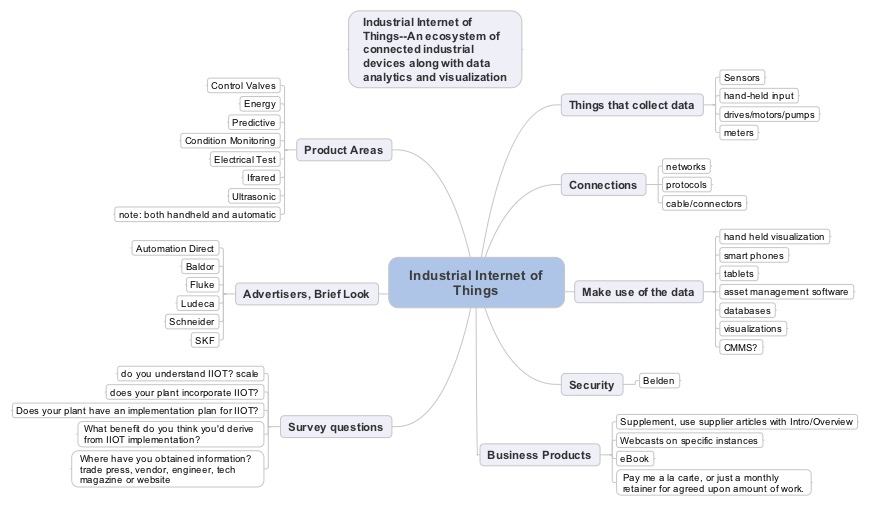
Scholars have discovered some drawings akin to mind maps in Da Vinci’s journals. A mind map is a powerful tool. And, if you use a digital tool (I use Mindjet Manager), you can put it in the cloud and many can collaborate on ideas.

Don’t know what a mind map is? Here is one  I constructed using the computer app rather than just drawing (maybe the preferred way) for a project I’m working on.

IIoT Project

You can take notes on a mind map, doodle ideas, organize a project or a book, think creatively. It is a great tool. I’m about to work on two books while I’m between soccer seasons. I’ll mind map the outline and then just add text.

Mind maps are a tool. Thinking is the skill. Providing a safe environment for collaboration is leadership. Put it all together and accomplish something this year.


Friday Leadership Post On Creating a Culture

October 30, 2015

“We need to have a program that we import from a consultant in order to change the organization’s culture,” said a staff member of an organization to me when questioned about why do a program.

This week at the Safety Leadership Conference in Greenville, SC, the subject of a company’s culture for safety came up far more often than any technology discussion.

Culture is important.

Uh, what is it?

Well, it’s the way people in the organization do things. It’s how they act and interact. It’s the questions they ask. The things they focus upon. It’s what they discuss in the coffee room. Or–lack of all that.

Programs almost never work. I think that they never work.

Change begins depending upon what questions the leader asks. When the leader begins asking about safety at every chance (as in the case of the conference this week), then people are naturally going to begin thinking about safety. Not with the first question. But over time, everyone begins to realize what’s important.

In a non-profit (but also often in a business), one of the questions asked is “Can you help with this?” The leader defines a need, finds a person who appears to have the qualities needed to fill that need, and asks.

Organizations ponder how to get more volunteers. Well, have you defined the need such that people would know what they’re in for? Maybe you have to advertise for candidates, but often the best candidates will be referred through networking. You ask, who do you know, then ask the candidate can you help.

I remember at my first job in manufacturing, the president called at 3:35 pm every working day and asked the production manager, “How many did you get out?” So, sometimes the products went “out of the door” not completed so that the manager could report a better number. Even though the company prided itself on building a quality product, the question was never about quality. Always about numbers. Guess what was important.

As a leader, what questions do you ask?